Documentary about the Swedish submarine Ulven which was sunk by a mine in Swedish waters in 1943 killing all 33 crew members.
Social & External
Self
See Kenneth W. Rendell's collection of over 6,000 artifacts that range from the end of World War I and the rise of Nazism to the start of World War II and the fight in Europe and the Pacific.
Easy Company, the 2nd Battalion of the 506th Parachute Infantry Regiment of the 101st Airborne Division, fought their way through Europe, liberated concentration camps, and drank a victory toast in April 1945 at Hitler's hideout. Veterans from Easy Company, along with the families of three deceased others, recount their horrors and victories, bonds they made and the friends they lost.
A remarkable film that takes a special look at the first war to be truly reported and recorded by one of the more unsung heroes of World War II: the combat photographer. Through the unflinching eye of their camera's lenses, these courageous soldiers continually risked their lives in their brave attempts to capture history.
An epic family saga told by the women around the famous architect Ludwig Mies van der Rohe.
The story of Hitler’s final hours told by people who were there. This special features exclusive forgotten interviews, believed lost for 65 years, with members of Hitler’s inner circle who were trapped with him in his bunker as the Russians fought to take Berlin. These unique interviews from figures such as the leader of the Hitler Youth Artur Axmann and Hitler’s secretary Traudl Junge, have never before been seen outside Germany. Using rarely seen archive footage and dramatic reconstruction, this special tells the story of Adolf Hitler’s final days in his Berlin bunker.
A documentary examining possible historical and modern conspiracies surrounding Christianity, the 9/11 terrorist attacks, and the Federal Reserve bank.
The filmmaker's father and uncle, Norm and Stan, are third generation Japanese Americans. They are "all American" guys who love bowling, cards and pinball. Placed in the Amache internment camp as children during World War II, they don't think the experience affected them that much. But in the course of navigating the maze of her father's and uncle's pursuits while simultaneously trying to inquire about their past, the filmmaker is able to find connections between their lives now and the history that was left behind.
The Katyn massacre, carried out by the Soviet NKVD in 1940, was only one of many unspeakable crimes committed by Stalin's ruthless executioners over three decades. The mass murder of thousands of Polish officers was part of a relentless purge, the secrets and details of which have only recently been partially revealed.
Live footage from concentration camps after the liberation, and the complex transport and lodging of masses of prisoners of war and other deported people back to their home countries, at the end of World War II. A 45min 35mm print also exists (shown at Cinémathèque française in 2023).
This short documentary produced by the University of Oregon Multimedia Journalism graduate program explores memories of Portland's Japantown – Nihonmachi – and the thriving Japanese American community in Oregon prior to World War II. The film features Chisao Hata, an artist, teacher and activist, and Jean Matsumoto, who was incarcerated at the Portland Assembly Center and in the Minidoka concentration camp as a child.
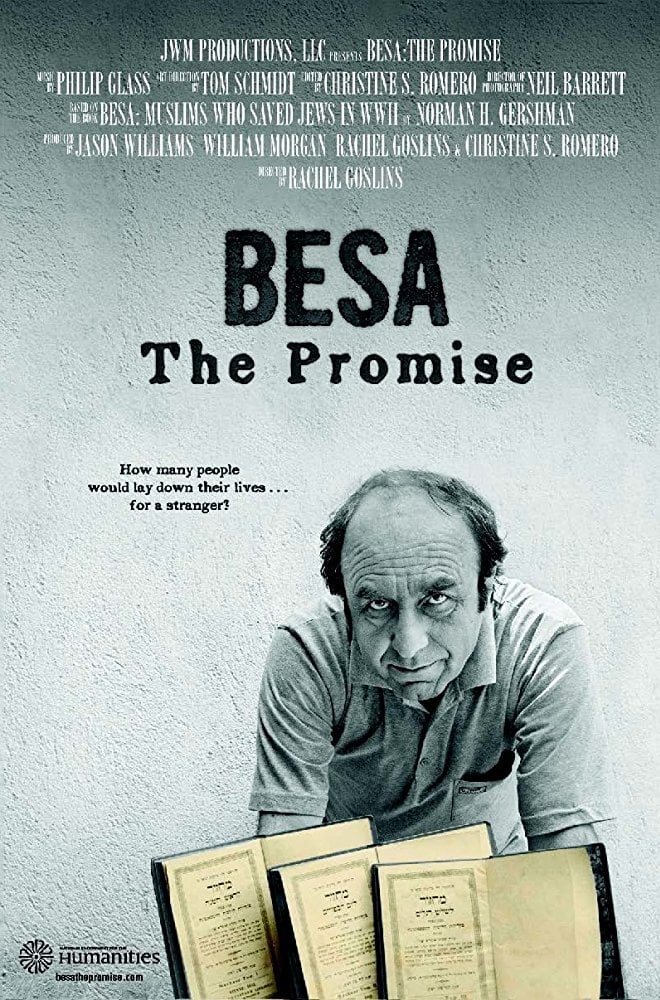
Lithuania, 1941, during World War II. Hundreds of thousands of texts on Jewish culture, stolen by the Germans, are gathered in Vilnius to be classified, either to be stored or to be destroyed. A group of Jewish scholars and writers, commissioned by the invaders to carry out the sorting operations, but reluctant to collaborate and determined to save their legacy, hide many books in the ghetto where they are confined. This is the epic story of the Paper Brigade.
A documentary chronicling the adolescent years of Elie Wiesel and the history of his sufferings. Eliezer was fifteen when Fascism brutally altered his life forever. Fifty years later, he returns to Sighetu Marmatiei, the town where he was born, to walk the painful road of remembrance - but is it possible to speak of the unspeakable? Or does Auschwitz lie beyond the capacity of any human language - the place where words and stories run out?
The SS chief Heinrich Himmler wanted to exchange Jews against so-called German Reich abroad, against arms sales or for cash - with the express approval of Hitler.
Using never-before-seen footage, Japan's War In Colour tells a previously untold story. It recounts the history of the Second World War from a Japanese perspective, combining original colour film with letters and diaries written by Japanese people. It tells the story of a nation at war from the diverse perspectives of those who lived through it: the leaders and the ordinary people, the oppressors and the victims, the guilty and the innocent. Until recently, it was believed that no colour film of Japan existed prior to 1945. But specialist research has now unearthed a remarkable colour record from as early as the 1930s. For eight years the Japanese fought what they believed was a Holy War that became a fight to the death. Japan's War In Colour shows how militarism took hold of the Japanese people; describes why Japan felt compelled to attack the West; explains what drove the Japanese to resist the Allies for so long; and, finally, reveals how they dealt with the shame of defeat.
Brigadier General Stanley M. Ulanoff, a widely decorated military historian who served with the Counterintelligence Corps in Europe during World War II, introduces this gripping documentary film. At 7:55 AM on Sunday, December 7th, 1941, which FDR called "a date which will live in infamy," the Japanese began an air attack that devastated the Pacific fleet and took the lives of 2,343 servicemen. Lt. Cmdr. John Ford skillfully blends historic action with studio shots in this Oscar-winning look at the day's events. Also included is The Fleet That Came to Stay, concerning the invasion of Okinawa.
Pearl Harbor Payback: The Japanese raid on Pearl Harbor united all Americans against a common foe, and from that day forward they spared nothing in order to mobilize against the menace that continued to threaten them in the Pacific. Also included are Target Tokyo, a 1945 documentary narrated by Ronald Reagan, which follows the first bombing raid on Tokyo by B-29 Superfortresses, and another World War II short film, Air War Against Japan. Appointment in Tokyo: Featuring enemy film taken from captured Japanese newsreels, this 1945 documentary depicts MacArthur's long struggle to fight his way back to the Philippines, after his enf-rced evacuation, and beyond to Japan. From Australia, he cut through the jungle of New Guinea and up the stairway of islands, making good on his promise to return, as Adm. Chester Nimitz went from Hawaii through the Gilberts, Marshalls, and Marianas.
The secret past of a World War II-era intelligence officer comes to light when his grandson, actor Joonas Saartamo, begins to investigate his grandfather's activities as the leader of a long-range reconnaissance patrol. Meeting various experts along the way, Saartamo discovers a new insight into the crucial role of long-range reconnaissance patrols in war. He also realizes how strongly the weight of his grandfather's war experiences has been passed down from generation to generation, affecting him directly.
The Nazis knew it was their last chance. The British knew it was the deadliest threat they'd ever face. And the Americans knew it could fall into the wrong hands. The V2 rocket quickly became Hitler's greatest deadly weapon and beacon of hope to turn the course of World War II in his favor. Watch Nazi Germany's desperate attempt at victory as the Allies race to stop them and see how the V2 miraculously went from deadly weapon to amazing feat of space technology.