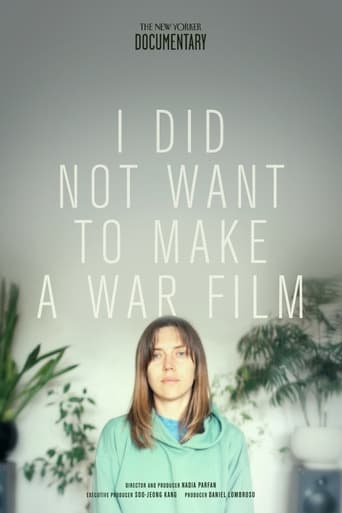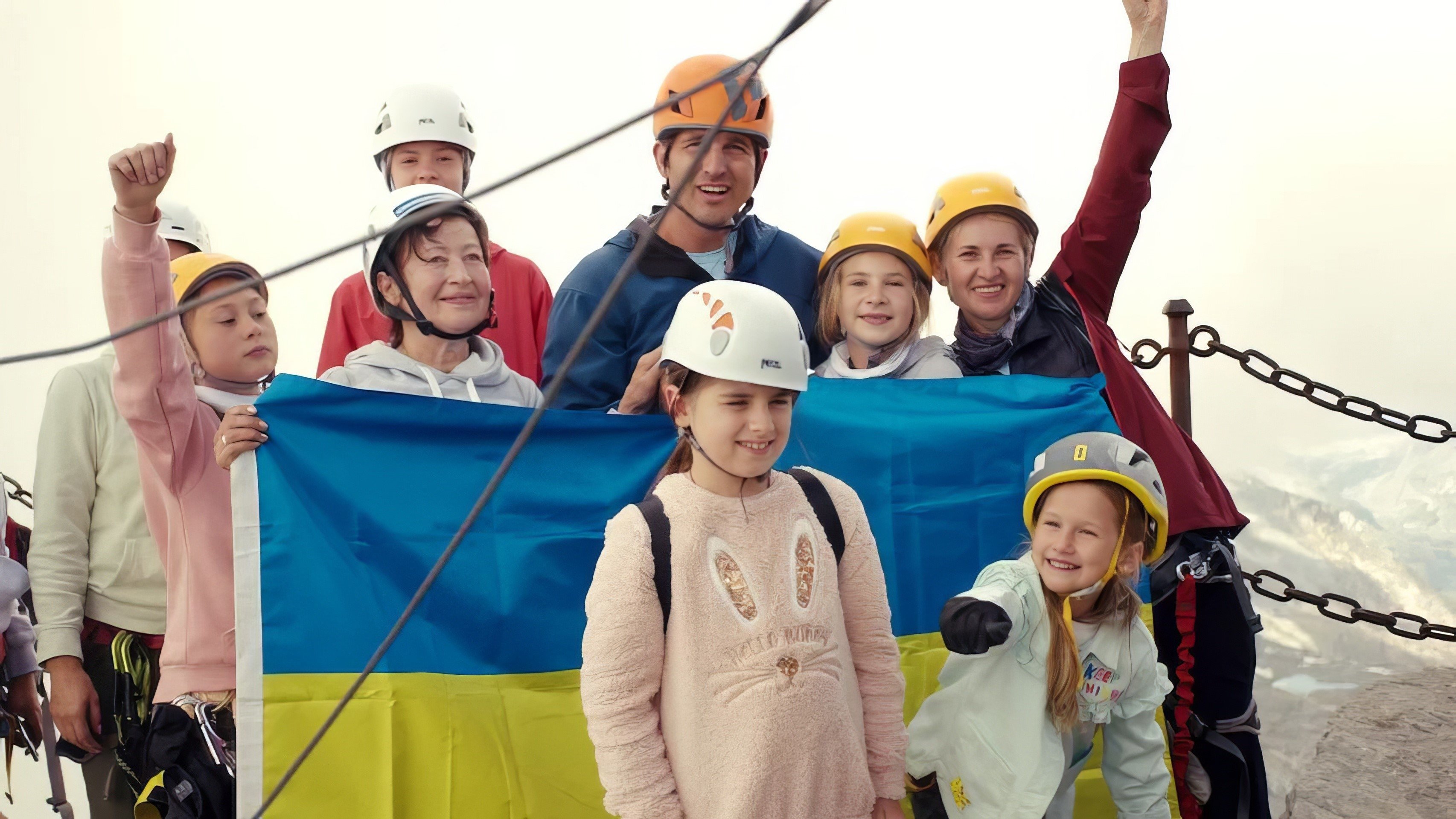

Made refugees by the war in Ukraine, Olga and her granddaughter Milana travel to a summer camp in the Austrian Alps to test the limits of their own bravery, and to strengthen their growing bond.
Stream
Social & External
Comedic behind-the-scenes film for the production of Mary and Max, originally released as webisodes.
As dawn breaks over Taipei, a whole world comes to life around the Luzhou temple night market, only to be dismantled by sunrise. In COME HUNGRY, Oscar-winner Carol Dysinger creates a city symphony out of the rhythms, sounds, colors, and flavors of this ephemeral community that revolves around Taiwanese food, traditions, and identity.
Rae Ripple, a welder from the outskirts of West Texas transforms neglected metal into works of art and in the process finds healing from her traumatic past.
The story of war, love and death that was documented by the immediate participants of events. Off screen and later on it are the two - a boy and a girl. He volunteered for the front; she went to the place just after the battle. He got into Ilovaysk cauldron, lost his closest brother-soldiers. She, while travelling along the ruined towns, strives to understand the essence of war and love. Both tell openly one another about their feelings during the war, escaping the cauldron, a try to live together after, and a common trip to the frontline.
A short documentary exploring the ways LGBT couples show affection, and how small interactions like holding hands in public can carry, not only huge personal significance, but also the power to create social change.
The story of trust and its absence against the background of events unfolding in Eastern Ukraine in early 2014. The main topic is revealed through the prism of the Luhansk border base, whose fighters the separatists and Russian special services tried unsuccessfully force to betray their country.
Celebrate the films that redefined animation, influenced culture and brought Spider-Man into all new dimensions as the filmmakers, journalists and fans share their love of the Spider-verse films.
In southern Germany, winter can still be admired in all its glory every year. With its white coat of snow and icicles and myriads of small crystals that look like geometric works of art. In the valleys and on the slopes the snow is still so thick every year that the alpine huts are snowed in up to the windows. Cows and dairymen are safe in their farms at lower altitudes. But not the wild creatures of the mountains! They need strategies to survive the cold season and to defy snow masses, cold and ice. And some seem to do it so easily that they even raise their young in the middle of winter. But how do animals, plants and fungi cope with the annually recurring ice age, which from our perspective is a time of need? The many adaptations in nature prove that winter is an integral part of the natural cycle of the year and the living environment of species. They are adapted to cold and frost. That is why the animals and plants at the edge of the Alps suffer particularly from climate change!
Murray Sinclair's acceptance speech for an award in honor of his role as chair of the Truth and Reconciliation Commission of Canada, intercut with the testimonies of survivors of the Indian residential school system.
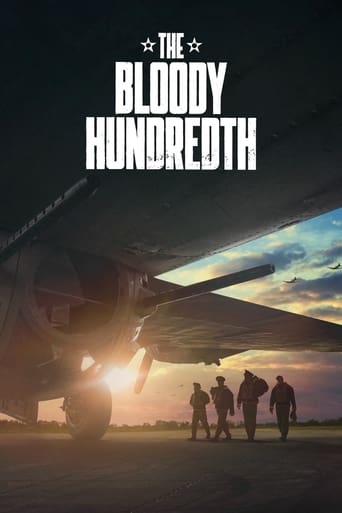
Five American soldiers fighting in Europe during World War II struggle to return to Allied territory after being separated from U.S. forces during the historic Malmedy Massacre.
Jamie Graham, a privileged English boy, is living in Shanghai when the Japanese invade and force all foreigners into prison camps. Jamie is captured with an American sailor, who looks out for him while they are in the camp together. Even though he is separated from his parents and in a hostile environment, Jamie maintains his dignity and youthful spirit, providing a beacon of hope for the others held captive with him.
Arctic Tale is a 2007 documentary film from the National Geographic Society about the life cycle of a walrus and her calf, and a polar bear and her cubs, in a similar vein to the 2005 hit production March of the Penguins, also from National Geographic.
George Lucas, Irvin Kershner, Lawrence Kasdan and John Williams look back at The Empire Strikes Back 30 years later.
From Trento to Chamonix, via Zermatt; from the Morgiou cove to the Eiger's north face; from Planica to the Lavaredo peaks, the Alps are depicted, illustrated, and magnified in all their unique and sublime beauty, through the sports practiced there and the most typical customs and traditions of their inhabitants. A helicopter rescue and a parachute jump from the Red Wall by Wolfgang Weizenbocks are experiences not to be missed.
A cell phone was the only thing that kept Yonas, an Eritrean refugee, connected to Jérôme, the French journalist who wanted to tell his story. They met in Libya in 2019, in the abyss of a detention center. Yonas managed to escape and attempted several times to cross the Mediterranean. Like many others who jump from one hell to another, Yonas's only option was to flee forward, and what lay before him was a small boat. Yonas's News chronicles the epic journey in which his life was at stake, summarized in the WhatsApp and voice messages, photos, and videos he was able to exchange with Jérôme. Jérôme Tubiana, journalist, researcher, and member of Doctors Without Borders, has visited Libya five times between 2018 and 2020.
From empire to ashes-Japan's rise, war, and reckoning. A gripping journey through ambition, conflict, and the cost of a nation's destiny.
In 2014, the war begins. Immediately, a system of evacuation of the wounded and killed is being built, the outpost of which is the Dnieper - it is here that the first will be delivered, it is here that they are still received. Tatiana Guba has been coordinating the evacuation for 5 years. She is called "Mom Tanya". Thousands of people are grateful to her for her life. Serhiy Kryvorotchenko, director of the Dnipro Airport, has deployed a helicopter evacuation system since the beginning of the war. Eugene Titarenko, the film's director, in 2014-2015 was part of a volunteer medical battalion, communicates with the heroes of the film about the evacuation system. The viewer will see the whole way of saving lives, will be directly in the vortex of events and will understand how many people are involved in the process of saving one person.
Ten years ago, Volodymyr Zelensky was just one of the many faces on Ukrainian television screens. He became a star thanks to the 2015 satirical series Servant of the People, in which he played a history teacher who becomes president. Four years later, what began as fiction became a reality. This French documentary follows the transformation of a popular TV comedian into a statesman on the front lines of the Russian invasion. Archival footage, family photos, television appearances, and interviews with Zelensky and those closest to him create a multi-layered portrait of a man who always longed for a large audience. At the same time, the film places his personal development in the broader context of post-Soviet Ukraine, which is also searching for its own identity.
Austrian mountaineer Heinrich Harrer journeys to the Himalayas without his family to head an expedition in 1939. But when World War II breaks out, the arrogant Harrer falls into Allied forces' hands as a prisoner of war. He escapes with a fellow detainee and makes his way to Lhasa, Tibet, where he meets the 14-year-old Dalai Lama, whose friendship ultimately transforms his outlook on life.
The true story of how businessman Oskar Schindler saved over a thousand Jewish lives from the Nazis while they worked as slaves in his factory during World War II.
The story of the battle of Iwo Jima between the United States and Imperial Japan during World War II, as told from the perspective of the Japanese who fought it.
After World War II, a woman refuses to believe her husband, missing on the Russian front, is dead. Flashbacks reveal their brief courtship and marriage. Years later, she travels to Russia with his photo, determined to find him. What will she discover?
When Sgt. First Class Brian Eisch is critically wounded in Afghanistan, it sets him and his sons on a journey of love, loss, redemption and legacy.
Korengal picks up where Restrepo left off; the same men, the same valley, the same commanders, but a very different look at the experience of war.
As the Russian invasion begins, a team of Ukrainian journalists trapped in the besieged city of Mariupol struggle to continue their work documenting the war's atrocities.
As daily airstrikes pound civilian targets in Syria, a group of indomitable first responders risk their lives to rescue victims from the rubble.
With unprecedented access, this documentary follows the extraordinary journey of “Raqqa is Being Slaughtered Silently”—a group of anonymous citizen journalists who banded together after their homeland was overtaken by ISIS—as they risk their lives to stand up against one of the greatest evils in the world today.
Prelude to War was the first film of Frank Capra's Why We Fight propaganda film series, commissioned by the Pentagon and George C. Marshall. It was made to convince American troops of the necessity of combating the Axis Powers during World War II. This film examines the differences between democratic and fascist states.
Romm pulls out all the stops in its selection of documentary material to draw the viewer not only into absolute horror about fascism and nazism in the 1920s–1940s Europe, but also to a firm conviction that nothing of the sort should be allowed to happen again anywhere in the world.
A documentary about World War I with never-before-seen footage to commemorate the centennial of Armistice Day, and the end of the war.
Armed only with their cameras, Peabody and Emmy Award-winning conflict Journalist Mike Boettcher, and his son, Carlos, provide unprecedented access into the longest war in U.S. history: they are embed with U.S. troops during nine days of intense combat in Afghanistan.
An American doughboy, stationed in France during the Great War, goes on a daring mission behind enemy lines and becomes a hero.
A Russian military propaganda film about the tank commander Kalashnikov, severely injured in battle in 1941. The accident leaves him incapacitated and unable to return to the front line. While recovering in the hospital, he begins creating the initial sketches of what will become one of the world’s most legendary weapons. A self-taught inventor is only 29 when he develops the now iconic assault riffle — the AK-47. Shot in occupied Crimea.
It is late spring of 1942, and the Great Patriotic War is in full swing. A long way off from the front-line, at some God-forgotten junction, the Germans make an air landing operation in an attempt to get through to the Kirov railway and the White Sea - the Baltic Sea Canal. These aren't just ordinary paratroopers. This is a team of seasoned and highly trained infiltrators, the elite of the Waffen-SS, superhumans. The only thing in their way is an anti-aircraft artillery unit of corporal Vaskov and five young women in training. It may seem like a fight of local significance, but the countrys main strategic transportation artery is at stake. Can the corporal and his 'petite newbies' prevent Nazi sabotage and at what cost? Television version: An extended version made out of four 45 minute episodes was released on Channel One Russia, on 9 May 2016. Available on PrimeVideo.
Talal Derki returns to his homeland where he gains the trust of a radical Islamist family, sharing their daily life for over two years. His camera focuses on Osama and his younger brother Ayman, providing an extremely rare insight into what it means to grow up in an Islamic Caliphate.
After the liberation of Auschwitz, an Italian prisoner of War begins a torturous voyage home to Turin, through a Europe caught between war and peace.
During World War II, enemy fighter pilots find themselves face to face after shooting down one another's planes over a desolate landscape. In order to survive, they must set aside the rules of war.
Time after time, soldiers of the Italian Army are forced to leave their mountain trenches in attempts to storm an enemy fortress, always with the same disastrous results. As casualties mount, indignation spreads among the rank and file. Disturbed by his superiors' decisions, Lieutenant Sassu is led to question the purpose of war and reconsider where his real duties lie.