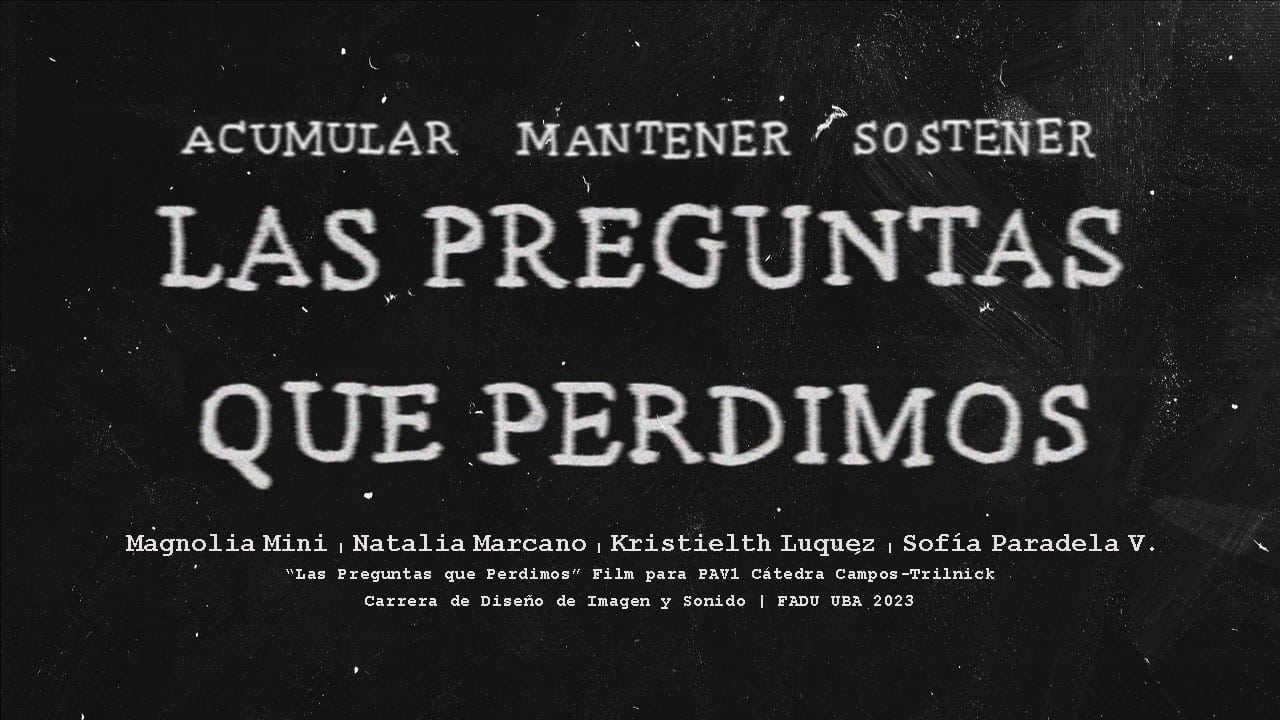
Social & External
Zac
Magnolia
Kris
Nati
Made in Japan, Last Room is both fiction and documentary. The occupants of the love-hotels and capsule-hotels tell their own intimate, dreamlike stories, interspersed with journeys through the archipelago's landscapes. Soon, these personal stories resonate with a collective history: that of Gunkanjima, the abandoned ghost island of Nagasaki, and then that of Japan as a whole.
Literary icon Joan Didion reflects on her remarkable career and personal struggles in this intimate documentary directed by her nephew, Griffin Dunne.
In 1963, Rosans, a village in the Hautes-Alpes region depopulated by the rural exodus, welcomed Harkis (military soldiers) forced to leave Algeria for supporting France during the Algerian War. Around thirty families settled in a camp below Rosans. Nearly half a century after their arrival, first- and second-generation Harkis and native Rosanais recount their experiences of this culture clash, often painful, sometimes happy. Language barriers, religious differences, living in barracks for 14 years, and unemployment were all obstacles to overcome in order to be accepted and then achieve mutual enrichment. Enriched with archive footage to explain the historical context of the time, the film seeks above all to express feelings and unspoken words.
The lastest neuroscience discoveries show surprising results: false memories, distortion, modification, déjà vus. Our memory is affected in many ways, and deceives us every day. The very fact of recalling souvenirs modifies them. The everyday consequences are manyfold. To what extent can we rely on our souvenirs? How much credit can we give them during trials? Even more shocking, scientists have proved to be able to manipulate our memory: creating artificial souvenirs, deleting, emphasizing or restoring them on demand.
The horses in Denys Colomb Daunant’s dream poem are the white beasts of the marshlands of the Camargue in South West France. Daunant was haunted by these creatures. His obsession was first visualized when he wrote the autobiographical script for Albert Lamorisse’s award-winning 1953 film White Mane. In this short the beauty of the horses is captured with a variety of film techniques and by Jacques Lasry’s beautiful electronic score.
Sirkka-Liisa died alone with no one left to miss her. Elina happened to buy her home after her death and ended up with all Sirkka-Liisa's possessions from books to photos. What would happen If Elina threw all her things away?
Based upon a habitual fidget of the filmmaker involving the tags in his clothing, Reilly Mitchell explores the feelings of his past by removing something that has always stayed so close to him and turning it into something new.
This short film is part of Karpo Aćimović Godina's experimental and documentary work in 1970s Yugoslav cinema. It extends his interest in regional identities, minorities, and the visual traces left by different cultures on Yugoslav territory. The film offers a journey through examples of architecture, decor, and objects related to Islamic tradition in the former Yugoslavia, such as mosques, ornamental elements, and calligraphy. It explores how this art is embedded in the region's history and in the daily lives of the communities that produced it. It is an observational film, without a dramatic plot, functioning primarily as a "visual essay" on the material culture of Islam in a Balkan context. The tone is analytical and contemplative, closer to a cultural study or a poetic inventory.
A community of cats lives in the Soledade Cemetery Park in Belém. "7 Vidas" follows these animals through a fictional letter written by one of them to his former owner. With real images of the cats among graves and trees, the film builds a sensitive narrative about abandonment, freedom and memory, revealing the poetry hidden in the coexistence between life and death.
Music as a counter-project to a bourgeois existence: Musicians, club and label operators, record store owners and other music lovers talk about how, despite social and economic constraints, they realize their very different, bohemian and sometimes precarious life projects on the sidelines - and always go on. Detailed essays, experience reports, portraits and interviews are dedicated to the alternative music and club scene in Berlin and Hamburg.
Pegah talks about Gholam, a man who’s not like her father, mother, uncles, or aunts, even though he’s always present at family gatherings. Gholam films these everyday scenes with his own camera. At the time, Pegah can’t imagine what the purpose of these films might be, but she’s happy to pose before the lens of this family friend, who she’s certainly very fond of.
About to turn 100 years old, Santo Amaro School closed its doors in 2020, amid the pandemic, leaving former students in deep sorrow. The story of the school is now told by different generations of students, teachers, nuns and employees, who return to the school building to remember their time over there: an unreachable past, which, through memories, becomes present once again.
A year after Betti's passing, her children and grandchildren are still clearing out a house full of objects. Through them, they begin to remember and tell her story. This way, the family leaves behind the sad memory of a terminal illness and replaces it with the joyful person that Betti was and meant to them.
As one walks through the rooms of the grandparents' old house, a photo film reveals lives that withstand the passage of time — memories imprinted in objects, sounds, and habits; where absence is felt in what remains, and existence is traced by what is gone.
After moving to Bucharest, Sânziana reflects on how this change has affected her perception of herself and her body.
An incoherent film diary.
The true story of Doug Bruce who woke up on Coney Island with total amnesia. This documentary follows him as he rediscovers himself and the world around him.
A frontier sheriff copes with a missing corpse, Briton Oscar Wilde and an assassination attempt.
A daughter confronts her mother with the most difficult question, and gets an answer she was not expecting.
“If you jerk off a 100 times, you die.” This threat rings through the ears of our main character. One day he has to choose between imminent hell and the impetuousness of adolescence.
The star in Mad Mad Mad swords is a common man with numerous weaknesses and a complete worthless student of a prestigious school. To the suprise of all, however, he manages to defeat a string of renowned swordsmen, including the one-armed swordsman and the blind swordsman, by tricks and luck.
Two madmen wish to avenge the historical Peruvian ship "Monitor Huascar" under the command of Capitain Grau: a hero, and a symbol of the 19th century war lost to Chile.
Kick off AEW Forbidden Door with the Buy-In PreShow! The Buy In matches are already announced. Check them below: Max Caster & Gunn Club vs NJPW Dojo The DKC, Kevin Knight, Alex Coughlin & Yuya Uemura. Keith Lee & Swerve Strickland vs El Desperado & Yoshinobu Kanemaru QT Marshall & Aaron Solo vs Hirooki Goto & Yoshi-Hashi
A dark, gritty drama that wraps around Louie Lazaro. a drug addict and a male dancer. As he tries to escape the evils of his past.
In the 1840's Mexico has ceded California to the United States, making life nearly impossible for the Mexican population due to the influx of land and gold-crazy Americans. Farmer Joaquin Murrieta revenges the death of his wife against the four Americans who killed her and is branded an outlaw. The reward for his capture is increased as he subsequently kills the men who brutally murder his brother. Joining with bandit Three Fingered Jack, Murrieta raises an army of disaffected Mexicans and goes on a rampage against the Americans, finally forcing his erstwhile friend, Bill Warren, to lead a posse against him.
In the middle of a broadcast about Typhoon Yolanda's initial impact, reporter Jiggy Manicad was faced with the reality that he no longer had communication with his station. They were, for all intents and purposes, stranded in Tacloban. With little option, and his crew started the six hour walk to Alto, where the closest broadcast antenna was to be found. Letting the world know what was happening to was a priority, but they were driven by the need to let their families and friends know they were all still alive. Along the way, they encountered residents and victims of the massive typhoon, and with each step it became increasingly clear just how devastating this storm was. This was a storm that was going to change lives.
Comanche Creek, Colorado, 1875: Prisoner Jack Mason is broken out of jail by a gang of strangers. They use him in a robbery, then when the dead-or-alive reward is high enough, they shoot him and collect. The National Detective Agency, now knowing the gang's methods, arranges to have agent Bob Gifford jailed in Comanche Creek for train robbery. The gang takes the bait (not before Gifford catches the eye of lovely saloon-keeper Abbie). But how will the bait get off the hook?
While his father lies sick in a hospital room, Albert and his family try to get on with their lives. Their world seems suddenly divided in two: what happens inside the hospital, and the universe outside.
The Martin Kušej production of Richard Strauss's "Elektra", filmed live at the Opernhaus Zurich on 30 November and 4 December 2005. Eva Johansson stars as Elektra, with Marjana Lipovšek as Klytämnestra, Melanie Diener as Chrysothemis, Rudolf Schashing as Aegisth, and Alfred Muff as Orest. Christoph von Dohnányi conducts.
Joy is a journey through the mind of a 65-year-old autistic lesbian who's addicted to sugar and can't stop thinking about her ex-girlfriend from youth. She lives with her partner—a mannequin that she's built to look like her ex. The tragicomic piece delves deep into moments of intimacy, loneliness, sexuality, joy, and the desperate longing to be loved.