During the summer semester at a New York City arts school, boundaries begin to blur between an adjunct professor and the students in her Personal Documentary filmmaking class.
Social & External
Cara
Zach
Legyaan
Irmak
Kalliopi
Grant
Abe
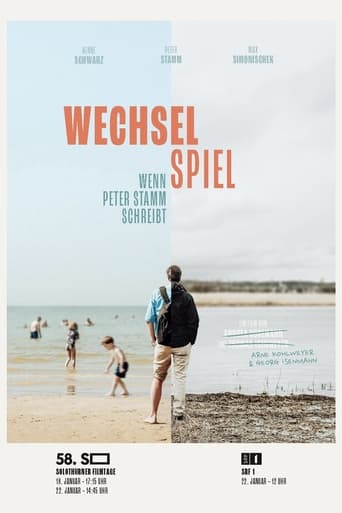
Two documentary filmmakers become the plaything of writer Peter Stamm and subject of the novel whose creation they actually wanted to document.
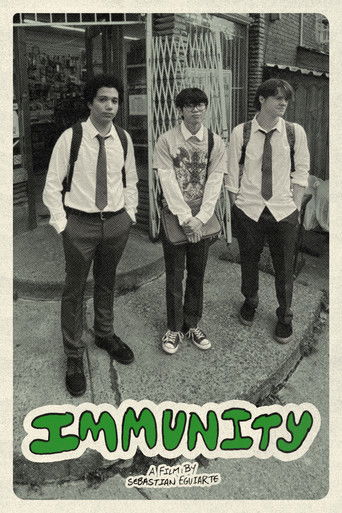
Felix and Mark are close to being invited to a party after school. Problem is — they need to bring their own alcohol. With zero experience, they enlist the aid of Ethan, but things don't go as planned, leading Felix and Mark into an argument that puts their friendship hanging in balance.
In this comedic docufiction, Javier (Javier Raphael) is a young man who has always wanted to be a football coach like his idol “El Chelís” (José Luis Sánchez Solá), but has never done anything to fulfill his dream. Now, guided by a nosy narrator (Jorge Pietrasanta), he will look for some of the most unorthodox amateur football coaches in Mexico, and for his beloved "Chelís", so that each one can give him lessons until he is fully trained to manage a match and thus become a true "Mexican football coach".
Stefan reunites with his family to celebrate his grandmother's birthday for the first time after his mother's recent passing. This homecoming, driven by his urge to complete a film about his mother and an attempt to make amends by rescuing a stray dog, will ignite an introspective journey for Stefan. Inspired by the director's real-life experiences and starring his actual family members in a mission to complete a lake house and a film, this is an intimate cinematic exploration of the timeless mother-son relationship.
"A country without artists is a dead country... I hope we are alive..." It is in this film by Fawzi Sahraoui produced by the RTA in 1985 and filmed a few months before the painter M'hamed Issiakhem 'turns off this sentence is spoken. A very interesting docu-fiction in which Issiakhem delivers himself with finesse, passion and generosity.
"All Five Millions of Us" is a hybrid of documentary and fiction feature film about father absence, based on data released by the National Council of Justice: there are 5.5 million children without paternal recognition in Brazil.
Issa, a footballer from Guinea-Bissau who plays in Portugal, is contacted by two filmmakers who want to know more about his life and make a documentary. Exposing the voices behind the camera, Nha Sunhu is a reflection on the gaze, bias, and representation of the other.
The film approaches the work of the Greek artist Nikos Koniaris. The particular way in which the painter depicts human suffering is presented through a film - a hybrid of real recording and directed material. The grief, the sick body, is reflected in self portraits, portraits of dying strangers and paintings of dead models. The paintings, apart from his work, also express a different version of himself. All together contribute to the depiction of man as a "garment of pain".
The Hugo's Brain is a French documentary-drama about autism. The documentary crosses authentic autistic stories with a fiction story about the life of an autistic (Hugo), from childhood to adulthood, portraying his difficulties and his handicap.
A radio DJ in pursuit of an exclusive interview follows ABBA during their mega-successful tour of Australia.
Departing from peripheral details of some paintings of the Bilbao Fine Arts Museum, a female narrator unravels several stories related to the economic, social and psychological conditions of past and current artists.
A cinematic impression of Vietnam, told through the eyes of Vietnamese immigrants.
A cameraman wanders around with a camera slung over his shoulder, documenting urban life with dazzling inventiveness.
Étienne Dinet (إتيان دينيه), born March 28, 1861 in Paris, where he died on December 24, 1929, was a French painter and lithographer. He was one of the leading representatives of Orientalist painting at the turn of the 19th and 20th centuries. Obtaining a scholarship in 1884, Dinet undertook his first trip to southern Algeria in the region of Bou-Saâda, the Naili culture having a profound impact on him, as he would return there many times until he settled in his first Algerian studio in Biskra in 1900. In 1905, he bought a house in Bou-Saâda to spend three-quarters of the year there. In 1907, on his advice, the Villa Abd-el-Tif was created in Algiers, modeled on the Villa Medici in Rome. Having lived much of his life in Algeria, he called himself Nasreddine Dinet (نصر الدين ديني) after converting to Islam. On January 12, 1930, he was buried in the Bou-Saâda cemetery, where a museum that houses many of his works bears his name.
A village meeting in communist Russia to pay homage to Stalin leads to a gossip marathon, which develops into an endurance test for the participants.
Tired of my city, I imagine the arrival of a cowboy in Lisbon.
Óscar Peyrou is a veteran Spanish film critic who writes his reviews according to a very peculiar method: in his opinion, it is not really necessary to watch the films since it is possible to judge them simply by looking at their promotional poster.
In the town of Xoco, the spirit of an old villager awakens in search of its lost home. Along its journey, the ghost discovers that the town still celebrates its most important festivities, but also learns that the construction of a new commercial complex called Mítikah will threaten the existence of both the traditions and the town itself.