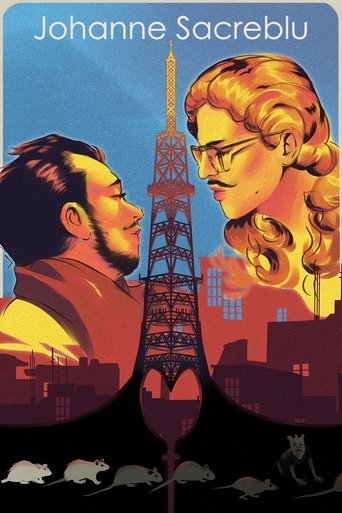
"Viva Varda!"
A Cine-Poem. A journey through Paris. A memory film. Three stories, dedicated to one pioneer of cinema.
Social & External
Louise
Claude
The Narrator
Himself
Orphaned and alone except for an uncle, Hugo Cabret lives in the walls of a train station in 1930s Paris. Hugo's job is to oil and maintain the station's clocks, but to him, his more important task is to protect a broken automaton and notebook left to him by his late father. Accompanied by the goddaughter of an embittered toy merchant, Hugo embarks on a quest to solve the mystery of the automaton and find a place he can call home.
Paris, 1930. Luis Buñuel is penniless after the scandal surrounding the release of his last movie. Sculptor Ramón Acín, a good friend, buys a lottery ticket and promises Buñuel that he will pay for his next movie if he wins the prize.
Over the course of a week, sisters Inger and Ellen find their relationship challenged on a highly anticipated coach trip to Paris. Inger reveals her struggles with schizophrenia to the group, receiving both pity and discrimination. On arrival, it soon becomes clear that Inger has a hidden agenda concerning a figure from her past, ultimately involving the entire group in her hunt for answers.
1983. The biggest architectural competition in history, both anonymous and open, is launched under the impetus of a new socialist president, François Mitterrand. Coveted by all the biggest international architectural firms, the competition is surprisingly won by an unknown: Johan Otto von Spreckelsen, an architecture teacher from Copenhagen. Until then, the fifty-year-old Danish had only built 4 buildings: his home and three small chapels.
Eloise spends a morning speaking to her school professor on the topics of love, and other guns. An affair in Paris isn't all that it's cracked put to be.
A chaotic family go on holiday to Spain and get mixed up with a gang of diamond thieves.
While vacationing without her busy British diplomat husband, a married woman falls for another man.
Henri, the Man from Nantes, comes back to his country after a successful stay in the United States, where he was working for Liski, the drug dealer. With the fame of being a tough guy preceding him, he sets himself to the task of knowing why the French operations were not so profitable - and soon he is master of all links of the organization. He can now get it honed to perfection - or destroy it. Only... the Police are following his every step.
Outwardly a chilling portrait of the aimless lives of unemployed inner city youths living on society's fringe, the underlying message of this volatile drama seems to call for violence to rectify social injustices. The film centers on two teenaged gangs who basically terrorize their neighborhoods with their anarchic behavior. There are few limits to their unpleasant philosophy of "desire equals acquisition." The loosely structured tale reaches its climax at a concert where the two rival groups collide.
In order to win over a tough dramatist at her next audition, a young actress turns to method acting to such an extreme that she slowly loses herself in the coveted role of a promiscuous bisexual self-destructive wild girl and starts sleeping around, provoking fights and cutting herself. Can she pull herself back from the edge of the abyss before it's too late?
Raven, a mobster just released from prison, settles the score by murdering Mendetta and her partner, who had turned him in. Having taken over Mendetta's various bars, he finds himself at war with other mobsters who want to kill him.
Tomas and Martin are a gay couple living in Paris whose marriage is thrown into crisis when Tomas impulsively begins a passionate affair with young schoolteacher Agathe. But when Martin begins an affair of his own, Tomas must confront life decisions he may be unprepared—or unwilling—to deal with.
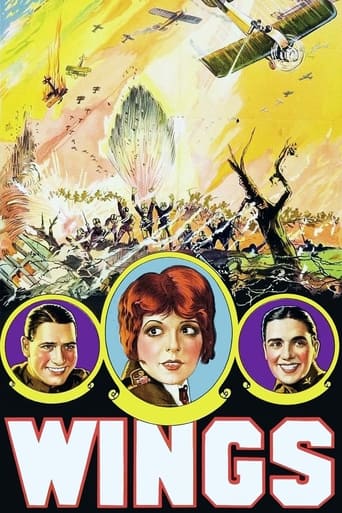
Theda Bara does her usual vamp turn in this picture, but this time she's a vamp who turns out to have a heart of gold. Her character, Blanchette DuMonde, is known as "the wickedest woman in Paris," and because of this sordid reputation, she is not allowed to serve as a nurse during World War I. So she becomes an Apache dancer instead.
Parigi O Cara is probably the most camp in the history of Italian cinema, certainly a favourite with the queer community who quote its lines by heart. Unique as it's the only film where Franca Valeri (now 90) is the unquestioned star, in the role of Delia, a snobbish, stingy prostitute who is moving to Paris looking for greener and more lucrative pastures. An anti-neorealist, amoral, almost abstract comedy, which anticipates Almodóvar, a ferocious, though gentle, non-moralistic portrayal of the 60's boom and its broken dreams. The dialogue between Delia and her brother (played by Fiorenzo Fiorentini), when he does (or does not) tell her he is a homosexual, is memorable, a primordial coming-out, a masterpiece of allusions. But what makes it one of the first examples of a film with a "gay point of view" is the approach: perceptive, non-conformist, caustically witty. A film ahead of its times, still unbeaten.
Disillusioned with her life, Ella embarks on a soul-searching journey to Paris where she navigates love, self-discovery and cheese amidst the enchanting backdrop of The City of Love.
Three war-torn strangers posing as a family flee Sri Lanka’s civil war to start over in a troubled Paris suburb, but their past traumas resurface as they struggle to survive in their new environment.
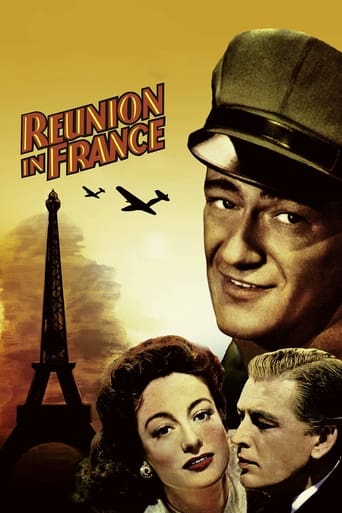
In this drama, an American art student is trapped amidst the political turmoil of war-torn Europe while visiting Paris and staying at the fabulous Ritz hotel. Rather than cope constructively with it all, the fellow opts to ignore it and continue living the high-life for as long as possible.
Alyssa (Lana Boy) follows her artistic aspirations to Los Angeles, leaving behind her husband Luka (Emmanuel Berthelot), who promises to join her later. The pandemic-induced lockdowns force them apart, straining their relationship until the couple decides it’s best to separate. Upon returning to Paris to finalize her divorce, Alyssa finds herself engulfed in her past life with Luka and old friends, all of which have moved on. She starts to question whether she was selfish to leave her past life behind in pursuit of career goals. Should she have been happy with the “little life” she left behind? Could she have been?
Paris of the 1930s, in the world of little rascals. Loulou gus is in the shade. To get a clean crust, it needs sorrel, fuzzy, dough. Especially since he owes a package to Pierrot's band that is close to making his skin. But Loulou is madly stiff. Luckily, Paul, who has a crush on her, spins in a small jewelry store. This is the perfect breakage opportunity. From a frill-frac behind the fagots. But Jo, Loulou's acolyte, who has no gas on all the floors, promises us not the breakage of the century, but at least the breakage of the evening… And then the Mother Mercandieux, jeweler of father in girl, is not ready to leave his jewelry to this band of thugs ... Especially since Paul is not going to let himself be told too long. So beware, there’s going to be some mayhem!
Convinced that a museum art sculpture is misaligned, a determined tourist challenges the gallery’s security protocols in an attempt to adjust the positioning of the central piece.