Social & External
An internal battle is simmering among US Christians over whether climate change is a call to protect the Earth, the work of God to be welcomed, or does not exist at all.
Climate change is among the world’s greatest challenges. As a small Caribbean island, Cuba is disproportionately affected by climate change through extreme weather events. Up to 10% of Cuban territory could be submerged by the end of the century, wiping out coastal towns, polluting water supplies, destroying agricultural lands and forcing one million people to relocate. Finding solutions is now essential. In this documentary, Dr Helen Yaffe goes to Cuba to find out about ‘Tarea Vida’ (Life Task), a long-term state plan to protect the population, environment and the economy from climate change. The Cuban approach combines environmental science, natural solutions and community participation in strategies for adaptation and mitigation. Produced by DaniFilms with Dr Helen Yaffe from the University of Glasgow for the COP26 conference in Glasgow.
Shishmaref is a community of about 600 people, located on an island just off the west coast of Alaska. The effects of global warming threaten the very existence of these people- so much that the entire population needs to be relocated off the island within 10 years. They have become the first tangible victims of the worldwide climate changes. The project exists of several components; exhibition, book, film, website, and educational program. In the documentary Jan Louter depicts the impending end of the traditional lifestyle on the island of Shishmaref trough the lives of three Inupiat families. Despite the alarming situation, the film has not become a political manifesto. The Last Days of Shishmaref is a moving film about identity, transience, mortality, and the clash between different eras and cultures.
How our societies can be transformed into an ultra-low carbon way of living fit for our children’s future?
Greta Thunberg, a 15-year-old student in Sweden, started a school strike for the climate as her question for adults was, if you don’t care about my future on earth, why should I care about my future in school? Within months, her strike evolved into a global movement as the quiet teenage girl on the autism spectrum becomes a world-famous activist.
Sheds light on an alternative approach to farming called “regenerative agriculture” that could balance our climate, replenish our vast water supplies, and feed the world.
Rising sea levels and sinking land threaten to destroy Venice. Leading scientists and engineers battling the forces of nature to try to save this historic city for future generations. Discover the innovative projects and feats of engineering currently underway, including a hi-tech flood barrier, eco-projects to conserve the lagoon, and new efforts to investigate erosion beneath the city.
Ida, the grandniece of Simona Kossak, travels to the Bialowieza Forest at the Polish-Belarussian border. Sorting through the photos left by Lech Wilczek, Ida uncovers the life he had with Simona, captured in the photographs, footage and memories. A moving and powerful documentary about the life of Simona Kossak, a biologist, ecologist and activist known for her efforts to preserve the remnants of natural ecosystems in Poland and for living among the animals in the Białowieża Forest for over 30 years.
The loss of biodiversity is highly alarming: our planet is currently experiencing the greatest extinction since the age of the dinosaurs. This film documents the extinction of species currently happening around the world. But it also highlights hopeful initiatives as committed men and women on every continent fight to save endangered species and work towards improving biodiversity.
A stunning and intimate portrait of the Arhuaco indigenous community in Colombia. In 1990, in a celebrated BBC documentary, the Arhuaco made contact with the outside world to warn industrialized societies of the potentially catastrophic future facing the planet if we don’t change our ways. Now, three decades later, with the advances of audio/visual technology, we go back to the Snowy Peaks of Sierra Nevada de Santa Maria to illuminate their ethos against the backdrop of an increasingly fragile world.
A Tibetan woman collects water near her family's yak farm and brings it back home 80-pounds full, in a ritual that takes her an hour to complete. A selection from Peabody Award-winning documentarian Bari Pearlman’s Nangchen Shorts series.
When Natural and human interests impinge on each other and over-regulation disturbs our biological balance, important questions arise. Do we belong to nature or does nature belongs to us? A thought-provoking story in which documentary maker Marijn Poels explores the human urge to control our climate, security and preferably the other. Balancing on a razor-thin line between regulation and manipulation. When technology reigns supreme and common sense vaporizes through the test of time, humanity is on the brink of becoming the tool. Miles away from the collective panic, fear and chaos, there is hope, inspiration and reconnection.
On September 30th, 2019; people rallied together to fight the system for climate change. This is the story of that rally, and the inevitable impact global warming will have on our planet.
A non-verbal visual journey to the polar regions of our planet portrayed through a triptych montage of photography and video. Landscapes at the World's Ends is a multi-dimensional canvas of imagery recorded above the Arctic Circle and below the Antarctic Convergence, viewed through the lens of whom is realistically an alien in this environment, the polar tourist. Filmed during several artist residencies on-board three expedition vessels, New Zealand nature photographer and filmmaker Richard Sidey documents light and time in an effort to share his experiences and the beauty that exists over the frozen seas. Set to an ambient score by Norwegian Arctic based musician, Boreal Taiga, this experimental documentary transports us to the islands of South Georgia, the Antarctic Peninsula, Greenland and Svalbard. Landscapes at the World's Ends is the first film in Sidey's Speechless trilogy, and is followed by Speechless: The Polar Realm (2015) and Elementa (2020).
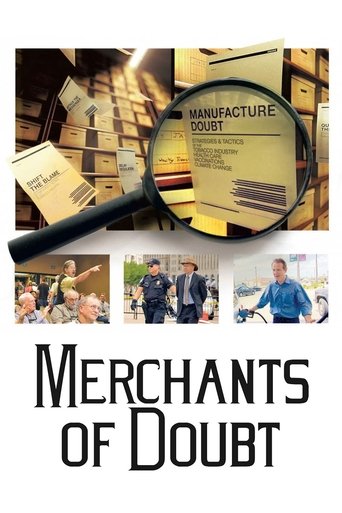
Tobacco, climate change, pesticides,... Never has scientific knowledge seemed so vast, detailed and shared. And yet it appears to be increasingly challenged. It is no longer surprising to see private corporations put strategies in place to confuse the public debate and paralyze political decision-making. Overwhelmed by excess of information, how can we, as citizens, sort out fact from fiction? One by one, this film dismantles the workings of this clever manoeuvre that aims to turn science against itself. Thanks to declassified archives, graphic animations and testimonies from experts, lobbyists and politicians, this investigation plunges us into the science of doubt. Along with a team of experts (philosophers, economists, cognitive scientists, political men, or even agnotologists), we explore concrete examples of doubt making and try to understand the whole process and the issues behind it.
The coastline of East England is vanishing before our eyes. As cliffs crumble and roads disappear, the land carries stories of the past and the uncertainty of the future. The sea is always present
A team of 20 elite Nepali climbers venture into the Death Zone of Mount Everest to restore their sacred mountain and the contaminated water source of 1.3 billion people. They ascend the highest point on the planet to the 150 bodies of deceased climbers and 100,000 pounds of rubbish that remain on the high slopes of Everest. This is the self-documented story of their life-threatening journey.
A film about climate activism in the suburbs.
Vast, wild, yet extremely fragile. The coldest place on our planet is also one of the most affected by global warming and needs to be protected. The expedition focuses on exploring, documenting, and surfing in the South Shetland Islands and the Antarctic Peninsula, in the area known as Domain 1, which is being pushed for Marine Protected Area (MPA) status. Protected areas are very important for mitigating climate change and, in this case, also for regulating human activities such as concentrated fishing. This film helps us understand the importance of this area and the threats affecting it.