"WHAT DOES POWER MEAN TO YOU?"
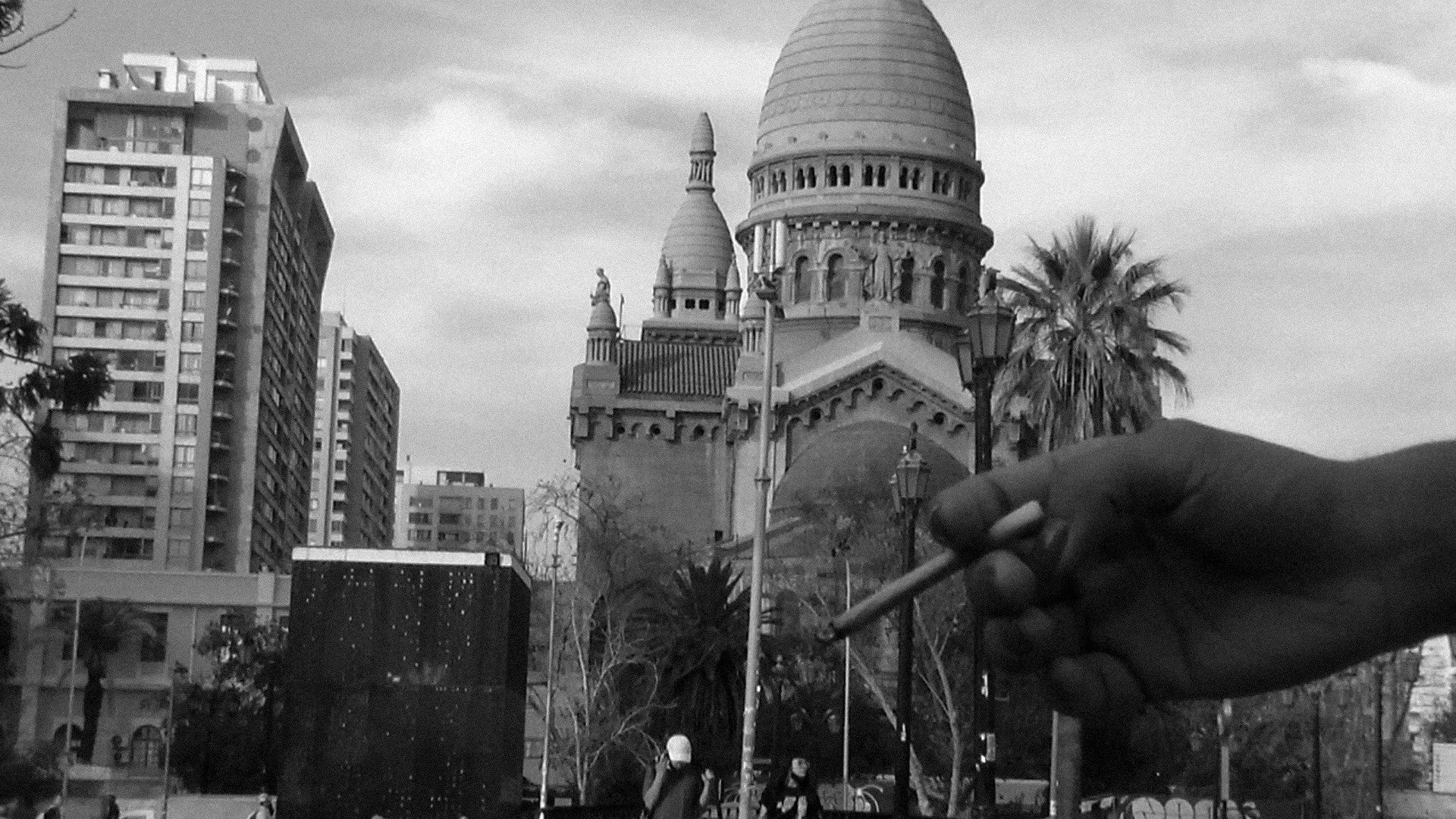
Chileans are asked about their definition of the word (and the concept of) "power", as they answer images flash on the screen of powerful and powerless figures in Chilean history.
Social & External
The ruthless dictator Teodoro Obiang has ruled Equatorial Guinea with an iron hand since 1979. Juan Tomás Ávila Laurel is the most translated Equatoguinean writer, but he had to flee the country in 2011, after starting a hunger strike denouncing the crimes of the dictatorship. Since then, he has lived in Spain, feeling that, despite the risks, he must return and fight the monster with words.
During the first days after the 1973 Chilean coup d’état, the political leadership of the Popular Unity government was arrested and transferred to Dawson Island, Magallanes Region, extreme south of Chile and the mainland. The wives of the then political prisoners began an incessant effort to find out the whereabouts of their husbands and then try to return them alive. In these circumstances, they meet and spontaneously organize into a group they call the “Dawsonianas.”
A short philosophical satire that wanders between the absurd and the profound. From a silent bed stare to a prophetic lentil, Cryptex explores the rituals of modern existentialism — one cup of coffee and one book at a time.
The third installment in Dan Přibáň's series of travel documentaries describes the author's journey with his friends across South America in vehicles that are often notorious but cult in their own way. The charming dynamics of the group on screen are further enhanced by the high-quality craftsmanship.
Terpsichore is a captivating exploration of dance as an art form, illuminating the passion, discipline, and vulnerability that transform movement into poetry. The documentary follows three distinct yet interconnected artists: Cece Trapani, an Irish dancer; Aurora Maur, a burlesque performer; and the Dayton Contemporary Dance Company (DCDC), a renowned contemporary dance ensemble. Through their stories, Terpsichore reveals the universal language of dance—one that transcends genre and speaks to the depths of human emotion. Intimate interviews and behind-the-scenes rehearsal footage offer a raw, unfiltered look at the artistry behind each performance, capturing the essence of dance as both personal expression and a bridge between artist and audience. More than a showcase of technique, Terpsichore delves into the soul of movement, celebrating its power to connect, inspire, and reveal the unspoken truths of the human spirit.
A pack of strays – seven dogs and one woman live in the shadows of Moscow. Hidden from the totalitarian authorities, two species share their existence on the verge of disappearance. They are straying in constant restlessness through a savage landscape where the city is cracking. Shot from the animal’s point of view, patterns of mutual dependence and taming begin to blur.
Drawing on a wealth of unseen archival material and unpublished notebooks, the film weaves a complex and personal portrait of Margaret’s life, from the perspective of a fellow artist sensitive to the potential Margaret envisaged for film as a poetic medium.
A Documentary film, following a group of friends going through their college life. with 3 months of filming starting in August 25th to November 1st 2024. most of everything was filmed in Boston. the purpose of the movie isn't to look amazing and have great story telling, but instead its meant to stamp a period in time. so that in 50 years we can look back and notice the human growth in a movie format. I hope you like the movie and thank you for watching :)
This excellent feature-length documentary - the story of the imperialist colonization of Africa - is a film about death. Its most shocking sequences derive from the captured French film archives in Algeria containing - unbelievably - masses of French-shot documentary footage of their tortures, massacres and executions of Algerians. The real death of children, passers-by, resistance fighters, one after the other, becomes unbearable. Rather than be blatant propaganda, the film convinces entirely by its visual evidence, constituting an object lesson for revolutionary cinema.
Bruno Muel's documentary on the coup in Chile in 1973. Muel, who was part of the famed Medvedkine group, along with Chris Marker and Jean-Luc Godard, among others, captured one of the most powerful portraits of the early days of Dictatorship. Profound solidarity with the socialist cause, Muel and his team showed great courage to mix the official registration of images with those triumphant, clandestine, of the nascent opposition.
A glimpse into a visual representation of memory; A Christmas-time series of meals, coffees, and movies, with friends, lovers, and housemates. Faced with the compounding of faces and places, each moment begins to collide with one another: voices are muddled, and faces are broken. How is memory created? How are they separated from one another?
A walk in the woods become a metaphoric journey in Chloé Leriche's short film. As a solitary figure moves through the forest, the texture of stone, the movement of water, all the infinite pageantry of the natural world is captured in its richness and detail. With the help of an orchestrated soundscape and composed cinematography, Blue Suns catches the miracle and mystery of this world as it unfolds.
"Gerboise bleue", the first French atomic test carried out on February 13, 1960 in the Algerian Sahara, is the starting point of France's nuclear power. These are powerful radioactive aerial shots carried out in areas belonging to the French army. Underground tests will follow, even after the independence of Algeria. From 1960 to 1978, 30,000 people were exposed in the Sahara. The French army was recognized recognized nine irradiations. No complaint against the army or the Atomic Energy Commission has resulted. Three requests for a commission of inquiry were rejected by the National Defense Commission. For the first time, the last survivors bear witness to their fight for the recognition of their illnesses, and revealed to themselves in what conditions the shootings took place. The director goes to the zero point of "Gerboise Bleue", forbidden access for 47 years by the Algerian authorities
Be. Belonging. Words on vintage flash cards shuffle past in a stream-of-consciousness that shows the mind working, assigning labels and names to things through love and language. In the space of a moment, perception embarks on an epic journey of tongues, through Cantonese and English sounds and Ektachrome memories that form the characters and identity of this American-born Asian filmmaker.
When her husband died Soumicha, mother of three, had to earn a living. She became the only woman taxi driver in Sidi Bel-Abbès, Algeria. This film accompanies Soumicha around a city where religious and political violence rages, and records her experiences in a job normally reserved for men.
As we wait to see whether Rupert Murdoch will fall from power and lose control of News International, Every Day is Like Sunday tells the forgotten story of the dramatic downfall of Cecil King—the newspaper mogul who used to dominate British media in the 1960s, before Rupert Murdoch arrived.
Somewhere, a man tinkers, cooks, and smokes in silence, caught between the tranquility of an afternoon nap and the strangeness of time stretching out.
In Portugal, during the night of April 24-25, 1974, a peaceful uprising put an end to the last government of the Estado Novo, the authoritarian regime established in 1933 by dictator António de Oliveira Salazar (1889-1970), paving the way for full democracy: a chronicle of the Carnation Revolution.