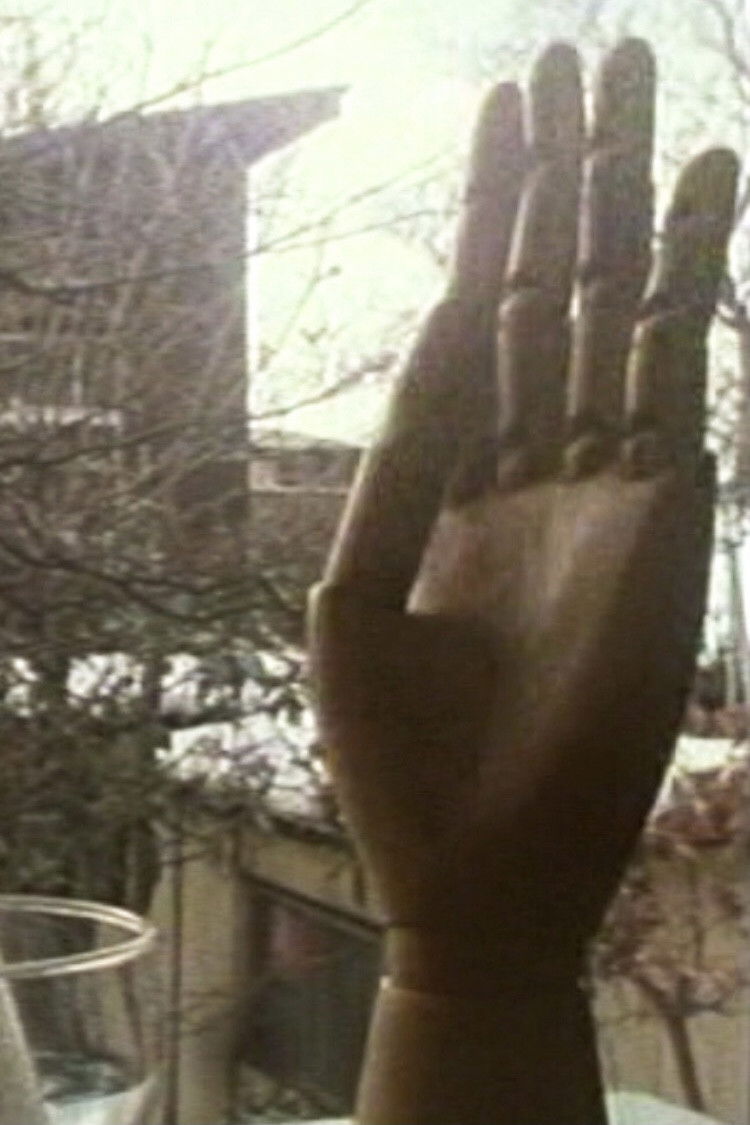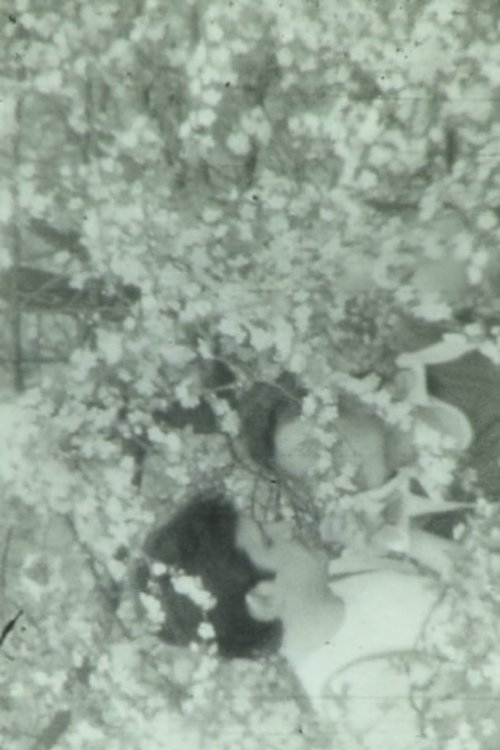
Poetic and romantic amateur footage of a young couple in a garden, as well as their travels — several spliced films with different plots were stored on one reel. The film includes the author's audio commentary.
Social & External

Obscure signs portend a looming, indecipherable slump. An oracular decoding of the landscape.
Korea, the now: A young man makes a fateful encounter with a stranger he passionately falls in love with. When Unk rides his scooter through the night he fails to notice a drunk pedestrian, a man called Boaz, and hits him. The accident has unforeseen repercussions since shortly afterwards Unk and Boaz start an intense relationship that leads into a gradually worsening dependency.
Digital Smoke is an experimental meditation on light, memory, and distortion. Shot at twilight in Minneapolis’s Loring Park, the film captures the moment just after sunset, when street lamps flicker on and reflect across the lake. As Devereaux moves the camera backward and forward, fading light introduces digital noise. Rather than correct it, he amplifies the imperfection, layering light trails until the noise becomes ethereal white clouds—“digital smoke”—that dissolve the boundary between image and abstraction. Frames evoke the hazy textures of J.M.W. Turner and the pixelated aesthetic of early video games, blending painterly romanticism with digital fragmentation.
The lives of people are observed within the confines of one, twenty-two story high rise apartment complex and its adjacent courtyard in Trump Village, Brooklyn, New York. Shot from one vantage point over a period of fifteen months, THE BALCONY, speculates on the evanescence of all our lives.
During WWII, the Japanese army developed experimental balloons able to cross the Pacific Ocean and reach the West Coast of North America in 3-6 days. Armed with explosives, they were given the code name fu-go, or fusen bakudan (“fire balloons,” or balloon bombs) in an attempt to instill a culture of fear like that caused by the far more deadly American firebombing of Japanese cities. The U.S. responded by enacting a censorship campaign, requesting newspapers avoid reports of fu-go landings or sightings. Living near the remains of a fu-go launch site in Fukushima Prefecture, Takeuchi mimics their flight take-off using a drone camera, and, traveling to North America, follows their arrival across the shoreline and rural landscapes, using a bat’s echolocation as narrative device to place fu-go and Fukushima as echos across history.
Christmas Eve in rapid camera.
Images of concrete and stone. A cemetery. Light making its way through the tree leaves.
"There will be no winters" - a film consisting of 14 short novels, each with its own plot and a musical theme. In fact, this is a screen version of the same album of Russian avant-garde singer Leonid Fedorov.
Incredible phantasmagoria of merry-go-round people, who are usually called the dregs of society . The clip of the band "Holy Hares" ("Inflatable pistol"). Vocalist Slava Martov.
Bert Deling's surreal, button-pushing and hallucinogenic paean to the emerging possibilities of avant-garde and homemade filmmaking. Telling the tale of a violent ex-cop searching for the man who killed his partner, the film takes an unexpected turn when he encounters drug lord Plastic Man and a tribe of LSD enthusiasts. What follows is both literal and metaphorical mayhem as the boundaries of the film start collapsing and our idea of what's real is pushed to its very limits.
shot in melbourne, may 2024
This audio-visual tone poem uses the language of filmmaking to offer a first-hand evocation of the turbulent psychological effects one can experience due to prolonged lack of sunlight.
One morning, the late Karlheinz Stockhausen awoke from a dream that told him to take to the sky. Stockhausen envisioned four helicopters swirling in the clouds, with each of a quartet’s members tucked inside his own chopper, communicating through headsets, stringing away in sync to the rotor-blade motors. He immediately set forth to make that dream a reality. In 1995, Dutch film director Scheffer followed Stockhausen in the days leading up to the premiere performance of his Helicopter String Quartet in Amsterdam. The resulting film offers a rare glimpse of Stockhausen as he patiently dictates every agonizingly detailed measure to the Arditti Quartet.
Cinematic magician, legendary provocateur, and author of Hollywood Babylon, Kenneth Anger was a unique figure in post-war American culture. His iconic short films are characterised by a mystical-symbolic visual language and phantasmagorical-sensual opulence that underscores the medium’s transgressive potential. Anger’s work fundamentally shaped the aesthetics of 1960s and 1970s subcultures, the visual lexicon of pop and music videos and queer iconography. These nine films form the basis of Anger’s reputation as one of the most influential pioneers of avant-garde film and video art. Fireworks, 1947, 14 min Puce Moment, 1949, 6 min Rabbit's Moon, 1950/1971, 16 min Eaux d'Artifice, 1953, 13 min Inauguration of the Pleasure Dome, 1954, 37 min Scorpio Rising, 1964, 28 min Kustom Kar Kommandos, 1965, 3 min Invocation of My Demon Brother, 1969, 11 min Lucifer Rising, 1981, 27 min
A colorful collage, with a subtle ecology theme, made largely from footage from trial runs of programs used for many of the other films.
Drawing inspiration from a poem penned by Castro Alves, this film vividly captures the political, cultural, and intellectual climate of Brazil during the late 1970s. At its core, the story revolves around four distinctive embodiments of Christ's image: a black man, a soldier, an Indian, and a guerrilla fighter. These courageous individuals, hailed as the harbingers of doom in the tupiniquim lands, valiantly combat the insatiable avarice and oppressive "civilizing" brutality propagated by the formidable John Brahms—a foreign exploiter devoid of morals.
A film-parable about the eternal movement of mankind from the Stone Age to self-destruction.
An audiovisual experiment that shows how oil is refined into gasoline and ultimately powers cars and other vehicles, accompanied by classical music and experimental synthesizer sounds. Filmed in the Libyan desert, the film traces the path and development of the gasoline, from the extraction of oil as it is drilled in the Libyan desert to the pump at the gas station, making road construction machines dance and convertibles roar through the Spessart forests. This film also drew Herbert von Karajan and Leo Kirch's attention to Hugo Niebeling, in which the director has road bulldozers "dance" to the music of Vivaldi.
OPEN FIELD is in the mind, of course, and exists as a weave of trees, grasses, waters, and bodies poised and fleeting at childhood's end. The scene is lit as by sun and moon alike and haunted by the pursuant adult. - Stan Brakhage