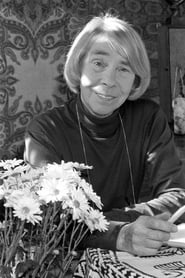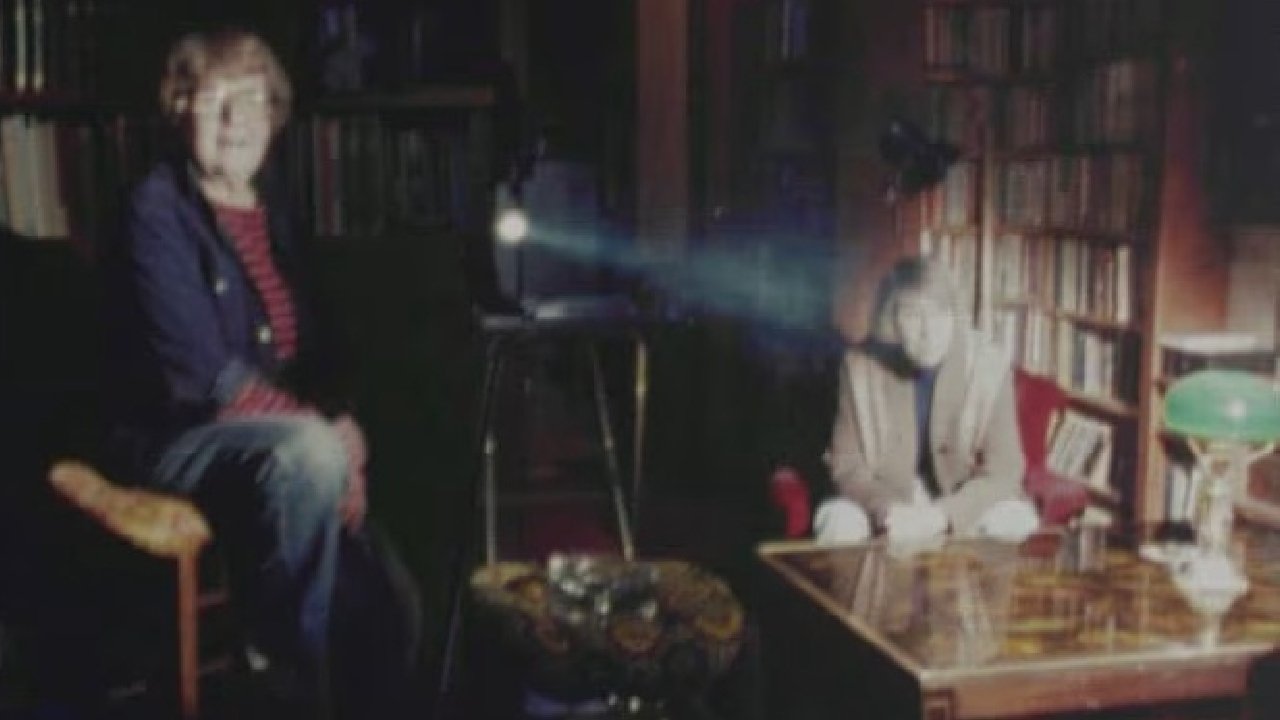
Artist and author Tove Jansson talks about her thoughts and life at home on Tähtitorninmäki in Helsinki and in her cottage in the outer archipelago.
Social & External
Self
Self / Reader (voice)
The sun rises over the tide pools of coastal Maine.
In the fishing village of Cedar Bay, terror lies within the water. And now it has surfaced in search of something more substantial to devour than marine life: human flesh. A captain and a sea biologist must wage a terrifying battle against the deadly creatures in order to save mankind from total extinction.
Saving the world's last dinosaur, the sea turtle.
Klaus Kinski has perhaps the most ferocious reputation of all screen actors: his volatility was documented to electrifying effect in Werner Herzog’s 1999 portrait My Best Fiend. This documentary provides further fascinating insight into the talent and the tantrums of the great man. Beset by hecklers, Kinski tries to deliver an epic monologue about the life of Christ (with whom he perhaps identifies a little too closely). The performance becomes a stand-off, as Kinski fights for control of the crowd and alters the words to bait his tormentors. Indispensable for Kinski fans, and a riveting introduction for newcomers, this is a unique document, which Variety called ‘a time capsule of societal ideals and personal demons.’
Man Ray, the master of experimental and fashion photography was also a painter, a filmmaker, a poet, an essayist, a philosopher, and a leader of American modernism. Known for documenting the cultural elite living in France, Man Ray spent much of his time fighting the formal constraints of the visual arts. Ray’s life and art were always provocative, engaging, and challenging.
A struggling writer is forced to fake a relationship to save her career, while overlooking the love of a longtime friend.
56-year-old artist Mindy Alper has suffered severe depression and anxiety for most of her life. For a time she even lost the power of speech, and it was during this period that her drawings became extraordinarily articulate.
Kansas, 1910. Widowed farmer Jacob Witting finds that taking care of both his farm and two children, Anna and Caleb, is too difficult to handle alone. John takes out an ad in a newspaper for a mail-order bride, to which the "plain and tall" Sarah Wheaton answers, soon traveling from Maine to Kansas to become John's wife. Despite the love that grows between Sarah and the family, Sarah finds herself homesick, and she must ultimately choose whether or not to stay.
Described in Art Review as the world’s most influential and expensive living artist, the German painter Gerhard Richter was enjoying enormous success in London with his retrospective show at Tate Modern entitled Panorama in 2011. This particular film was made some years ago at the time of his equally successful American retrospective at MOMA entitled “40 Years of Painting” and charts his entire artistic career. Born in Dresden in 1932, the year before Hitler came to power, Richter later grew up in communist East Germany, before escaping to the West just before the Wall went up in Berlin. Since then he has produced a large diverse body of work from his blurred photobased paintings to his gigantic abstractions, from his Baader Meinhof pictures to his perceptual installations using sheets of glass. Gerald Fox’s film caught up with the artist at his home in Cologne where he was undergoing a period of quiet reflection and preparation before beginning a new series of paintings.
10 May 1943. Something is spotted drifting ashore off the coast of Northwest Donegal, Ireland. Something that would change the lives of the local people forever.
Newfoundland painter Gerald Squires has referred to his portraits as "confrontations," though not intending the hostility that word can convey. This film shows a meeting between the artist and Edythe Goodridge, art curator and critic. Through a combination of Squires's reflections on his life and work and the good-natured banter of these two friends, an intimate portrait evolves of the artist and his subject.
The artist J.M.W. Turner is widely recognised as England’s greatest painter. Tate has the world’s finest and most extensive collection of his work. Turner at Tate explores Turner’s art through many of his best-known canvases and exquisite sketches and watercolours, all newly and exceptionally filmed in HDTV from the original artworks. Incorporating the landscapes and places that inspired the works, the film provides an overview of Turner’s life and - in an accessible and engrossing way - of critical approaches to his art. The film’s focus is Turner and England, and his work is considered against the radical social and political changes of the early nineteenth century. Turner at Tate is a film about ideas and history and landscape, a film about colour and light. Contributors include Tate curators Ian Warrell and David Blayney Brown, and art historians Sam Smiles and Barry Venning. Also featured on the DVD are ten additional short films, each of which considers in detail a major work.
Black Is the Color highlights key moments in the history of Black visual art, from Edmonds Lewis’s 1867 sculpture Forever Free, to the work of contemporary artists such as Whitfield Lovell, Kerry James Marshall, Ellen Gallagher, and Jean-Michel Basquiat. Art historians and gallery owners place the works in context, setting them against the larger social contexts of Jim Crow, WWI, the civil rights movement and the racism of the Reagan era, while contemporary artists discuss individual works by their forerunners and their ongoing influence.
Deep Blue is a major documentary feature film shot by the BBC Natural History Unit. An epic cinematic rollercoaster ride for all ages, Deep Blue uses amazing footage to tell us the story of our oceans and the life they support.
An Austrian director followed five successful African music and dance artists with his camera and followed their lives for a year. The artists, from villages in Ghana, Gambia and Congo, were the subjects of Africa! Africa! touring across Europe, but they have unbreakable roots to their homeland and their families. Schmiderer lovingly portrays his heroes, who tell their stories about themselves, their art and what it means to them to be African with captivating honesty. The interviews are interwoven with dance scenes and colourful vignettes set to authentic music.
Aquatic life, textures, and viscera found along the Northern California coast.
Ten years ago, Volodymyr Zelensky was just one of the many faces on Ukrainian television screens. He became a star thanks to the 2015 satirical series Servant of the People, in which he played a history teacher who becomes president. Four years later, what began as fiction became a reality. This French documentary follows the transformation of a popular TV comedian into a statesman on the front lines of the Russian invasion. Archival footage, family photos, television appearances, and interviews with Zelensky and those closest to him create a multi-layered portrait of a man who always longed for a large audience. At the same time, the film places his personal development in the broader context of post-Soviet Ukraine, which is also searching for its own identity.
Documentary about filmmakers of the New German Cinema who were members of the legendary Filmverlag für Autoren (Film Publishing House for Authors). Among them are Werner Herzog, Rainer Werner Fassbinder, and Wim Wenders.
The English novelist, John Le Carré discusses his life as a secret agent and writer in this documentary about spies in fact and fiction, produced for British television.