An animated remake of the 1974 children's movie "Shan shan de hong xing"
Social & External
Unknown Role
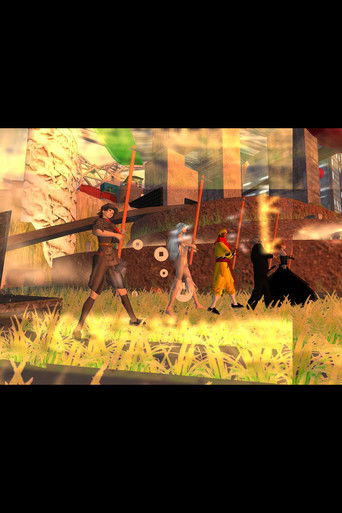
Cao Fei explores a virtual metropolis within the online platform Second Life. The work blends real and fictional elements of Chinese identity and urbanism to comment on capitalism and development in the aftermath of the global financial crisis. Marxist iconography intersects with modern corporate structures, creating a dystopian yet whimsical reflection on 21st-century economic realities.
China, in the early sixties: an angry mob is persecuting a rich landowner. Mei, a young worker, who is part of the crowd. Suddenly she recognizes the victim who she secretly loves. Frightened of revealing her feelings, Mei doesn't know what to do.
During the period of Culture Revolution in 1960s and 1970s in China, a disable old man wanted to use his handicraft, a snuff bottle with inside painting, for the exchange of “Grain Coupon” from a soldier. The soldier promised to give more coupons if the old man can forge a precious stamp. The old man had to do it, however, he failed and fell out with the soldier. At the end, the old man got grain in another way.
An artist looks back on his younger years at the Chongqing Art Academy in the turbulent 1990s. The selection and demands used to be killing. He was close friends with two boys and a girl. They fought with local youngsters and tried to give each other pep talks. Parallels with the childhood years of his parents, during the Cultural Revolution, also show violence and gun battles. Semi-autobiographical, with motion capture.
Throughout Hong Kong’s history, Hongkongers have fought for freedom and democracy but have yet to succeed. In 2019, a controversial extradition bill was introduced that would allow Hongkongers to be tried in mainland China. This decision spurred massive protests, riots, and resistance against heavy-handed Chinese rule over the City-State. Award-winning director Kiwi Chow documents the events to tell the story of the movement, with both a macro view of its historical context and footage and interviews from protestors on the front lines.
After the cultural revolution
1975 on the south west border of China
In an epic tale of theater, gender, love and class, two Beijing opera actors navigate political turmoil as their friendship evolves over decades.
After a fateful encounter in the summer of 1966, the lifepaths of two brothers from a middle-class Roman family diverge, intersecting with some of the most significant events of postwar Italian history in the following decades.
The touching encounter of two drifting beings - Meiting, a hairdresser, and Chen Mo, a street vendor, in Beijing. A strange relationship on the background of survival and anonymous urbanization, a chronicle on the survival of feelings.
Northern China, 2004. When miner Zhang Baomin returns to his home, a small and isolated mining village, his wife tells him that their son has mysteriously disappeared while shepherding his small flock.
As the Communist Party of China celebrates its 100th anniversary, this documentary looks back at the party’s history, from the 1920’s, to the Civil War, the Great Leap Forward, the Great Famine, the Cultural Revolution and the reforms by Mao Zedong and Deng Xiaoping. Did the Great Famine cost more than 15 million lives? How does the Cultural Revolution continue to shape Chinese politics today? What was capitalism like after Mao’s death? Through rare and never-before-seen historical footage, expert interviews and eyewitness accounts of the Great Famine, Tiananmen incident, and the Cultural Revolution, get to know how one party has so profoundly shaped China.
Ming Wang is an impoverished Chinese prodigy who flees Communist China to become a pioneering eye surgeon in America. When tasked with restoring the sight of an orphan in India, who was blinded by her stepmother, Wang must confront the trauma of living through the violent uprising in his youth, the Cultural Revolution.
Set in the frozen steppes of Mongolia, a young nomad is confronted with his destiny after animals fall victim to a plague which threatens to eradicate nomadism.
Spring 1976, 5-year-old Swallow is abandoned at a public boarding preschool in central Beijing. When the persimmons are ripe, Swallow masters how to cry, but doesn't forget how to fly.
During the Cultural Revolution, two young men are sent to a remote mining village where they fall in love with the local tailor's beautiful granddaughter and discover a suitcase full of forbidden Western novels.
The friendship between two children is threatened by their parents’ differences. Malú is from a family that was upper-class before the Revolution and remains well-to-do through remittances from relatives overseas, and her single mother (Larisa Vega Alamar) does not want her to play with Jorgito, as she thinks his background coarse and commonplace. Jorgito’s mother (Luisa María Jiménez Rodríguez),
An American Merchant Marine captain, rescued from a Chinese Communist jail by local villagers, is "shanghaied" into transporting the entire village to Hong Kong on an ancient paddle steamer.
The world was in a cold war in the late 1960s and early 1970s. After the Sino-Soviet Treasure Island conflict, Beijing teenager Qi Weizhi evacuated with his mother to Hanzhong City in the hinterland of the Qinling Mountains, and experienced a pure juvenile sexual maturity out of touch with the political atmosphere of that era. Hanzhong was China's third-tier town during the Cold War. Mother Qi Xiuxuan deliberately concealed her husband's death because of her husband's emotional betrayal, and was quite indifferent to her son. Qi Weizhi's missing mother's love was rewarded by class teacher Zhou Wenyao, so he had a subtle affection for Zhou Wenyao.