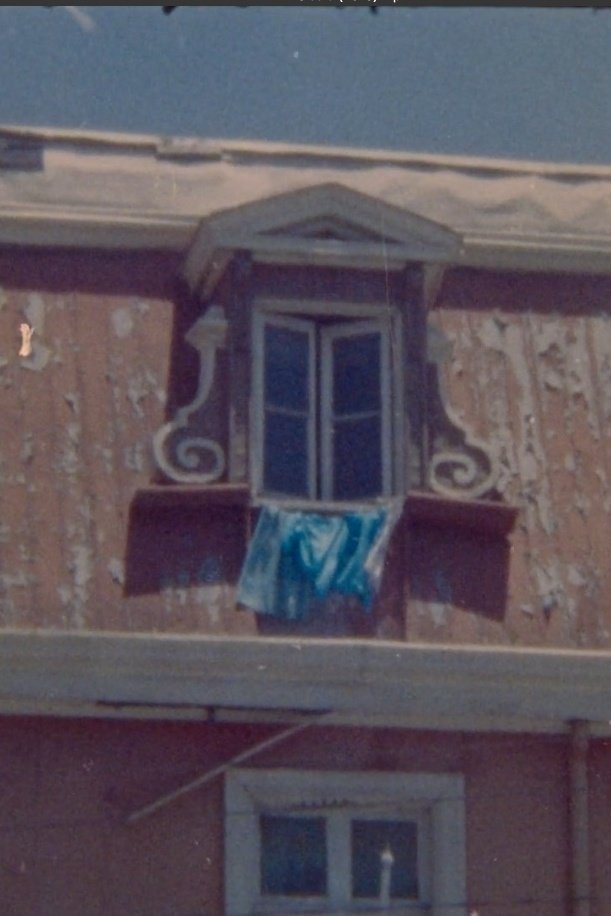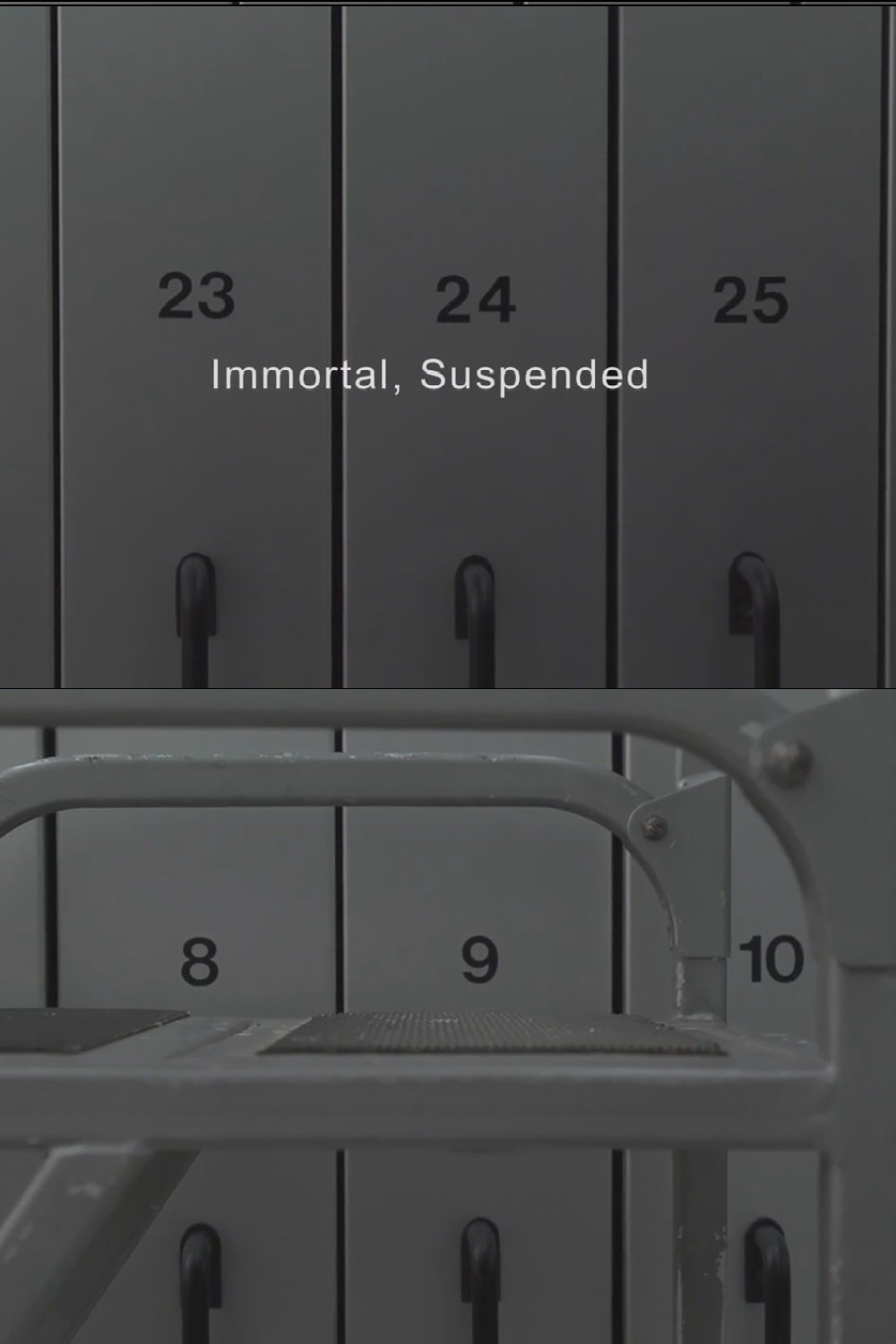
The idea of suspension is evoked on shifting registers – as levitation, cessation, preservation, and suspense – and located in sites whose identities slip as we track through a space within a space.

Stream
Rent
Social & External
An anthology of one-minute films created by 51 international filmmakers on the theme of the death of cinema. Intended as an ode to 35mm, the film was screened one time only on a purpose-built 20x12 meter public cinema screen in the Port of Tallinn, Estonia, on 22 December 2011. A special projector was constructed for the event which allowed the actual filmstrip to be burnt at the same time as the film was shown.
Made on a wind-up Bolex camera, The Sound of Seeing announced the arrival of 21-year-old filmmaker Tony Williams. Based around a painter and a composer wandering the city (and beyond), the film meshes music and imagery to show the duo taking inspiration from their surroundings.
This experimental nature documentary by Minna Rainio and Mark Roberts depicts climate change and the wave of extinction from the point of view of our near future. Actually, it depicts the age we live in now, or rather its fateful consequences.
A documentary portrait of Utopia, loosely framed by Plato’s invocation of the lost continent of Atlantis in 360 BC and its re-resurrection via a 1970s science fiction pulp novel.
A man steadily bashes through the snow. He disappears and the trees, covered in white, shift and show a beautiful array of hidden colors. A poetic, meditative short film about letting go of the past and embracing the unknown future.
We live with stories. And it's hard for us to give up on these stories, which provide us our identity, a way of understanding ourselves. Reflections from three successive generations are dusted off and presented as remaining fragments. An attempt to archive thoughts on familial history, narrative traditions, human perception and "the story" from known and unknown sources. "There is history behind it and the history becomes the story and the story becomes the pattern and the pattern becomes rigidity."
In his essay film, Jerry Tartaglia, longtime archivist and restorer of the film estate of queer New York underground, experimental film, and performance legend Jack Smith, deals less with Smith’s life than with his work, analyzing Smith’s aesthetic idiosyncrasies in 21 thematic chapters. It's a film essay about the artist’s work, rather than a documentary about his life. An unmediated vision of Jack Smith, an invitation to join him in his lost paradise.
A small portrait of the volatility of intimacy and of breaking free from abusive cycles: made in response to a year of collapsing relationships and violent accidents that left me broken, dislocated and stuck in my apartment.
An unnamed passer-by is forced to trace a circular route inside an abandoned tram station, facing loss and time. The broken walls act as a channel, transmitting fragmentary, blurred and analogical memories.
Experimental film fragment made with the Edison-Dickson-Heise experimental horizontal-feed kinetograph camera and viewer, using 3/4-inch wide film.
In 1967, experimental filmmaker Jorgen Leth created a striking short film, The Perfect Human, starring a man and women sitting in a box while a narrator poses questions about their relationship and humanity. Years later, Danish director Lars von Trier made a deal with Leth to remake his film five times, each under a different set of circumstances and with von Trier's strictly prescribed rules. As Leth completes each challenge, von Trier creates increasingly further elaborate stipulations.
'The angle of the world allows us to see the real as an outer and inner presence at the same time, an opaque otherness, yet capable of becoming an intimate space. These incommensurable lengths and distances of an interior that opens up: The mysterious movement of the clouds, the cadence of the waves against the light, or the silent slippage of a barely identifiable human silhouette, everything seems transfigured, derealized and reinvented by light in a poetic world that evokes the paintings of Turner or Friedrich, the writings of Poe or Baudelaire.’ — Violeta Salvatierra

A cameraman wanders around with a camera slung over his shoulder, documenting urban life with dazzling inventiveness.
The second entry in Velu Viswanadhan's series of experimental documentaries. This film traces the Ganges river upstream.
This portrait of a guinea fowl is the first clear vision I've had of the hot-blooded dinosaurs still living among us. (SB)
This stream-of-consciousness could be nothing less than pathway of the soul, as images of Marilyn's window are remembered from inside-out, its "view" interwoven with all of other windowing and the Elements of the known world.
The discovery of a human torso thrown into a waterway, leads the viewer to observe the work of modern criminology and the task of special agents to track and record the psychopath's mentality through the elucidation of techniques present in the reality of the police investigation.
A meditation on the human quest to transcend physicality, constructed from decaying archival footage and set to an original symphonic score.

At various points in its history, tiny St. John's Island was where Singapore's colonial founder Sir Stamford Raffles docked his ship upon arrival, a quarantine centre for immigrants and pilgrims returning from Mecca, a penal colony for political detainees and secret society leaders, and a sleepy holiday resort. Unlike its neighbouring islands, however, St. John's was never fully developed. It occupies an in-between space, the vestiges of its history scattered around the land. Its indeterminacy stands in sharp contrast to Singapore, where land use is meticulously planned to fulfil economic and social functions. In this film, St. John's Island - otherwise known as 'Bukit Orang Salah', a nickname coined by the people who were quarantined there - becomes a site of and for reflection, prompting questions about our history, heritage and identity.