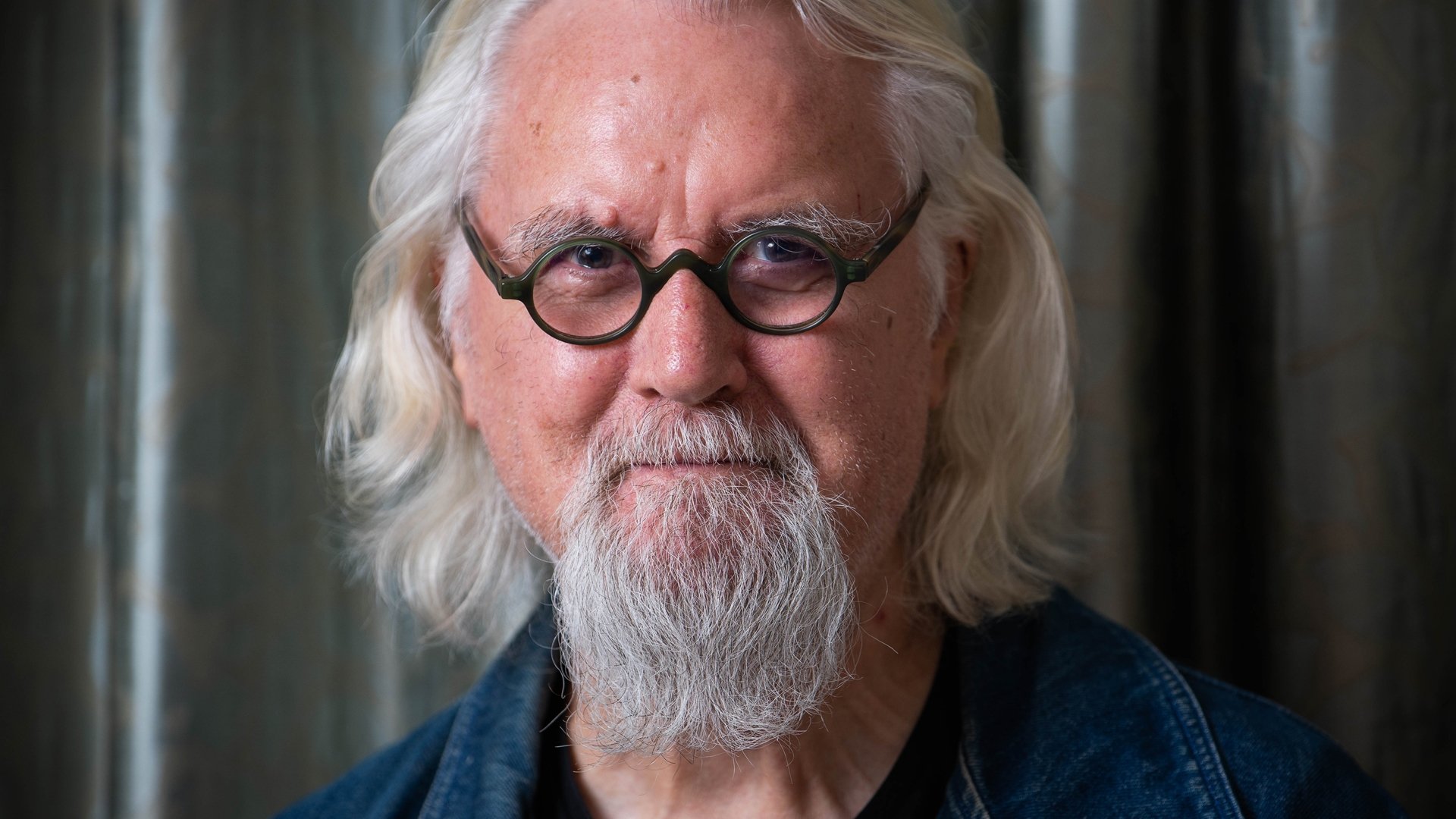
Billy Connolly returns to Glasgow’s famous Kings Theatre, where his journey into comedy first began, to talk life, death and laughter, in a no holds barred encounter with Will Gompertz.
Social & External
Himself - Interviewed Guest
Himself - Presenter
A comic, biting and revelatory documentary following a small group of prankster activists as they gain worldwide notoriety for impersonating the World Trade Organization (WTO) on television and at business conferences around the world.
Germán Cipriano Gómez Valdés Castillo, a young radio announcer from Cuidad Juárez, succeeds in drawing attention to the pachuco movement through his character Tin Tan, laying the groundwork for a new form of binational and mass linguistic expression: Spanglish. He soon became a leading figure in theater and film on the American Continent. Singled out by critics as a destroyer of the language, he quickly won the approval of the public. His ability to improvise revolutionized the film industry. His talent as an actor, singer, dancer and comedian contributed to the Golden Age of Mexican Cinema. From El Hijo Desobediente to Capitán Mantarraya, from Cuidad Juárez to Havana, from mambo to rock, the legacy of Tin Tan makes him one of the great icons of Mexico today. This film tells his story as it has never been told before.
Over fifty of the greatest living comedians are called to a party at Bob Hope's house, where each of them is systematically killed (and their bodies thrown in Hope's pool!). Hope and the rapidly shrinking cast try to discover who is the mysterious killer known only as "Joys."
The Hugo's Brain is a French documentary-drama about autism. The documentary crosses authentic autistic stories with a fiction story about the life of an autistic (Hugo), from childhood to adulthood, portraying his difficulties and his handicap.
When Francois Truffaut approached Alfred Hitchcock in 1962 with the idea of having a long conversation with him about his work and publishing this in book form, he didn't imagine that more than four years would pass before Le Cinéma selon Hitchcock finally appeared in 1966. Not only in France but all over the world, Truffaut's Hitchcock interview developed over the years into a standard bible of film literature. In 1983, three years after Hitchcock's death, Truffaut decided to expand his by now legendary book to include a concluding chapter and have it published as the "Edition définitive". This film describes the genesis of the "Hitchbook" and throws light on the strange friendship between two completely different men. The centrepieces are the extracts from the original sound recordings of the interview with the voices of Alfred Hitchcock, Francois Truffaut, and Helen Scott – recordings which have never been heard in public before.
On May 8, 1989, Sports Illustrated ran an article about Ultimate frisbee… about a team with no name hailing from New York City that was about to change the sport forever. From its 1968 New Jersey birth to its unanimous 2015 recognition by the International Olympic Committee, FLATBALL circles the globe to showcase four decades of world-class Ultimate and goes even further: to a set of fields in the Middle East to understand and demystify the unique spirit of the game.
This interview with Bruce Dern is on the DVD for 'Silent Running' (1972), released in 2002.
Jacques Lemonnier of IBM France, Francois Dalle of L'Oreal and other ultrapowerful French moguls are surprisingly candid -- and cold-blooded -- as they discuss their attitudes about business in this startling 1978 documentary. After sounding off about unions, strikes, hierarchy and management, the subjects realized how callous they sounded and managed to convince the French government to suppress the film.
Delve into the musical influences of iconic rockers Led Zeppelin, whose epic brand of arena rock grew out of a deep love of the blues, the skiffle and folk rock. Music historians and authors join producers Joe Boyd and Larry Cohn, as well as performers John Renbourn, Chas McDevitt and Davey Graham, in their analysis of the band's musical roots. An enthralling section also explores Zeppelin's fascination with the occult.
Using previously unheard audiotapes recorded shortly after John Belushi’s death, director R.J. Cutler’s documentary feature examines the too-short life of the once-in-a-generation talent who captured the hearts and funny bones of devoted audiences.
Sergio Citti talks about a video he shot in 1975 after Pier Paolo Pasolini's death.
The cast of the 1988 film, Bad Dreams, talk about their experiences making a film with heavy themes of suicide, guilt, depression, and mass death.
Under the warm rays of the sun, the protagonists become living still lifes, resting on benches, chairs, and deckchairs. In the quiet embrace of nature, they wait, reflect, and remember. This cinematic group portrait delves into the legacy and creative spirit of Vilko Filač, the Slovenian master of film photography, celebrating the enduring mark he left on the world of cinema.
Straight-forward production stories from the Hollywood players who made the movie happen.
Mia and Roman is a 1968 23-minute documentary film which was shot during the making of Rosemary's Baby.
Clive Barker gives viewers a brief insight into his work and what he thinks about the attitudes of the time.
Cast and crew, as well as some famous fans, recall the insanity of making of the ultimate experience of grueling terror that is The Evil Dead.
An Interview with The Quay Brothers & Alan Passes April 2006 at Atelier Konick, London