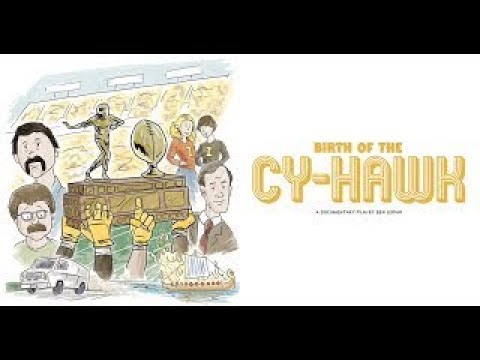
A Local Iowa documentary about the history of trophy to the Cy-Hawk games.
Social & External
Shot during three seasons, Kenuajuak's documentary tenderly portrays village life and the elements that forge the character of his people: their history, the great open spaces and their unflagging humour. Though Kenuajuak appreciates the amenities of southern civilization that have made their way north, he remains attached to the traditional way of life and the land: its vast tundra, the sea teeming with Arctic char, the sky full of Canada geese. My Village in Nunavik is an unsentimental film by a young Inuk who is open to the outside world but clearly loves his village. With subtitles.
‘Spitfire— Birth of a Legend‘ tells the story of the Spitfire from a radical design on the drawing board to the fighter aircraft that became the symbol of Britain’s determination to fight on to victory. It celebrates the history of this acclaimed aircraft, the men who designed and built it, and those who flew and fought in it. The story, along with dramatic archive and colour film of aerial combat, graphically illustrates the appeal and fascination the Spitfire has maintained since it faced and fought the fighter and bomber formations of the Luftwaffe.
Using historically-accurate, battle-filled re-enactments and interviews with expert historians and noted authors, this two-part documentary series brings to vivid life the captivating true stories behind Britain's bloody civil wars.
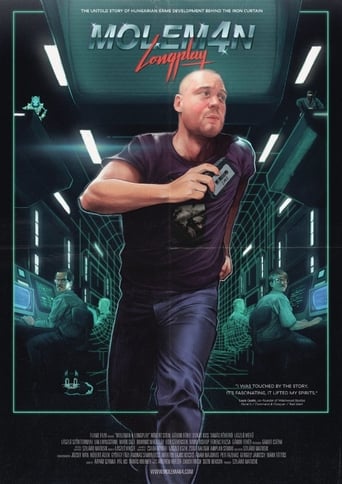
The Xbox Originals documentary that chronicles the fall of the Atari Corporation through the lens of one of the biggest mysteries of all time, dubbed “The Great Video Game Burial of 1983.” Rumor claims that millions of returned and unsold E.T. cartridges were buried in the desert, but what really happened there?
King Corn is a fun and crusading journey into the digestive tract of our fast food nation where one ultra-industrial, pesticide-laden, heavily-subsidized commodity dominates the food pyramid from top to bottom – corn. Fueled by curiosity and a dash of naiveté, two college buddies return to their ancestral home of Greene, Iowa to figure out how a modest kernel conquered America. With the help of some real farmers, oodles of fertilizer and government aide, and some genetically modified seeds, the friends manage to grow one acre of corn. Along the way, they unlock the hilarious absurdities and scary but hidden truths about America’s modern food system in this engrossing and eye-opening documentary.
How are biographies charted? How is identity constructed? Can we relive our past, reinvent it, rearrange or recycle it? Can we really know who we are if we ignore where do we come from?
Denese Joy Becker, a manicurist living in Iowa, discovers she is indeed Dominga Sic Ruiz, a survivor from a 1982 Guatemalan massacre, when more than 200 people were killed in the small village of Rio Negro, after opposing the construction of a dam, sponsored by World Bank. She then tries to unveil the truth.
Unlike what people may think, Krakatoa was not the biggest volcanic eruption in history. More than two hundred years ago, on April 10th 1815, Mount Tambora in Eastern Indonesia became a merciless killer. It unleashed the most deadly volcanic eruption in human memory, wiping out at least 117,000 people. And an entire civilization and its language disappeared. But the killing didn’t stop there. It has now been proven that this eruption could have triggered an extraordinary and little known cataclysmic event: worldwide climate change.
For two thousand years, caravans traveled from Xian in China along the Silk Road to Istanbul, a hub of world trade at the time. Julien Berjeaut begins his journey through Turkey on the banks of the Bosphorus. Istanbul, once called Byzantium and then Constantinople, is still a bubbling center of international trade in the 21st century: In the Grand Bazaar, with its thousands of stores, this half-mythical, half-historical past is brought back to life for customers and traders alike.
Archival footage of an American Nazi rally that attracted 20,000 people at Madison Square Garden in 1939, shortly before the beginning of World War II.
July 1969. America made history and sent the first humans to the moon. High-quality NASA footage and extensive news broadcasts bring this sensational moment in history bursting back into life. Live news footage from every corner of the globe recreates the excitement and elation that surrounded the event, as 600 million people tuned in to watch Neil Armstrong's remarkable first steps.
This World War II documentary rests on an unusual thesis: it argues that, in the wake of Pearl Harbor, the actions precipitated by the U.S.A.F. that truly helped turn the tide were perpetrated not by the widely-ballyhooed U.S.N. aviators or aircraft carriers, but by the American submarines - silent warriors beneath the deceptively placid ocean surface. The subs, after all, were responsible for gravely wounding Japan's industry, all but destroying the Japanese merchant fleet, and therefore preventing reinforcement of Japanese military garrisons. In relaying this story, the program draws on a series of interviews with military veterans, and endless archival footage of naval battles that chronologically tells the gripping story of the Pacific Front of the war.
Sixty-years after setting sail on the PT 658, a group of World War II veterans reminisce about their extraordinary experiences on the boat while attempting to restore it to it's original condition in a documentary that has a little something for war buffs and amateur historians alike.
As Australian cinema broke through to international audiences in the 1970s through respected art house films like Peter Weir's "Picnic At Hanging Rock," a new underground of low-budget exploitation filmmakers were turning out considerably less highbrow fare. Documentary filmmaker Mark Hartley explores this unbridled era of sex and violence, complete with clips from some of the scene's most outrageous flicks and interviews with the renegade filmmakers themselves.
How the Monuments Came Down is a timely and searing look at the history of white supremacy and Black resistance in Richmond. The feature-length film-brought to life by history-makers, descendants, scholars, and activists-reveals how monuments to Confederate leaders stood for more than a century, and why they fell.
No matter what your age you'll love watching this impressive and comprehensive story of the development of railroading in America. Rail enthusiasts as well as history buffs, teachers and home schoolers, plus kids of all ages will appreciate this magnificent rail adventure covering live action historic operating railroads, rare photos of drawings and valuable memorabilia, and live action re-enactments. Featuring spectacular cinematography and an inspiring musical score, this Award-Winning four part DVD covers over one-hundred years of railroading evolution.
Over the course of 10 months, a camera travels to Buenos Aires, Argentina and Hanover, Germany to meet with Magalí, María Belén, Ivana and Carla, the founding members of the Archivo De La Memoria Trans Argentina, the first existing Trans Archive in the world. Taking the shape of a photo-novel, the documentary not only recounts the founding members lives as trans women under the Argentine dictatorship (1976-1983), the AIDS epidemy, state repression and mass assassinations but also years of fighting for their rights, sorority and the exaltation of life and laughter in times of death. Filming each one of them is filming them embracing their new role as curators, archivists and historians while a collection of 7,000 photos goes through the filter of their memories.
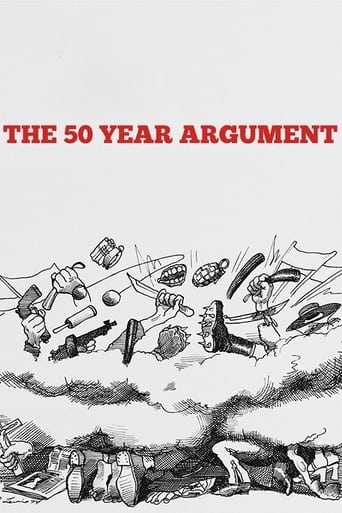
Carne Ross was a government highflyer. A career diplomat who believed Western Democracy could save us all. But working inside the system he came to see its failures, deceits and ulterior motives. He felt at first hand the corruption of power. After the Iraq war Carne became disillusioned, quit his job and started searching for answers.
On June 11th, 1997, Philippe Kahn created the first camera phone solution to share pictures instantly on public networks. The impetus for this invention was the birth of Kahn's daughter, when he jerry-rigged a mobile phone with a digital camera and sent photos in real time. In 2016 Time Magazine included Kahn's first camera phone photo in their list of the 100 most influential photos of all time.
The story of Hitler’s final hours told by people who were there. This special features exclusive forgotten interviews, believed lost for 65 years, with members of Hitler’s inner circle who were trapped with him in his bunker as the Russians fought to take Berlin. These unique interviews from figures such as the leader of the Hitler Youth Artur Axmann and Hitler’s secretary Traudl Junge, have never before been seen outside Germany. Using rarely seen archive footage and dramatic reconstruction, this special tells the story of Adolf Hitler’s final days in his Berlin bunker.