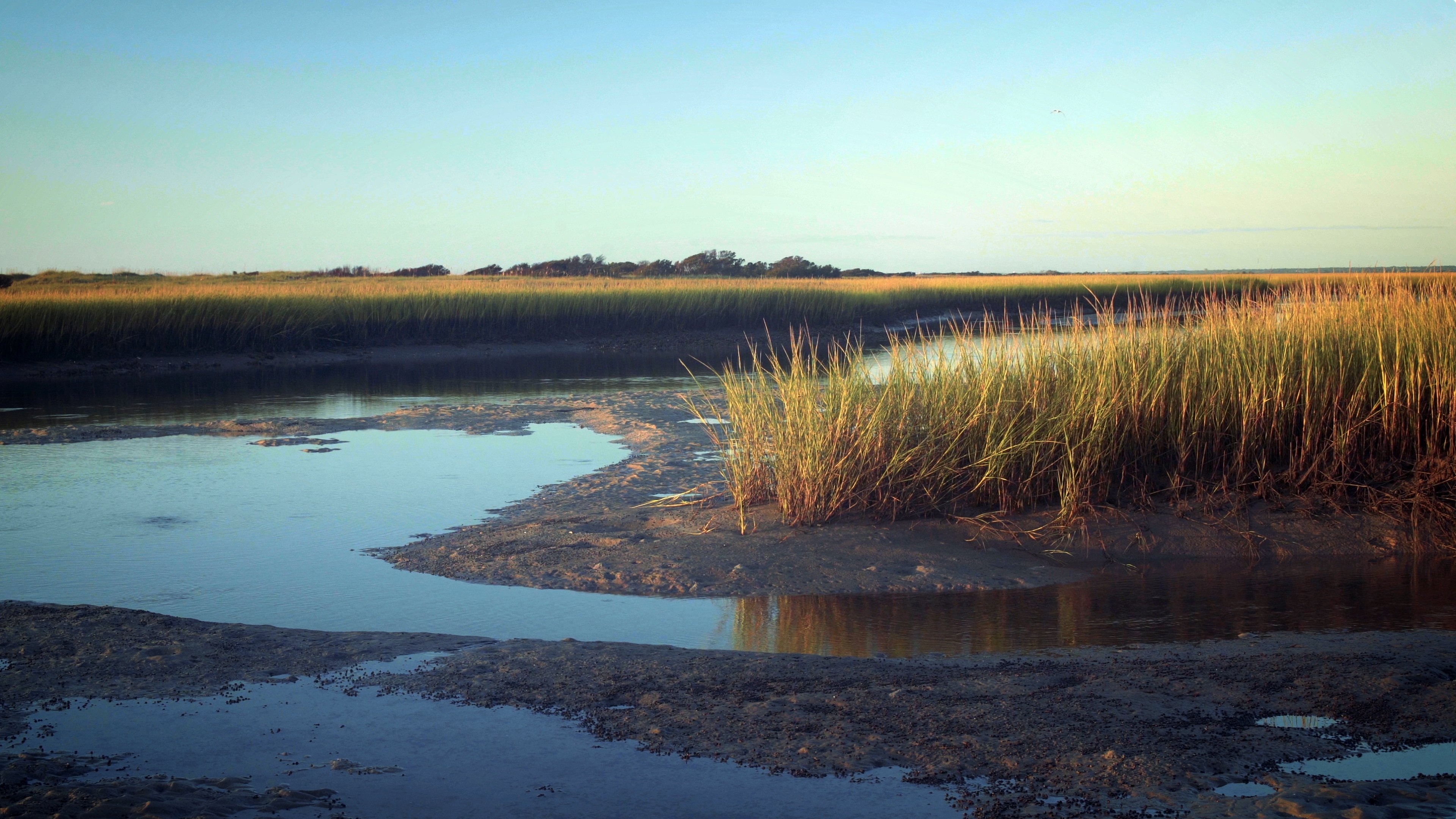
Filmed at Masonboro Island, an undeveloped barrier island in southeastern North Carolina, “Tides” contemplates the liminal space between the modern technological world and that more ecological dimension we label as “nature” or “the environment.”
Social & External
This documentary explores a variety of projects undertaken by scientists at Environment Canada's Freshwater Institute in Winnipeg to study the processes that pollute or disrupt clean and balanced freshwater environments.
The experimental documentary filmed at rescue centres in Prague and Vlašim refuses the anthropocentric perspective and views the world through the eyes of wounded animals. The term Animot was taken over from Jacque Derrida. While the French philosopher and deconstructivist uses the term to refer to everything animalistic and non-human, the film, on the other hand, uses intimate details to point out the proximity between human beings and animals. They are connected by their vulnerability, helplessness and mortality.
"Go Further" explores the idea that the single individual is the key to large-scale transformational change. The film follows actor Woody Harrelson as he takes a small group of friends on a bio-fueled bus-ride down the Pacific Coast Highway. Their goal? To show the people they encounter that there are viable alternatives.
The day-to-day life of a family of farmers from the up-country of Coronel Freitas, city in the west of Santa Catarina, Brazil. The routine of a married couple and their children, from the moment they wake up until bedtime. There is no narration or soundtrack. The narrative is constructed solely through the linearity of the scenes, all of which preserving the ambient sound.
Amongst the contemplative static shots of decaying architecture weaves an abstract narrative unveiling the life-cycle of a higher perception, too large to perceive. Shot at various sites across south-east England, INFRASTRATA is a study on the concept of super-organisms, and the relationship between structure and nature.
A 1970 projection of what may come when pollution over powers nature.
The 20 km zone surrounding the Fukushima Nuclear Power Plant was designated an evacuation zone due to the radiation caused by the accident in March 2011. However, the thousands of people of Itate, situated just outside the zone, and those who had fled the area and taken shelter there were left to their own devices for over a month. Later on Itate became a restricted area and the residents were allowed only visits having to leave the area for good. The place became a ghost town, as it was too close to the Zone and many pets and farm animals are stranded there. There are said to be 150~200 dogs, 400~800 cats, 50 chickens and a pig although the exact numbers are unknown. The public interest in the accident has all but gone but there is one man who still cares what happens to those animals.
Indigenous chief Juma Xipaia fights to protect tribal lands despite assassination attempts. Her struggle intensifies after learning she's pregnant, while her husband, Special Forces ranger Hugo Loss, stands by her side.
A short philosophical satire that wanders between the absurd and the profound. From a silent bed stare to a prophetic lentil, Cryptex explores the rituals of modern existentialism — one cup of coffee and one book at a time.
In what could be considered a follow up to Al Qasimi’s 2020 work Mother of Fire, she once again invokes the figure of the jinn (spirits in Islamic mythology) to explore the ghosts of British imperialism in the UAE. As its spectre lingers on the horizon, two teenage girls seek to liberate a pirate damned to spend purgatory on a site now being developed into a hotel. Originally commissioned for Sharjah Biennial 15: Thinking Historically in the Present, Al Qasimi entangles historical narratives with contemporary notions of piracy. In examining how it has been historically and culturally represented, new perspectives of old mythographies come into focus. (Myriam Mouflih)
A climatologist, a physicist, and a volcanologist set out to conquer the highest peak in the Alps. Through exceptional images, the film recounts their odyssey and reveals the immense wealth of this natural laboratory. Straddling France, Italy, and Switzerland, the Mont Blanc massif was formed 240 million years ago. Four times the size of Paris, it covers 400 km2. Its summit, the highest in Western Europe, rises to 4,810 meters. Three scientists begin its ascent: Martine Rebetez, a Swiss climatologist; Étienne Klein, a philosopher and physicist at the French Atomic Energy Commission; and Jacques-Marie Bardintzeff, a geologist and volcanologist. Advancing in two roped teams, they are accompanied by Jean-Franck Charlet and François-Régis Thévenet, mountain guides, as well as physiologist Hugo Nespoulet.
"When the shamans stop dancing and life in the rainforest loses its balance, the sky will collapse and come to crush everything." This wisdom is passed down from generation to generation by the Yanomami of Brazil. But gold miners are polluting the rivers, shamans are dying, the rainforest is disappearing and the earth is getting hotter. Davi Kopenawa, a tribal leader and spokesman for the Yanomami, has been fighting relentlessly against the colonization of his land for 40 years. He warns Westerners that when the sky collapses, they too will be crushed. Why don't they listen? Translated with www.DeepL.com/Translator (free version)
Before the creation of the secret cities of Los Alamos, Oak Ridge and Hanford, the Manhattan Project hired the Mallinckrodt Chemical Works of St. Louis to refine the first uranium used in the atomic bomb dropped on Hiroshima. For the next two decades, Mallinckrodt continued its classified work for the Atomic Energy Commission during the Cold War. The resulting radioactive waste contaminated numerous locations in the St. Louis area some of which have not been cleaned up 70 years after the end of World War II. Told through the eyes of an overexposed worker, the story expands through a series of interviews that careen down a toxic pathway leading to a fiery terminus at a smoldering, radioactively-contaminated landfill. The First Secret City reveals a forgotten history and its continuing impact on the community in the 21st Century, uncovering past wrongdoing and documenting the renewed struggles to confront the issue.
As queer trans and gender non-conforming children of the Vietnamese diaspora, we are fragmented at the crossroads of being displaced from not only a sense of belonging to our ancestral land, but also our own bodies which are conditioned by society to stray away from our most authentic existence. Yet these bodies of ours are the vessels we sail to embark on a lifetime voyage of return to our original selves. It is our bodies that navigate the treacherous tides of normative systems that impose themselves on our very being. And it is our bodies that act as community lighthouses for collective liberation. Ultimately, the landscape of our bodies is our blueprint to remembering, to healing, to blooming.
It's death on an unimaginable scale, when a majority of Earth's species quickly die out. It's called "mass extinction," and it's happened at least five times before. Cataclysms, such as supervolcanoes or asteroids, are thought to cause these events, but some experts believe a manmade mass extinction could be next. Is our planet in trouble? And if so, is there anything we can do to stop the next catastrophic annihilation? Experts are traveling the world, performing groundbreaking scientific detective work to answer these very questions.
Because Quebec Sign Language cannot be captured on paper, videography has revealed itself to be the best way to represent this visual language. The first ‘comic strip’ in sign language, the film depicts snatches of conversations between various deaf and hearing protagonists. A visit to a silent world, where the hearing impaired ask us to listen to them.
A vision from Limbo, where the canoeist of the eternal lake floats in his boat, between sleep and wakefulness. When he sleeps, he dreams of the everyday of a parallel time. when he wakes up, the same song haunts him again and again. his boat, “ara” (time, in guarani) travels through time like a shooting star.
Fragments from Brussels, about the flow of the city, A cinema, A body, A film, and a wind that blows through the town. The film is a Schizomentry experience that blends real stories and fiction. After all, where is the border?
What We Never Forget For Peace Here Now is a personal peace memorial produced in the United States, a country that does not have war memorials dedicated to peace. This video explores how we forget and how we remember memories of war. I think about who are my survivors and witnesses of war, and the deep impressions they've given me, becoming a part of me. Drawing inspiration from peace activists young and old, I ask viewers to join me in a practice of peace, here and now.