Social & External
herself
himself
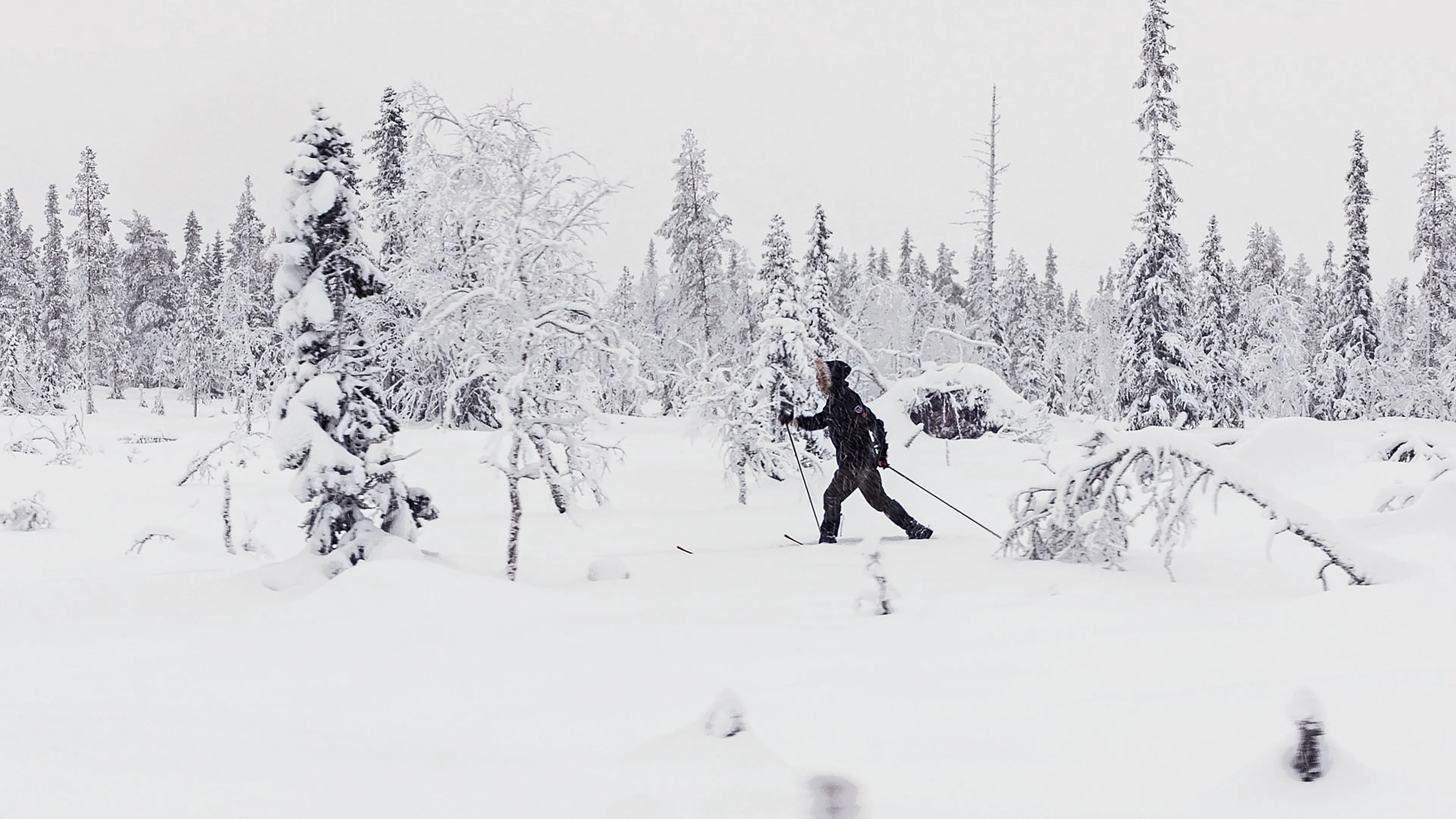
Documentary about the making of a pair of skis using old methods, from the scouting for the perfect tree to finished product.
After years of preparation, a team of highly motivated Quebeckers set out on one of the longest wilderness expeditions ever documented. Stage one involves skiing in relentless polar conditions from Ellesmere Island to the Northwest Passage where the challenge was reaching the mainland. Cue canoes for a 2000km journey across Nunavut and NWT until they reach the first dirt road available where bikes are waiting to be pedalled 4000km to Point Pelee in Ontario.
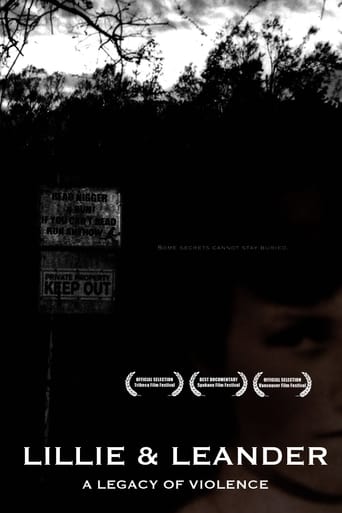
When a black teenager is shot and killed attending a bonfire party in Jay, Florida, the town's racist past becomes its present and leads to the uncovering of a shockingly similar murder in 1922 that changed the community forever.
Film about skiing and other winter sports.
World reference of the disco with 400 million albums sold, unforgettable titles like Waterloo, Mamma Mia ! or Dancing Queen, ABBA is a real planetary success. For 50 years, the world has been dancing to the rhythm of this mythical group. One year after the release of their new album, Agnetha, Björn, Benny and Anni-Frid meet again in a documentary that retraces the recipe of their incredible longevity. Between musicals, movies and concerts with their holograms, ABBA reveals the secret of their eternity.
Ethnologist and adventurer, Count Eric von Rosen was a man of contradictions: interested in the natives of Africa and colonial racism. Nestler embarks on a journey in search of his grandfather.
This Pete Smith Sports Champion short visits Southern California where it quickly moves from orange orchards to the mountain snow playground at Big Pines L.A. County Camp for some winter sports including sledding, skating, and ski jumping.
Inside the dramatic search for a cure to ME/CFS (Myalgic Encephalomyelitis/Chronic Fatigue Syndrome). 17 million people around the world suffer from what ME/CFS has been known as a mystery illness, delegated to the psychological realm, until now. A scientist in the only neuro immune institute in the world may have come up with the answer. An important human drama, plays out on the quest for the truth.
A documentary drama addressing the shared tribulations and historical unity between Black and Jewish Americans.
Film about the 10th Olympic Games in Grenoble in 1968. Using a subjective camera, Ertaud and Languepin take the pulse of the Games, cutting out the eyes and slowing down the movement when necessary. The dominant figure at the Grenoble Winter Games is Frenchman Jean-Claude Killy, whose three gold medals matched Toni Sailer's 1956 feat. The filmmakers bet on his winning streak, and include commentary from him as he prepares for each race. Another athlete, Marielle Goitschel, is treated insightfully on screen and wins the women's slalom. Ice dancing fans will appreciate the coverage of winner Oleg Protopopov and his partner Ludmila Belousova. President Charles De Gaulle was present for the spectacular Opening Ceremony.
The story of Tasmanian-born actor Errol Flynn whose short & flamboyant life, full of scandals, adventures, loves and excess was largely played out in front of the camera - either making movies or filling the newsreels and gossip magazines. Tragically he was dead from the effects of drugs and alcohol by the time he was only 50 & the myths live on. But there is another side of Flynn that is less well known - his ambitions to be a serious writer and newspaper correspondent, his documentary films and his interest in the Spanish Civil War and Castro's Cuba
From humble beginnings, complex family dynamics and tragic, life-changing events, to her unlikely rise to success in two very different worlds: fashion modeling and professional skiing. “How Did I Get Here” is a coming-of-age story, full of adventure, exploration, heartbreak, growth and inspiration.
The first American space station Skylab is found in pieces scattered in Western Australia. Putting these pieces back together and re-tracing the Skylab program back to its very conception reveals the cornerstone of human space exploration.
The earliest surviving motion-picture film, and believed to be one of the very first moving images ever created, was shot by Louis Aimé Augustin Le Prince using the LPCCP Type-1 MkII single-lens camera. It was taken on paper-based photographic film in the garden of Oakwood Grange, the Whitley family house in Roundhay, Leeds, West Riding of Yorkshire (UK), on 14 October 1888. The film shows Adolphe Le Prince (Le Prince’s son), Mrs. Sarah Whitley (Le Prince’s mother-in-law), Joseph Whitley, and Miss Harriet Hartley walking around in circles, laughing to themselves, and staying within the area framed by the camera. Roundhay Garden Scene is often associated with a recording speed of around 12 frames per second and runs for about 2 to 3 seconds.
Migrating by sea from Holland as an eight-year-old, Dirk de Bruyn went on to be a doyen of Australian experimental cinema. But as this intimate film reveals, his work is suffused with the trauma of migration, and the struggle to recognise himself as a ‘new Australian'. In conversation with documentarian Steven McIntyre, Dirk guides us through more than 40 years of his filmmaking: the early years exploring technique and technology, a subsequent phase of unflinching self-examination brought on by upheaval and overseas travel, and more recent projects where he attempts a fusion of personal, cultural, and historical identity. What emerges is an inspiring, rugged, and at times poignant portrait of an artist committed to self-expression and self-discovery through the medium of film.
Esperanto is TGR’s latest action-packed mountain bike film with an added twist. Mixing the rock stars of the sport with a cast of unknown and up-and-coming heroes, the film explores how we share our dreams through a universal two-wheeled language no matter what our native tongue may be. The sacred ritual of the ride might sound different all across the world – whether it’s a full-face getting pulled down to drop into a big jump line or wheeling a beat-up bike out of a mud hut to pedal to school – but it’s a universal process no matter what language we speak. There are more than 7000 languages spoken on Earth. In 1887 a Polish-Jewish doctor named L.L. Zamenhof created a new one, a universal second language based on a combination of existing widely-spoken European languages. Its goal, to help bring people together from different ideologies, beliefs, and nations and ultimately to help end war. The language was called Esperanto. Translated into English it means ‘one who hopes.’
A village in Cambodia. Bopha raises her son Sokhem alone. One night, guided by a strange voice, he sets off in pursuit of a magic mango. Bopha follows him and reaches the border between the world of the living and the dead. Memories of war and oppression resurface. Bopha then reveals his heavy secret.
Thanks to new excavations in Mauritius and Madagascar, as well as archival and museum research in France, Spain, England and Canada, a group of international scholars paint a new portrait of the world of piracy in the Indian Ocean.
In 1928, the city of Curitiba went through a rare snowstorm. To this day, it is the harshest snowstorm to ever take place in the city. Everything was recorded by Alberto Botelho in this short documentary.