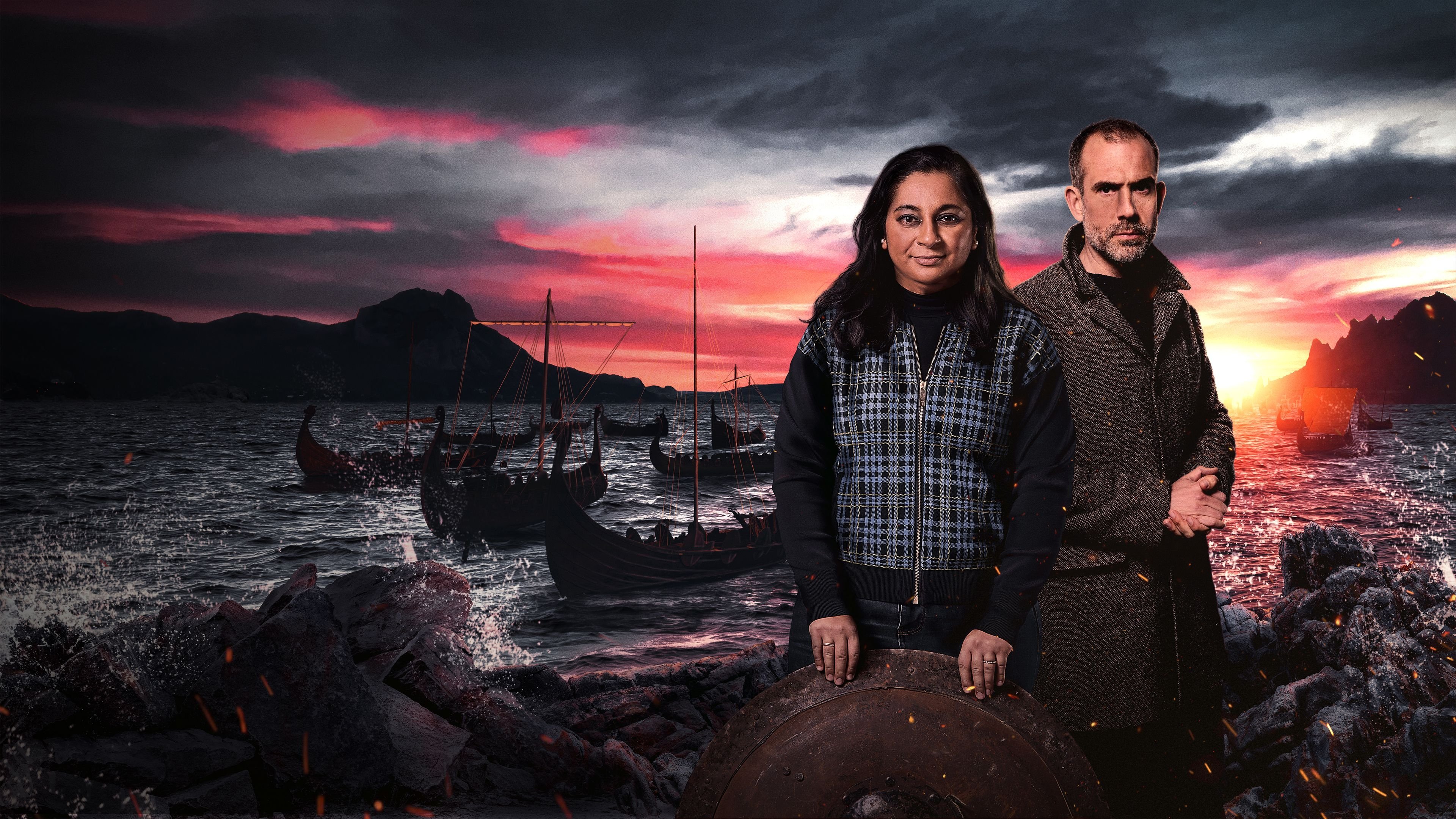


Dr Xand van Tulleken and archaeologist Raksha Dave tell the brutal story of one of the most bloody and savage conquests in English history.
Social & External
Self
Castles are the powerhouses that dot across our islands. History Hit’s Matt Lewis discovers Irish castles, from ancient high points to Norman keeps to medieval citadels.
Jonathan Roberge dives into the world of Montréal crime during the 1957-1977 period, when the city saw a prolonged war between the police and bank robbers.
Professor Alice Roberts travels across Greece and thousands of years back to our collective past, tracing how the Ancient Greeks developed philosophy, art, theatre and democracy.
Vikings is a 2012 BBC television documentary series written and presented by Neil Oliver charting the rise of the Vikings from prehistoric times to the empire of Canute.
Secrets to Civilisation is a groundbreaking History series which explores the recent explosion in data about our planet's past, offering a completely fresh perspective on the ancient world from the Bronze Age to the fall of Rome.
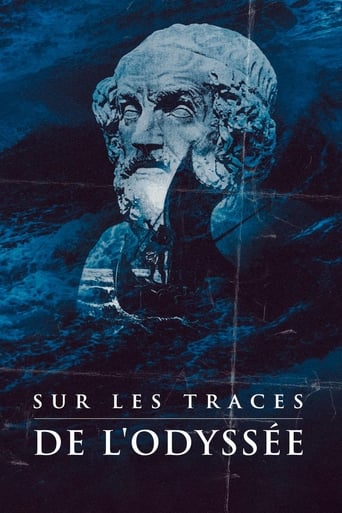
Who was Homer, and what is the meaning of The Odyssey? In this documentary we follow the footsteps of Ulysses, also known by his Greek name Odysseus—a hero as relevant today as he was nearly three thousand years ago, on a journey across some of the most fascinating landscapes and seascapes of the Mediterranean region. With the help of prominent international scholars, we seek to resolve the questions that still surround one of humanity’s greatest literary works and its enigmatic author.
Nearly 1,000 years ago, the Vikings left Scandinavia and settled across Europe - giving their name to Normandy along the way - before their Norman descendants seized the English throne at the Battle of Hastings in 1066. But what do we really know about them? By combining expert analysis with compelling drama, 'The Last Journey of the Vikings' (Swedish title: 'Vikingarnas sista resa') tells a new and often surprising story about this complex people.
The dramatic story of America's national mammal, which sustained the lives of Native people for untold generations, being driven to the brink of extinction, before an unlikely collection of people rescues it from disappearing forever. Ken Burns recounts the tragic collision of two opposing views of the natural world—and the unforgettable characters who pointed the nation in a different direction.
A multimedia course for secondary school and college teachers that examined global patterns through time, seeing history as an integrated whole. Topics were studied in a general chronological order, but each is observed through a thematic lens, showing how people and societies experience both integration and differences.
The Blues (2003) is a seven-part documentary series produced by Martin Scorsese that explores the history and influence of blues music. Each episode, directed by a different filmmaker, traces a unique aspect of the genre’s evolution—from its African roots to its global impact. Originally airing on PBS, the series includes Scorsese’s Feel Like Going Home, Wim Wenders’ The Soul of a Man, Richard Pearce’s The Road to Memphis, Charles Burnett’s Warming by the Devil’s Fire, Marc Levin’s Godfathers and Sons, Mike Figgis’ Red, White and Blues, and Clint Eastwood’s Piano Blues.
Despite decades of research, many mysteries remain about the ancient Maya. Now, archaeologists are unearthing new clues that transform long held ideas about how these people came to dominate vast areas of Mexico and Central America. Through immense lost monuments, ancient inscriptions and new forensic evidence, this series tracks the Maya from their earliest origins all the way to the present day, unlocking the dark secrets of the rise and fall of the Maya.
A lecture series about the basic problems of flight, explained by visual presentation of flow experiments. As the material of the lectures should be understood by every interested listener, no mathematical or other theoretical knowledge is used for explanation. Every problem is demonstrated by a true-life experiment and purely scientific language is avoided. Each of the lectures deals with a basic problem of flight. The experiments are mostly shown as flow picture but at certain points scale models and flying models are used to ensure easier understanding.
Following the biggest archaeological excavation in Pompeii for a generation. Exciting discoveries and fresco-inspired animations tell the story of life in Pompeii AD 79.