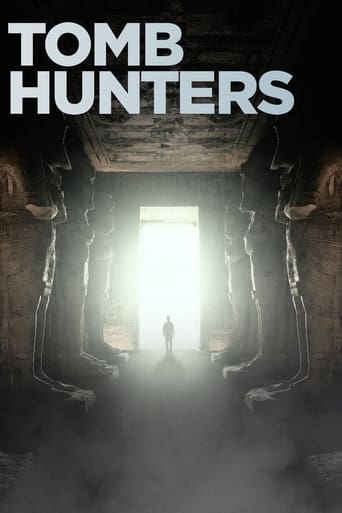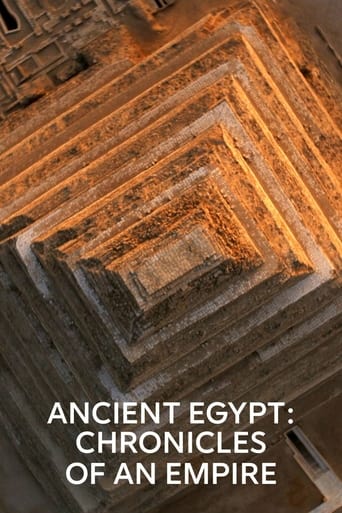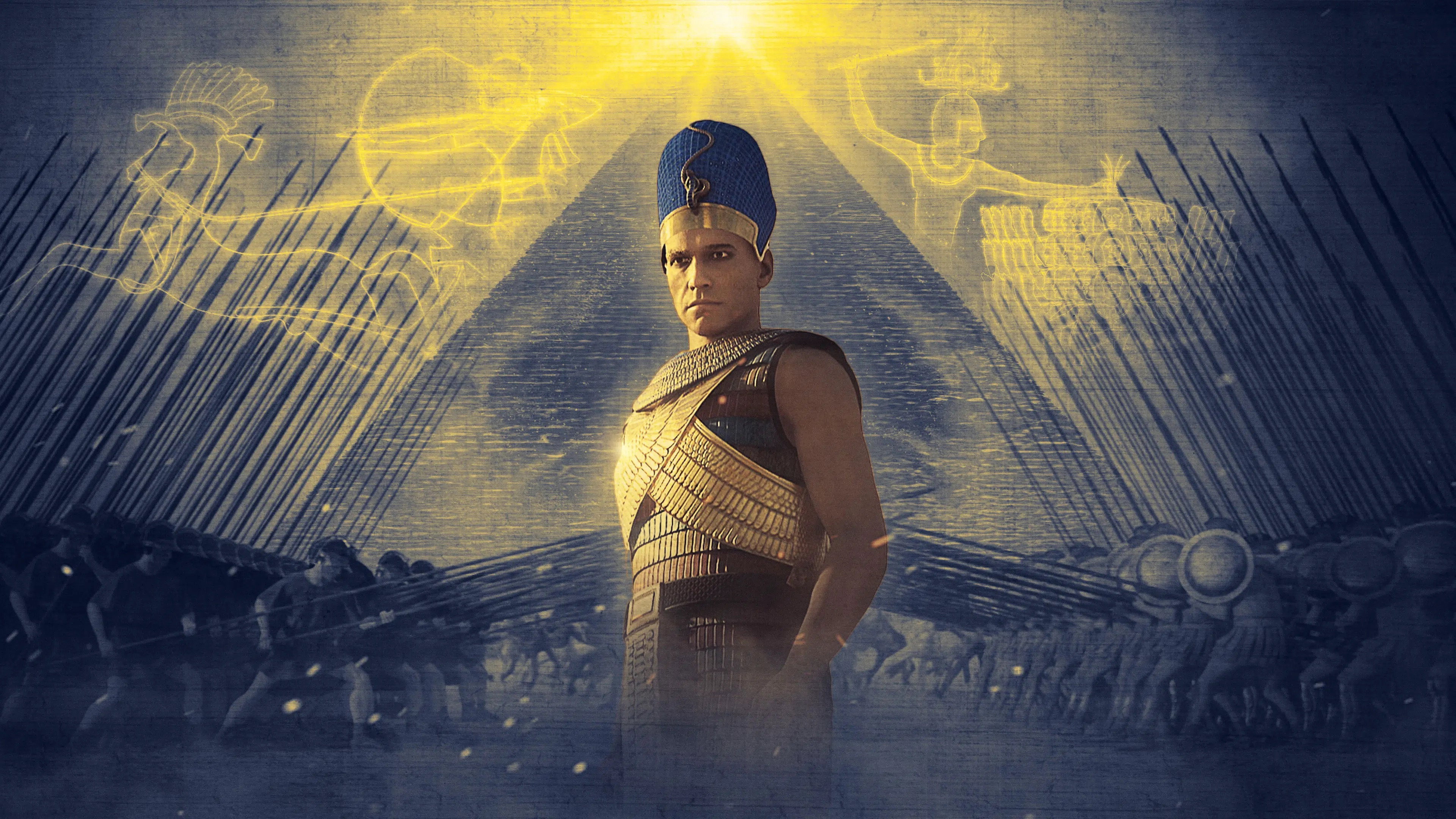
Each episode explores a decisive clash that forged pharaonic power and sparked cultural exchanges that helped build one of the greatest empires in history.
Social & External
Unknown Role
Decisive Battles was a television show on the History Channel that depicted historic battles. It ran for thirteen episodes in mid-2004. The show used the game engine from Rome: Total War to present 3-D versions of the battles. The show was hosted by Matthew Settle, who usually traveled to the sites of the battle. Reruns of the show air on the History International channel and the Military History channel.
Alastair Sooke tells the story of Ancient Egyptian art through 30 extraordinary masterpieces.
Major factual drama telling the story of history's greatest maritime evacuation, after the World War II Battle of Dunkirk in May and June 1940.
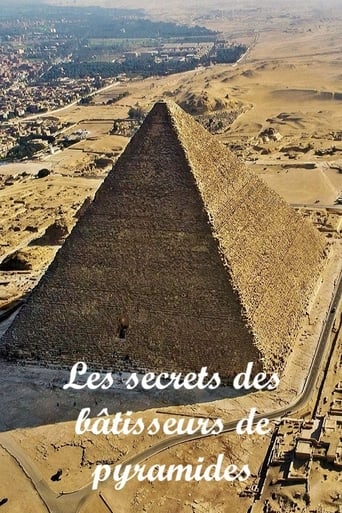
Pyramid aka Building the Great Pyramid is a 2002 BBC Television documentary film which tells the story of the building of the Great Pyramid at Giza through the commentary of the fictional builder, Nakht.
Les Grandes Batailles is a series of historical television programs by Daniel Costelle, Jean-Louis Guillaud, and Henri de Turenne, broadcast on French television in the 1960s and 1970s, depicting the major battles of World War II, as well as the Nuremberg Trials. The project for the series actually began with an official government commission for a program on the Battle of Verdun in 1966. Ten other programs about World War II followed. The writers and producers of the series were Henri de Turenne and Jean-Louis Guillaud, both journalists. They entrusted the production of the series to the young director Daniel Costelle.
Three soldiers who met while each was serving a different partition of Poland form a friendship that lasts after their homeland regains independence.
Professor Alice Roberts gets exclusive access to some of the most recently uncovered archaeology in Egypt as she travels the country by train.
The adventures of Ragnar Lothbrok, the greatest hero of his age. The series tells the sagas of Ragnar's band of Viking brothers and his family, as he rises to become King of the Viking tribes. As well as being a fearless warrior, Ragnar embodies the Norse traditions of devotion to the gods. Legend has it that he was a direct descendant of Odin, the god of war and warriors.
Cleopatra, the famed Egyptian Queen born in 69 B.C., is shown to have been brought by Roman ruler Julius Caesar at age 18. Caesar becomes sexually obsessed by the 18 year old queen, beds her, and eventually has a son by her. However, his Roman followers and his wife are not pleased by the union. In fact, as Caesar has only a daughter by his wife, he had picked Octavian as his successor.
I went backpacking around Egypt & Jordan for one month by myself. Egypt & Jordan are undoubtedly on most people's travel bucket lists, but I've always had the impression that the majority of people travel there on an organised tour. So I wanted to give it a go by myself and see what it was like booking everything on the go, treating it like a normal backpacking trip.
The history of Rome is a 1,000-year-long epic, filled with murder, ambition, betrayal and greed and encompassing such legendary characters as Rome’s Iron Age founders Romulus and Remus and its greatest general Julius Caesar. Larry is accompanied by some of Europe and America’s foremost classical experts who reveal the atmosphere of intrigue, conflict and violence at the places where the saga unfolded.
Forbidden love blossoms in the city of Pompeii, which until the eruption of volcano Vesuvius in 79 AD, is one of the empire's most powerful cities.
Twenty year-old Julius Caesar flees Rome for his life during the reign of Sulla but through skill and ambition rises four decades later to become Rome's supreme dictator.
Turning points in ancient Roman history and some of the Empire's greatest stories are brought to life in this drama documentary series.
Culloden is a 1964 docudrama written and directed by Peter Watkins for BBC TV. It portrays the 1746 Battle of Culloden that resulted in the British Army's destruction of the Scottish Jacobite uprising and, in the words of the narrator, "tore apart forever the clan system of the Scottish Highlands". Described in its opening credits as "an account of one of the most mishandled and brutal battles ever fought in Britain", Culloden was hailed as a breakthrough for its cinematography as well as its use of non-professional actors and its presentation of an historical event in the style of modern TV war reporting. The film was based on John Prebble's study of the battle.
The Caesars is a British television series produced by Granada Television for the ITV network in 1968. Made in black-and-white and written and produced by Philip Mackie, it covered similar dramatic territory to the later BBC adaptation of I, Claudius, dealing with the lives of the early emperors of Ancient Rome, but differed in its less sensationalist depictions of historical characters and their motives.
Professor Mary Beard looks beyond the stories of emperors, armies, guts and gore to meet the everyday people at the heart of Ancient Rome's vast empire.
Tells the stories of three little-known but significant Egyptian queens, revealing how they became the standard-bearers for their sex long before the modern era.