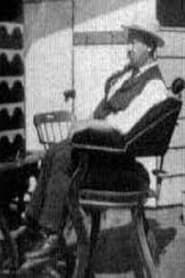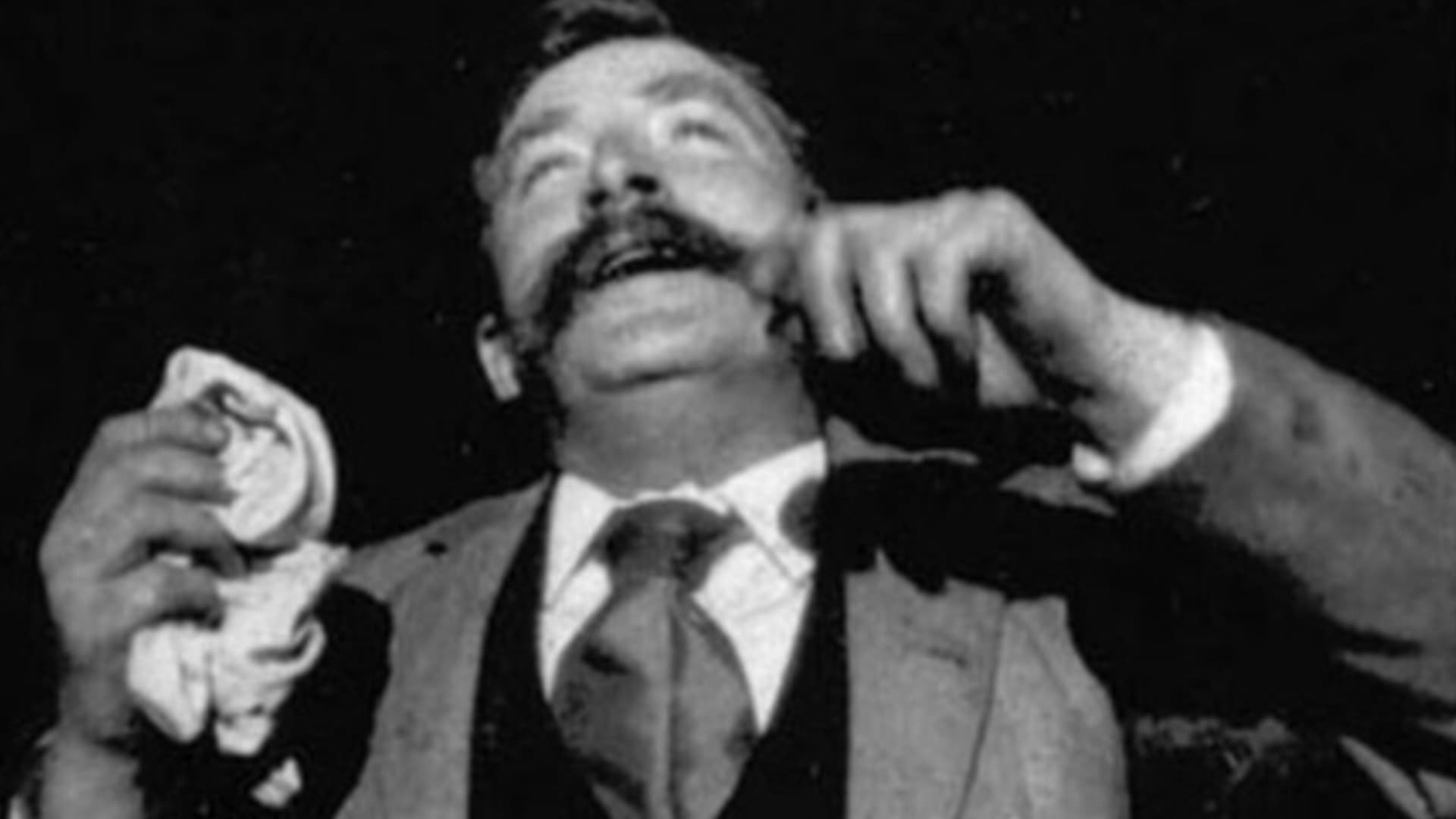
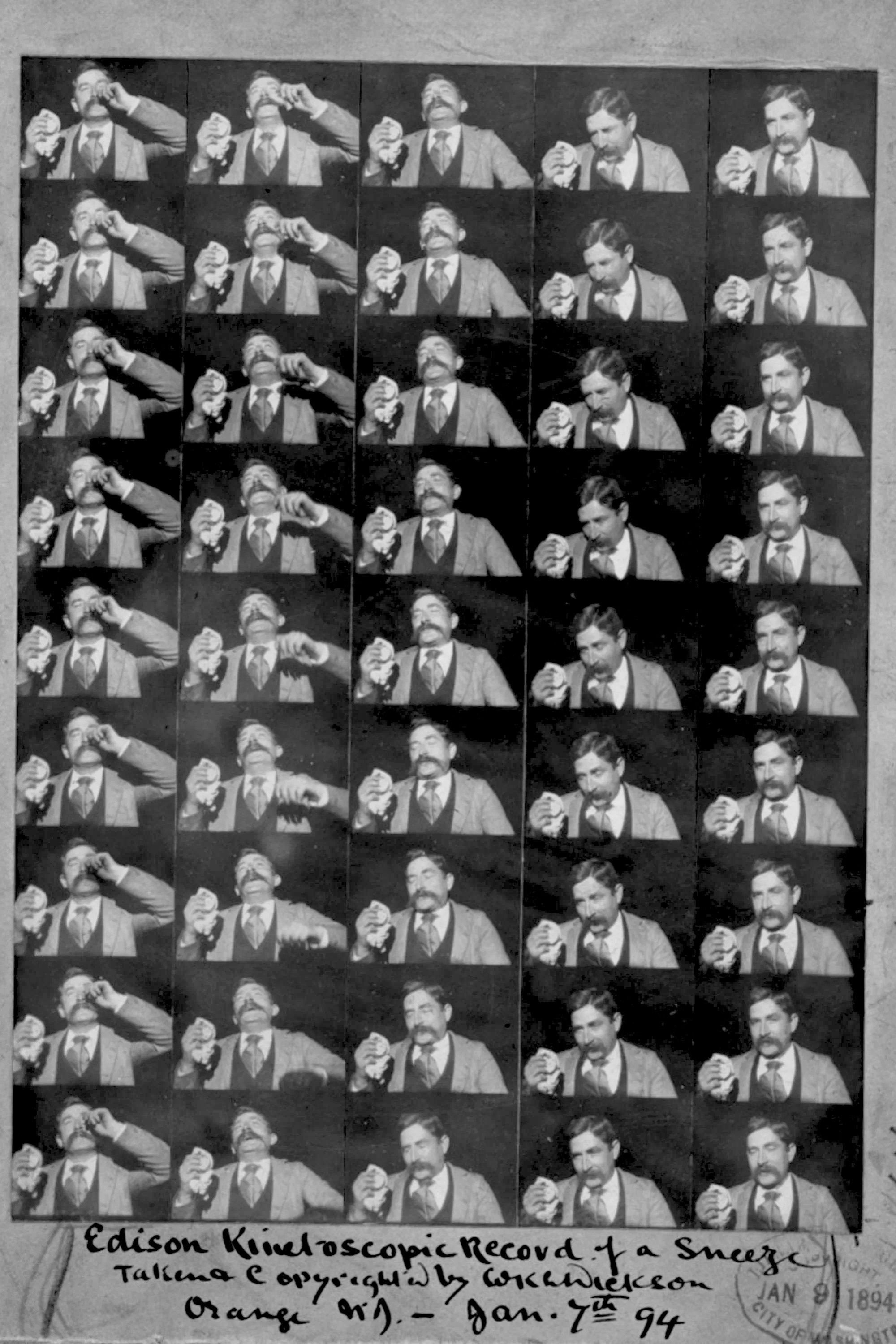
A man (Thomas Edison's assistant) takes a pinch of snuff and sneezes. This is one of the earliest Thomas Edison films and was the second motion picture to be copyrighted in the United States.
Social & External
Sneezing Man
In 1968 Herz Frank made Without Legends (Bez leģendām) at the Kuibishev studios, together with Aloizs Brenčs and Aleksandr Sazhin.
One of the highest achievements of the new wave of Kirghiz cinema, which emerged in the mid-1960s. This story of a boy building sandcastles on the shores of the Issyk-Kul Lake becomes a documentary parable on the tensions between an artist and society.
This poetic core in youngsters is also touched in Stanukina's less known Your very personal poetry (Свои, совсем особые стихи, 1982), a wonderful film about a poetry class. It is here that one recalls Kogan's admiration of Lyalya's emotional documentary skills. And it is here that one recalls Kosakovsky's depiction of Lyalya as a person of extraordinarily prosperous feelings, sensitive and energetic, childish and female, shrill and quiet. The young poets are marvellously sneaky, respectfully adoring and creatively playing with - maybe even deconstructing - "Aleksandr Sergeevich", Mr. Pushkin, Russia's exclusive trade mark of high culture and literature.
Movie-lesson observations in the classroom teacher of the Leningrad Conservatory honored artist of the RSFSR N..The Serval. Forty physical steps from the Leningrad Conservatory to the Kirov (Mariinsky) theatre - the way of the artist, overcome, physically and emotionally exhausting rehearsals. Great camera work.
A film about a simple village woman Zinaida Zvereva who married a disabled frontline soldier and lay all the hardships of living together onto herself
The film tells a story of Kosynka, a pregnant mare, and her owner, a battered old man. Kosynka leads the “horse walker,” designed to train young horse to walk steadily and at a pace. Set to a soundtrack of Bach and Russian folk music, this film is another example of a parable-like narrative, which became more popular in Soviet documentary in the early 1970s.
This is a documentary film on the romantic and decadent atmosphere of Venice at the end of the 18th century. A vigorous comment by Jean Cocteau tells us of the sick souls and the sorrows of literary characters and musicians who lived the dream of this city. It is the Venice of Lord Byron, Alfred de Musset, George Sand, d'Annunzio; a Venice made of precious images, palaces reflected in the water, mysterious moonlights, little squares where unhappy lovers wander under the music of Richard Wagner.
Made on a wind-up Bolex camera, The Sound of Seeing announced the arrival of 21-year-old filmmaker Tony Williams. Based around a painter and a composer wandering the city (and beyond), the film meshes music and imagery to show the duo taking inspiration from their surroundings.
I started from the assumption that the discourse about the hospital could be the objective pretext for communication between two people, the link that allows them to continue writing to each other, the intermediary between two desires.
Struggling with fear, tension, and anxiety amid the early stages of the COVID-19 pandemic, a high school student reflects upon what really matters.
Behind the scenes of the animated short film.
Can you be a virgin, gay and into girls? This film is an intimate study of six homosexual boys. In the changing room some of the uncertainties and embarrassment's of youth emerge, such as the tale of hunky Peter, romance and the naff value of losing your virginity during a Disney movie.
Finland’s first nature documentary. The filmmakers’ expedition leads them all the way to the Åland Islands and the Karelian Isthmus.
In order to determine the ability to drive after drinking alcohol, three men take various tests when sober and when drunk.
A group of people are standing along the platform of a railway station in La Ciotat, waiting for a train. One is seen coming, at some distance, and eventually stops at the platform. Doors of the railway-cars open and attendants help passengers off and on. Popular legend has it that, when this film was shown, the first-night audience fled the café in terror, fearing being run over by the "approaching" train. This legend has since been identified as promotional embellishment, though there is evidence to suggest that people were astounded at the capabilities of the Lumières' cinématographe.
A day in the city of Berlin, which experienced an industrial boom in the 1920s, and still provides an insight into the living and working conditions at that time. Germany had just recovered a little from the worst consequences of the First World War, the great economic crisis was still a few years away and Hitler was not yet an issue at the time.
Immersion in Mustapha's mind during the lockdown period.
A short black-and-white silent documentary film featuring one dog jumping through hoops and another dancing in a costume, which was considered lost until footage from an 1896 Fairground Programme was identified as being from this film.
"All sounds travel in waves much the same as ripples in water." Educational film produced by Bray Studios New York, which was the dominant animation studio based in the United States in the years surrounding World War I.
Short film documenting the San Francisco Youth for Service program.
In a long, diaphanous skirt, held out by her hands with arms extended, Broadway dancer Annabelle Moore performs. Her dance emphasizes the movement of the flowing cloth. She moves to her right and left across an unadorned stage. Many of the prints were distributed in hand-tinted color.
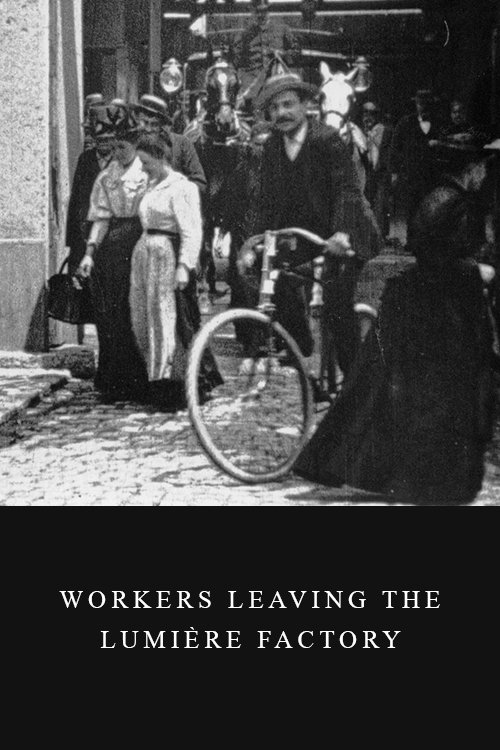
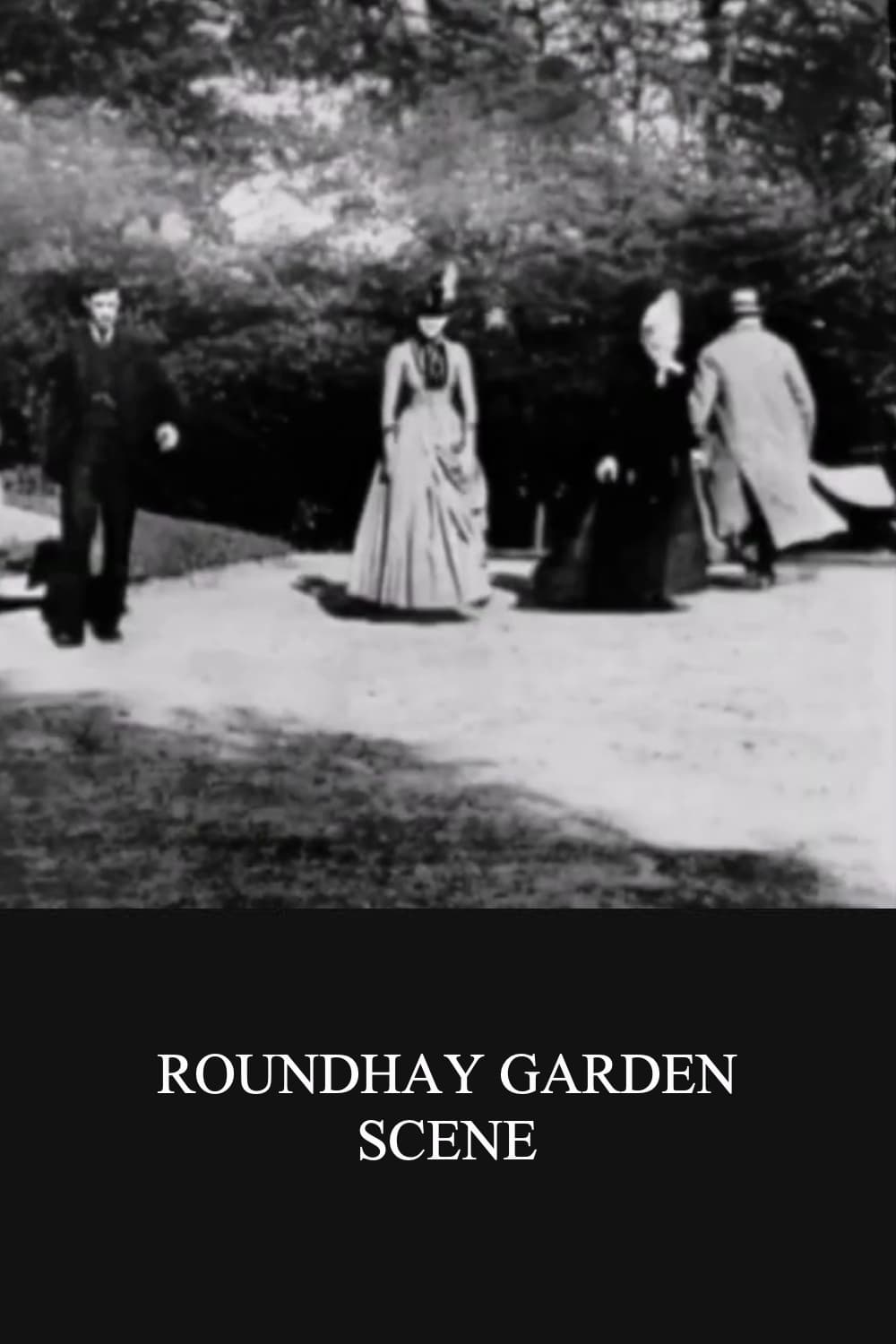
Working men and women leave through the main gate of the Lumière factory in Lyon, France. Filmed on 22 March 1895, it is often referred to as the first real motion picture ever made, although Louis Le Prince's 1888 Roundhay Garden Scene pre-dated it by seven years. Three separate versions of this film exist, which differ from one another in numerous ways. The first version features a carriage drawn by one horse, while in the second version the carriage is drawn by two horses, and there is no carriage at all in the third version. The clothing style is also different between the three versions, demonstrating the different seasons in which each was filmed. This film was made in the 35 mm format with an aspect ratio of 1.33:1, and at a speed of 16 frames per second. At that rate, the 17 meters of film length provided a duration of 46 seconds, holding a total of 800 frames.
The film consists of a series of animations on a beach containing two beach huts and a diving board. Two characters play at diving into the water from the diving board and then appear on the beach. The woman begins to play with a small dog and is then joined by a gentleman. The two play around on the beach before getting changed into bathing costumes and going into the water. They bob up and down in the water before swimming out of the scene. Once the couple have gone a man sails out in a boat.
William K.L. Dickson plays the violin while two men dance. This is the oldest surviving sound film where sound is recorded on the phonograph.
Chronophotograph record of a ball falling through a soap bubble.
Lasting for roughly 50 seconds, it shows the goodbyes of many passersby - first Europeans, then Palestinian Arabs, then Palestinian Jews - as a train leaves Jerusalem.
Ava, an award-winning chef at a big-city restaurant, has lost her spark. Her boss sends her out to find herself to save her menu and her job. She returns home and finds little to inspire her, but when she reunites with her childhood friend Logan, Ava has to get her head out of the clouds and her foot out of her mouth to rediscover her passion for food.
A former alcoholic returns home after ten years in prison for the murder of her husband. As her recollection of the murder returns, things take a different turn.
A father, a mother and a baby are sitting at a table, on a patio outside. Dad is feeding Baby her lunch, while Mum is serving tea.
During a failed art heist, the Djinn is once again liberated. This time, to complete the 1001 wishes that he needs before the final 3, he lets himself go to prison, where he starts his evil reign twisting the hopes of the prisoners. Meanwhile, the woman who set him free accidentally, Morgana, tries to find a way to stop him, aided by a young priest.
A few years ago, a mysterious serial-killer caused panic on Crippen High School. The killer was never caught. A movie company, Cosmic Pictures, has decided to make a feature movie about these events - on location, at the now abandoned school. Since members of cast and crew disappear without a trace, it seems as if history is repeating itself...
In answer to an orphan boy's prayers, the divine Lord Krishna comes to Earth, befriends the boy, and helps him find a loving family.
Marnie puts her magic on the line to get several Halloweentown teenagers transferred to her high school in the mortal world. But soon, Marnie and her new friends are in trouble and out of luck when the evil Knight Of The Iron Dagger appears. He's determined to destroy all things magical, and it's up to Marnie to save her high school, the human world and her magic.
Fifteen years after his father's experiments with matter transmission fail, Philippe Delambre and his uncle François attempt to create a matter transmission device on their own. However, their experiments have disastrous results, turning Philippe into a horrible half-man, half-fly creature.
When the Spirit World is flooded due to an unusual rainfall which overflows the River Sanzu (aka the River Styx), Lord Koenma senses an extremely powerful enemy. He entrusts Death God Botan, to deliver to Spirit Detective Yusuke, a mysterious item which must be protected from the invading enemy. However, by the time Botan finds Yusuke, she's too weak to explain the situation. Yusuke and his friends are left in the dark about the new enemy, but not for long. Soon it is a battle for Earth between mere Spirit Detectives and the almighty king of the Netherworld.
The stand-alone pilot OVA which was shown as part of the "Jump Super Anime Tour" of 1998. Shortly before the TV series, a summary is presented of the story of Gon who wants to become a hunter and the friends he makes in the process.
As novice detectives, Bud and Lou come face to face with the Invisible Man.
After the older DigiDestined are abducted by the mysterious Kokomon, the next generation of kids team up with American DigiDestined Willis to rescue them - only to discover that their enigmatic enemy has an unexpected connection to their new friend!
The Symphony of Haruhi Suzumiya or The String Performance of Haruhi Suzumiya (涼宮ハルヒの弦奏 Suzumiya Haruhi no Gensou), was an event featuring several songs and background music used in the The Melancholy of Haruhi Suzumiya anime. All of the songs are performed by the Tokyo Philharmonic Orchestra, and conducted by Phillip Chu, on April 29, 2009.