Social & External
Narrator
A woman returns to the site of her birth, which is now a funeral home. She drinks a white monster energy drink.
Two elderly sisters share the delicate art of making traditional Hungarian strudel and reveal a deeply personal family story about their mother, who taught them everything they know.
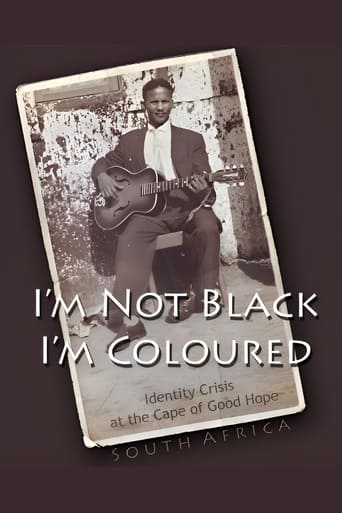
The director explores the birth origins of actress Merle Oberon, traveling to Tasmania and India in search of the truth, but her quest ultimately results in probably more questions than it answers.
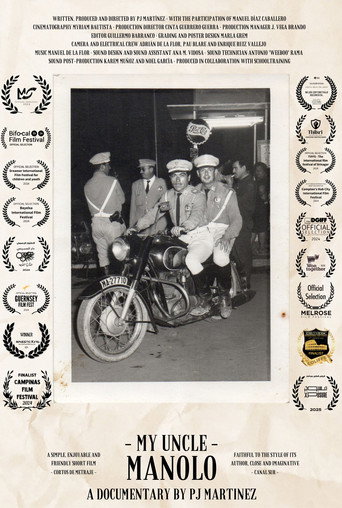
Galician writer Xavier Queipo is getting ready to move back to his homeland after more than 30 years of living in Brussels. He empties his house and puts his memories in boxes the removal company loads onto their truck to take them to Spain. Another Galician man, the filmmaker Hugo Amoedo, who is based in Brussels, too, wonders whether and when he’ll be back in his homeland. In the meantime, he teaches his son to ride a bike, wonders, dreams, struggles to unravel ideas for films, and argues with the clerks of the Brussels post.
The 6 Guarani villages of Jaraguá, in São Paulo, fight for land rights, for human rights and for the preservation of nature. They suffer from the proximity to the city, which brings lack of resources, pollution of rivers and springs, racism, police violence, fires, lack of infrastructure and sanitation, among others. Unable to live like their ancestors, their millenary culture is lost as it merges with the urban culture.
ADRIFT- People of a Lesser God is the story of an incredible odyssey made by several-times Pulitzer Prize-nominated undercover reporter Dominique C. Mollard. In this gripping story, Mollard sails with 38 African migrants, among them a five-month-old baby, out of West Africa on a quest to reach the golden shores of Europe. All aboard are packed together like sardines in a leaky fishing canoe as they set off under full moon on their harrowing journey. ADRIFT-People of a Lesser God captures the struggle of these desperate migrants as they brave their way across the cold Atlantic, risking their lives in search for a better future. —Ziad H. Hamzeh
A cellar. A forgotten amphora. The ashes of a woman. Her granddaughter, daughter-in-law and son characterise her, entwining their memories and experiences. They reflect about filial love, gender and isolation through her overbearing nature.
Cheikh Djemaï looks back on the genesis of Gillo Pontecorvo’s feature film, The Battle of Algiers (1965). Through archive images, extracts from the film and interviews with personalities, the filmmaker retraces the journey of a major work - from the events of the Algiers Casbah (1956-1957) to the presentation of the Lion of 'Or causing the anger of the French delegation in Venice - which left its mark as much in the history of cinema as in that of Algeria.
1962, at the end of the Algerian War, Algerian independence activists are released from Rennes prison. For one night, filmmaker Yann Le Masson films them. They tell him their vision for the future of Algeria and the place women must occupy in the new society to be built. Fifty years later, with the soundtrack missing, Raphaël Pillosio sets out to find these women. Two deaf people set about lip-reading the women filmed by Yann Le Masson, revealing snatches of sentences, words cut short by the camera's shifts. An investigative film in which the few activists still alive discover their old testimonies and tell us their silent story. The reconstruction of the lost soundtrack will remain in suspense; no happy ending will come to absorb the absence, to cancel the ferocious operation of time. An essay film about cinema that depicts their disappearance, and forever keeps them alive.
A film that delves into director Jean Carlomusto's family history by trying to find out if the rumors about her grandmother's death -- trying to rid herself of an unwanted pregnancy in 1939 -- are true.
The film consists of video tapes made by the filmmaker’s father documenting daily scenes of family life, family celebrations, and holidays over the course of fifteen years. The tapes are a mixture of the personal and the political – the father was politically engaged in the revolutionary movement that brought Hugo Chávez to power. The family’s life becomes a backdrop for political and economic developments in Venezuela and their impact on the lives of ordinary citizens.
The pupils of about fifteen secondary schools in the suburbs of Paris react to the projection of two short films taken from the series "No More Lies ! 12 perspectives on everyday racism". Their comments, questions and reactions are of course focused on the subject of racism, but they also take a stand about what it means to have two cultural identities. Is it enough to be born in France in order to feel French ? What is their vision of a society obsessed with the idea of integration? What do they expect of the future ? With their questions and their protests, they often put their finger on the heart of the issues at stake. Beyond fiction, we discover their reality...
Illustrated with archival photographs, animations and live action, this film explores the history and historical and spiritual heritage of Emir Abd El-Kader. Algerian leader of the 19th century, was admired by Abraham Lincoln and celebrated to this day by the Red Cross as a great humanitarian. Emir Abd el-Kader, the man who challenged the French armies from 1832 to 1847 before creating the bases of a real Algerian state, is today considered by independent Algeria as one of the most outstanding figures. of its history. The nobility of his attitude after his capture and the very effective protection he brought to the Christians of Damascus at the end of his life also earned him great prestige among his former adversaries. A documentary told in dialectal Arabic by the voice of Amazigh Kateb.
At the edge of the Yangtze River, not far from the Three Gorges Dam, young men and women take up employment on a cruise ship, where they confront rising waters and a radically changing China.
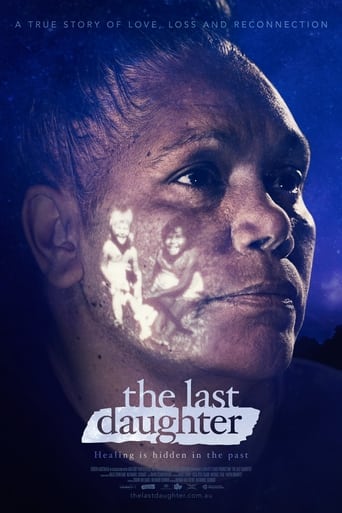
Filmmaker and educator Janine Windolph ventures from Saskatchewan to Quebec with her two teens and younger sister, tracing their familial origins to the Cree First Nation of Waswanipi. Against the scenic backdrop of these Traditional Lands, Elders offer newfound interdependence and hands-on learning, transforming this humble visit into a sensory-filled expression of reclamation and resilience. Our Maternal Home lovingly establishes a heart-centred form of resistance to confront and heal from the generational impacts of cultural disconnection, making space for what comes next.
“La Voix du Peuple,” composed of archival photographs by René Vauthier and others, exposes the root causes of the armed conflict of the Algerian resistance. Participating in a war of real images against French colonial propaganda, these images aimed to show the images that the occupier had censored or distorted, by showing the extortions of the French occupation army: torture, arrests and arbitrary executions, napalm bombings, roundabout fires, erasing entire villages from the map, etc. This is what the French media described as a “pacification campaign”.
An account of the victims of the Sierra Leone Civil War and depicts the most brutal period with the Revolutionary United Front (RUF) rebels capturing the capital city on January 1999.