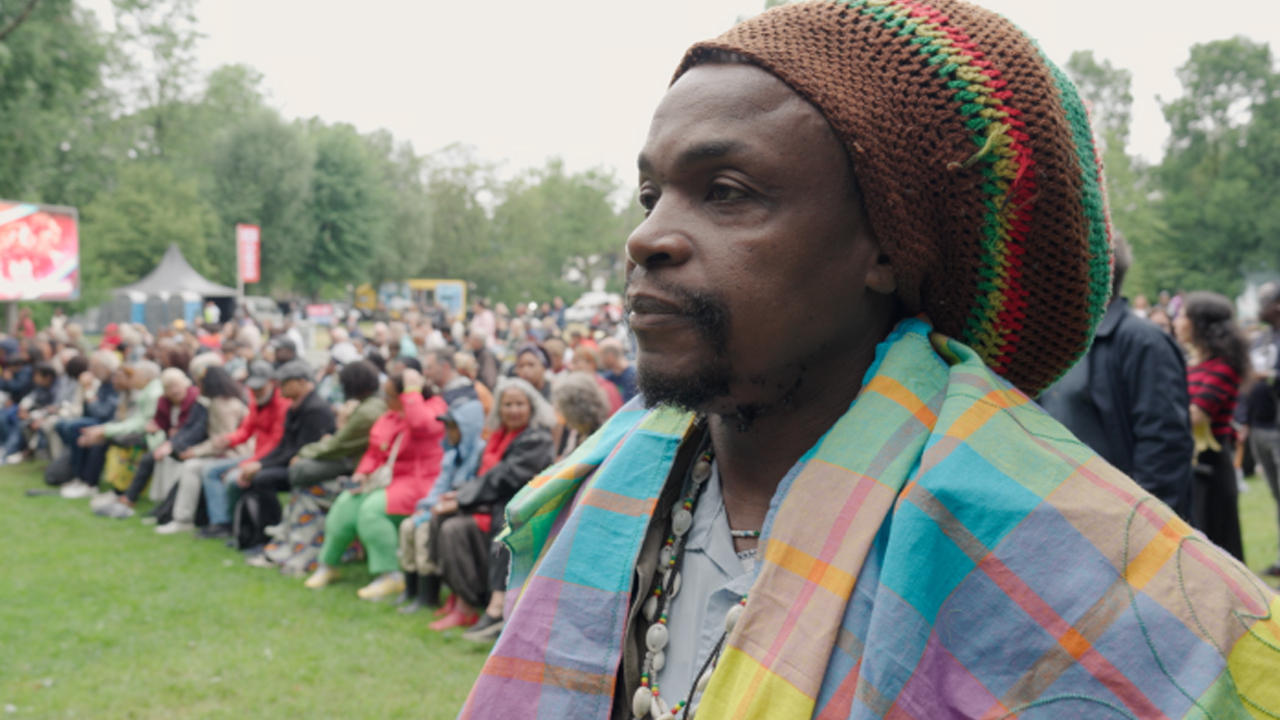
Frans Bromet goes in search of his family history and discovers that Hermanus Bromet was a well-known slave trader in Suriname. Should he feel guilty for what his ancestor did? How do you deal with a burdened family past?
Social & External
Epigenetics and psychogenealogy through a VERY personal experience.
Alex, a wealthy and handsome man living a meaningless life, meets Tika, a beautiful and refined woman from a different background. He falls in love with her and pretend to learn Batik at Tika's mother's gallery to win her heart.
Paul Grignon's 47-minute animated presentation of "Money as Debt" tells in very simple and effective graphic terms what money is and how it is being created
A fascinating account of the presidency of Andrew Jackson, who was both one of America's great presidents and a borderline tyrant. The seventh president shook up the glossy world of Washington, DC with his "common-man" methods and ideals, but also oversaw one of the most controversial events in American history: the forced removal of Indian tribes, including the Cherokees, from their homes.
This film sheds light on the little-known history of plantations and the enslaved in North Florida. It seeks to advance a sense of place and identity for thousands of African-Americans by exploring the invisible history of slavery in Leon County.
Two elderly sisters share the delicate art of making traditional Hungarian strudel and reveal a deeply personal family story about their mother, who taught them everything they know.
Slavery has always been part of Sudan's history, but in recent years it has become a new means in Sudanese warfare. Focuses on the moral dilemma aid organisations are faced with in Southern Sudan. For more then 17 years Africa's largest country is crippled by civil war between the Islamic North and the Christian-animistic South. Over 2 million people died during this conflict. One of its horrible consequences is the revival of slavery. Slavery has always been part of Sudan's history, but in recent years it has become a new means in Sudanese warfare.
Heroin anti-drug educational film
The film tells the story of 25-year-old Urmila Chaudary from Nepal. At the age of six she was sold by her family and was forced to work as a slave under appalling conditions for 12 years. Her dream is to end child slavery in Nepal. To this end she fights today as a freedom activist. A film about the quest for justice with a strength that gives courage and hope.
A woman returns to the site of her birth, which is now a funeral home. She drinks a white monster energy drink.
A cellar. A forgotten amphora. The ashes of a woman. Her granddaughter, daughter-in-law and son characterise her, entwining their memories and experiences. They reflect about filial love, gender and isolation through her overbearing nature.
Eliza Dushku takes on her homeland of Albania.
Filmmaker and educator Janine Windolph ventures from Saskatchewan to Quebec with her two teens and younger sister, tracing their familial origins to the Cree First Nation of Waswanipi. Against the scenic backdrop of these Traditional Lands, Elders offer newfound interdependence and hands-on learning, transforming this humble visit into a sensory-filled expression of reclamation and resilience. Our Maternal Home lovingly establishes a heart-centred form of resistance to confront and heal from the generational impacts of cultural disconnection, making space for what comes next.
At the edge of the Yangtze River, not far from the Three Gorges Dam, young men and women take up employment on a cruise ship, where they confront rising waters and a radically changing China.
This is the true story of Fetim Salam, a Saharawi refugee falsely portrayed as a slave in the Australian documentary 'Stolen'. Australian filmmakers, Violeta Ayala and Daniel Fallshaw, travel to the Saharawi refugee camps in Tindouf, Algeria in 2007 and claim to discover 20,000 slaves in the camps run by the independence movement Polisario Front. Refugees are outraged for being portrayed as slaves, and humanitarian aid workers are incredulous about these allegations as they know the camps intimately. Filmmaker Carlos Gonzalez retraces their steps in search of the truth and finds a web of lies, misinformation and Moroccan operatives reshaping the truth.
A documentary filmmaker travels to Bolivia to learn more about his father and his family's history.
INFINITY minus Infinity draws on several inspirations: the modernist verse of the Jamaican poet Una Marson, the alluvial invocations of the Martinican philosopher and poet Édouard Glissant, the black feminist poetics of the Brazilian philosopher Denise Ferreira da Silva, and the racial formation of geology theorised by British geographer Kathryn Yusoff amongst others in order to envision a black feminist cosmos animated by the principles of mathematical nihilism.