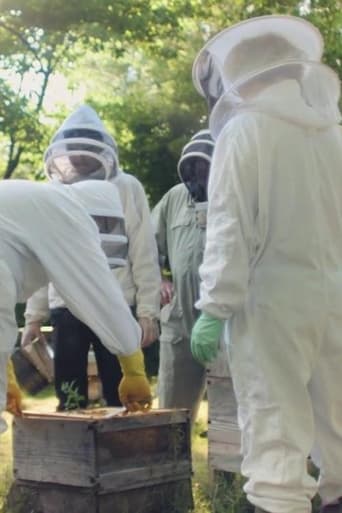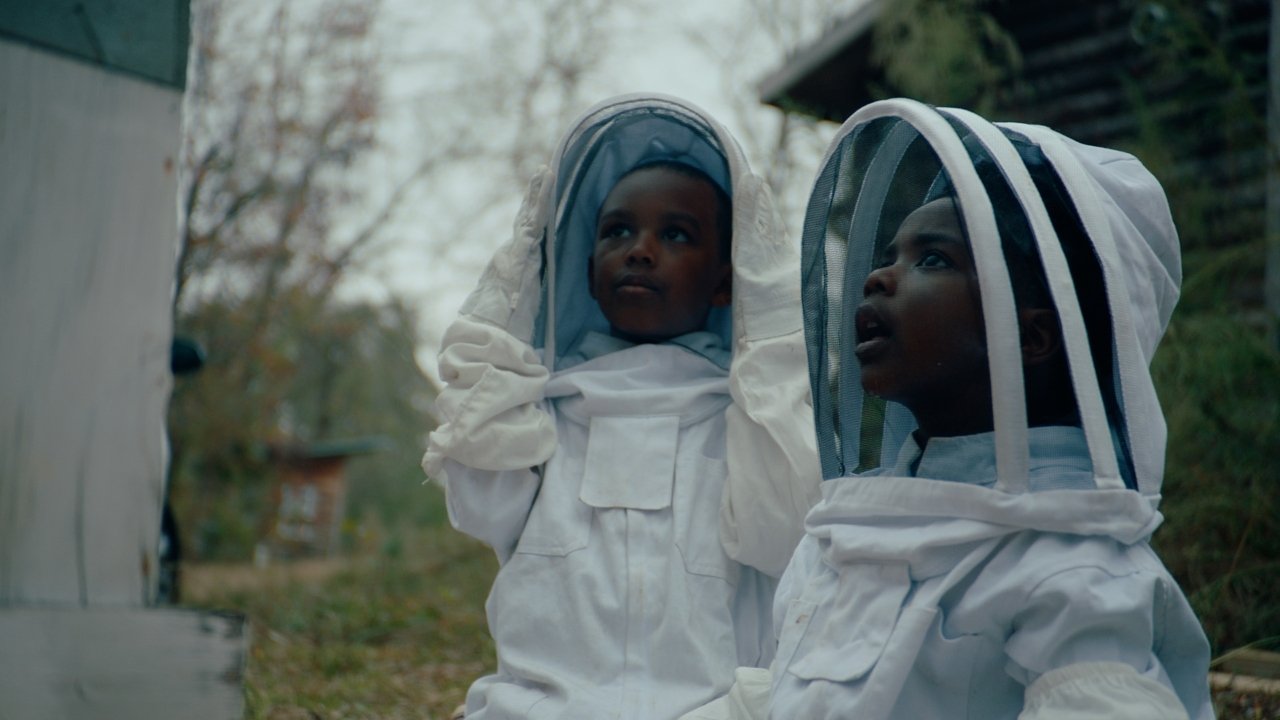
Traces a family’s journey toward freedom, nurturing their bees and their young sons amid Georgia’s shifting seasons while they learn to care for the land that sustains them.
Social & External
The documentary tells the story of Uschi, a farmer living free and recluded in the bavarian alps. Shot in epic black and white pictures, Still follows Uschi's life over a ten year period. From an untroubled summer of making cheese through pregnancy and the uncertain future of the parental farm, Matti Bauer portrays Uschi's struggle to keep alive the dream of a way of life that has become rather untypical in this day and age.
Set in the sparsely populated lobster fishing villages of southern Nova Scotia, Plains is a cinema vérité approach to documenting the curious lives of Jon and Cat, a young couple who are developing politically left-leaning virtual reality video games. Against the busy backdrop of their art practice, we sit in on their quiet rural life, which, in its proximity to nature and the vast green and oceanic spaces that surround, echoes the romanticism of a simpler time. As the decaying world of physical labour and the mechanical industry faces up to an expanding digital empire, Jon gradually retreats into the alternative realities of his own design.
Exploring the reports of a spectral mansion on the outskirts of Rougham, a village in the Eastern county of Suffolk. The film delves into local folklore surrounding these sightings as villagers recount their haunting experiences against the desolate backdrop of rural Britain. It reflects on themes of memory, place, and the fading tradition of oral storytelling, evoking the eerie atmosphere of a fractured England and our growing disconnect from the natural environment.
Routine Pleasures, Slow Cinema.
Director Hannah Livingston spends 6 months tracking two of America's most radical Christian hate groups - a notorious pastor from Arizona and a network of extremist preachers.
Jawaher was a farmer with her father when she was young, and a beekeeper in old age. Beekeeping to her is a way to overcome life's difficulties. Despite the difficulties she's facing; the economic situation, climate change, and wars, she's still sticking to her source of livelihood to save a living.
Leandre, 20, dreams of having a child with Juliette, with whom he has been in a relationship for several months. This summer will be an opportunity for him to question his ability to become a father and to reflect on himself.
A short documentary about a local beekeeping business in Macclesfield. Paul talks about life as a beekeeper and why he is so passionate about it.
Anthropocene is a part of video trilogy – History of Impossible Destiny – which focuses on the fate of the species UN declared the most important for the survival of Earth – the honey bee (Apis mellifera). By documenting beekeeping activities Makela reveals how intrinsically anthropocentric our attitudes are, and how this affects the process of subjucating the honey bee into a condition of exploitable natural resource. Thru a sensitive, intimate and prolonged observation Makela discovers surprising behavior inside and outside the hive, which she offers as a set of dialogues that bring humor, poetry, reflection and an insight into the fantastic dimension of this species.
Argentine filmmaker Gerardo Vallejo, exiled in Spain, visits the Salamanca village of Cespedosa de Tormes, where his grandfather was born, and reconstructs the memories of his time with the locals.
A group of educators led by Fernand Deligny are working to create contact with autistic children in a hamlet of the Cevennes.
Edeltraut Hertel - a midwife caught between two worlds. She has been working as a midwife in a small village near Chemnitz for almost 20 years, supporting expectant mothers before, during and after the birth of their offspring. However, working as a midwife brings with it social problems such as a decline in birth rates and migration from the provinces. Competition for babies between birthing centers has become fierce, particularly in financial terms. Obstetrics in Tanzania, Africa, Edeltraud's second place of work, is completely different. Here, the midwife not only delivers babies, she also trains successors, carries out educational and development work and struggles with the country's cultural and social problems.
Takes us to locations all around the US and shows us the heavy toll that modern technology is having on humans and the earth. The visual tone poem contains neither dialogue nor a vocalized narration: its tone is set by the juxtaposition of images and the exceptional music by Philip Glass.
The meaty saga of Burger Baron, a rogue fast-food chain with mysterious origins and a cult following, run by a loose network of fiercely independent Arab Canadian immigrants.
ANDRO DADIANI's political performances dissect the oppression by state and church in Georgia and conquer Tbilisi's urban spaces. As a queer, non-binary protest and performance art figure, their identity remains a secret. The danger of open resistance is too great.
When an unidentified hiker is found deceased in the Florida wilderness, authorities release a sketch. Multiple hikers call in claiming to have met the man. There's only one problem – he never told them his name. It would take two years, thousands of devoted internet sleuths, and a miracle of science to identify him, and that's when the trouble really starts.
At the heart of the Moroccan High Atlas mountains, water is a resource in short supply. The village of Tizi N'Oucheg has undergone a transformation thanks to Rachid Mandili, who is well-aware that the development of his village depends on access to clean water and on his strong leadership of this project. Mandili rallies all the villagers together and calls upon the knowledge of French and Moroccan scientists to tap water sources, to purify, and reuse waste water for irrigation. The documentary highlights the Berbers' community ties and ingenuity in their dream of independently managing their village water resources. It equally paints a portrait of a man whose initiative and resourcefulness has opened Tizi N'Oucheg up to modernity while still conserving its cultural heritage. Tizi's example presents some of the problems of water access in semi-arid regions and puts forward concrete solutions to these problems.
The story of community in the Deep South that is forced to deal with the struggles of ignorance, hypocrisy and oppression.
“Olive” is a short documentary that follows Olive Hagemeier, an energetic woman, on her daily routine of salvaging, repackaging and redistributing food, and occasional other types of “waste”, across Atlanta, GA. Presented in a quiet observational style, this film is both a character study of a committed and enigmatic volunteer, as well as an ethnographic work that places the audience in the heart of a decentralized, volunteer-run mutual aid network in a “post-COVID” American city.
Mothers and fathers of gay, lesbian, and trans children from Georgia, Moldova, Russia, and Ukraine travel to Berlin to walk together in the Pride parade. Living under one roof, they prepare for the march — painting signs, cooking borscht, and reflecting on how their relationships with their queer children have evolved over the years.