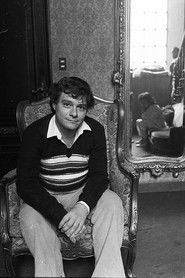
Documentary about the Venezuelan poet Armando Rojas Guardia.
Social & External
Self
Sir John Betjeman visits and explains the architecture of various churches in the Diocese of Norwich. Among those visited: Sandringham church on the Queen's private estate, the Holy House of Our Lady of Walsingham and Norwich Cathedral.
A short documentary about the rapidly disappearing era of heritage movie palaces and the film going experience once offered within those hallowed walls.
A lost chapter in black British film: extraordinary rushes from a documentary showcasing talented members of the black community.
A biography of the poet W. B. Yeats and his contribution to the Irish independence movement as a Protestant nationalist.
Combining the authenticity of Indigenous writer Rebecca Thomas' narrative, the power of poetry, and stunning animation, "I Place You into the Fire" invites viewers to consider their roles in fostering understanding, compassion and justice.
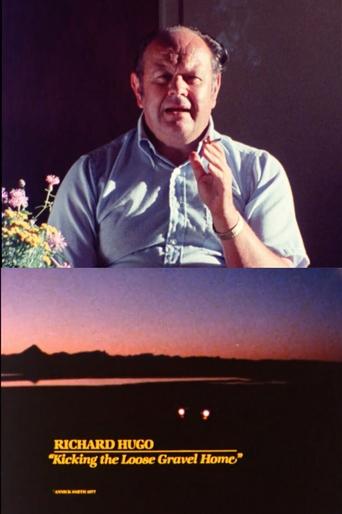
Filmed on location in Montana and Washington State, this 1976 biography of poet and teacher Richard Hugo features readings of some of his most famous poems as well as interviews with his family and friends.
Jean Sénac, born in Béni Saf in Algeria in 1926 and died in Algiers in 1973, is today considered one of the great French writers and poets and the only one of his reputation to have accompanied the Algerian revolution before November 1954. part of all the debates and got involved, very early and with immense enthusiasm, in a work of commitment which ended badly. His poetry, his sexual preferences and his political lyricism work against him: rejected as much by the Pieds Noirs as by the FLN activists then by the power in place in Algiers, Jean Sénac was assassinated in 1973 at his home in Algiers, in circumstances never clarified.
Five gay Black men who are HIV-positive discuss how they are battling the double stigmas surrounding their infection and homosexuality.
After World War II a group of young writers, outsiders and friends who were disillusioned by the pursuit of the American dream met in New York City. Associated through mutual friendships, these cultural dissidents looked for new ways and means to express themselves. Soon their writings found an audience and the American media took notice, dubbing them the Beat Generation. Members of this group included writers Jack Kerouac, William Burroughs, Allen Ginsberg. a trinity that would ultimately influence the works of others during that era, including the "hippie" movement of the '60s. In this 55-minute video narrated by Allen Ginsberg, members of the Beat Generation (including the aforementioned Burroughs, Anne Waldman, Peter Orlovsky, Amiri Baraka, Diane Di Prima, and Timothy Leary) are reunited at Naropa University in Boulder, CO during the late 1970's to share their works and influence a new generation of young American bohemians.
In this portrait film, we meet Inger Christensen in her apartment in Østerbro, Copenhagen, where she tells of her life and work, and reads excerpts from her major works.
A short film, based on a series of poems, about childhood, the break with parental, and war.
Performance and conversation with husband-and-wife poets Donald Hall and Jane Kenyon at a New Jersey festival, in their Wilmot (N.H.) hometown and their Eagle Pond farmhouse.
A theatrical documentary about Hrytsko Chubai, a genius of Ukrainian poetry, a connoisseur of literature, art and music and the brightest representative of Lviv underground culture of late 60s early 70s.
A short documentary on the River Ouse, following it downstream from Lewes to Newhaven, meditating on the surrounding area.
About Jösta Hagelbäck (1945-2009), Swedish film director, writer, poet, musician, actor etc. A human bipolar mixture of genius and madman. Invited to Hollywood, had an artistic hit with the film "Kejsaren/The Emperor" (1979) at the Berlin Film Festival.
Song is a story of the last Finnish rune singer and his pupil, and the comforting power of singing.
This film is dedicated to Mas-Félipe Delavouët, the poet discovered by Lawrence Durrell, who wrote 14,000 verses in Provençal over a period of thirty years, and who died on November 18, 1990. "The sky, history and Mediterranean and Provençal myths are the inexhaustable wellspring of this man rooted down there, near Salon-de-Provence" (J.-D. Pollet). "Mas-Félipe Delavouët wrote five books in Provençal, 14,000 verses. A sort of "Odyssey". Of myths. What is stunning in him is that he always talks of disappearances. Cities, works, men, writings, television, etc., everything has to disappear. In order to be reborn. No pain. A sort of hand-to-hand of man and nature. During the filming, I would simply throw out some words... For example, one time I said "creation" and he said: "creation doesn't exist..., creation is before me..., I can only read creation"; this sentence describes Delavouët perfectly (J.-D. Pollet, 1989 and 1993).