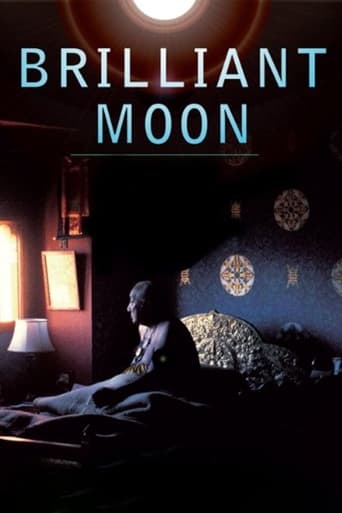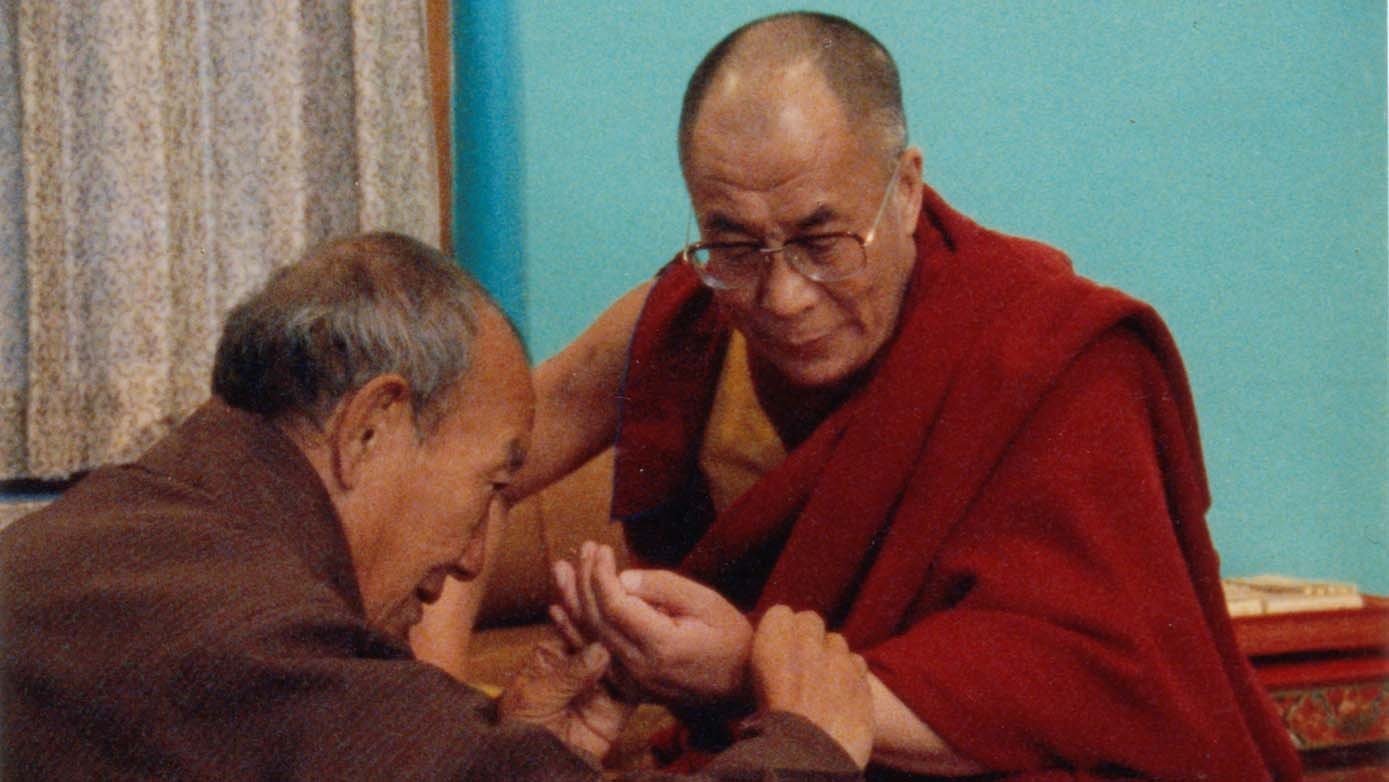
A documentary film about Tibetan traditional medicine.
Social & External
Self
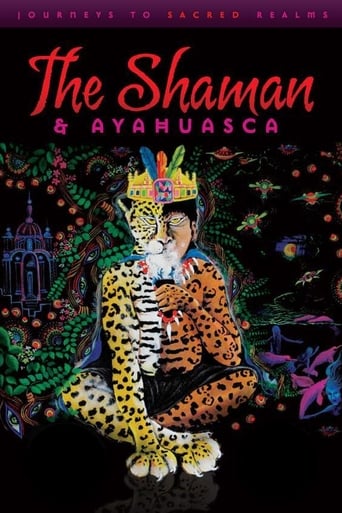
After many years of life marked by PTSD, men and women veterans of the wars in Vietnam, Afghanistan, and Iraq travel to the Peruvian Amazon to participate in shamanic ceremonies to heal their traumas.
The traditional healers in the Swiss and French mountains.
An intimate portrayal of the everyday lives of Carthusian monks of the Grande Chartreuse, high in the French Alps (Chartreuse Mountains). The idea for the film was proposed to the monks in 1984, but the Carthusians said they wanted time to think about it. The Carthusians finally contacted Gröning 16 years later to say they were now willing to permit Gröning to shoot the movie, if he was still interested.
“I am a hypochondriac”, admits Rosa Von Praunheim, the icon of the gay movement, right at the beginning at the film. The director, who turned seventy in 2012, is afraid of cancer, and he actually suffers from glaucoma, with osteoarthritis in his big toe. Von Praunheim is interested in alternative medicine and goes on a foray into the scene.
How can structures, which take up defined, rigid portions of space, make us feel transcendence? How can chapels turn into places of introspection? How can walls grant boundless freedom? Driven by intense childhood impressions, director Christoph Schaub visits extraordinary churches, both ancient and futuristic, and discovers works of art that take him up to the skies and all the way down to the bottom of the ocean. With the help of architects Peter Zumthor, Peter Märkli, and Álvaro Siza Vieira, artists James Turrell and Cristina Iglesias, and drummer Sergé “Jojo” Mayer, he tries to make sense of the world and decipher our spiritual experiences using the seemingly abstract concepts of light, time, rhythm, sound, and shape. The superb cinematography turns this contemplative search into a multi-sensory experience.
When Harvard PhD student Jennifer Brea is struck down at 28 by a fever that leaves her bedridden, doctors tell her it’s "all in her head." Determined to live, she sets out on a virtual journey to document her story—and four other families' stories—fighting a disease medicine forgot.
About the extraordinary doctors and activists—including Paul Farmer, Jim Yong Kim, and Ophelia Dahl—whose work 30 years ago to save lives in a rural Haitian village grew into a global battle in the halls of power for the right to health for all.
A personal, scientific, mystical exploration of Amazonian curanderismo, focus on Ayahuasca and Master Plants, their healing and visionary properties and risks, along with the Shipibo people and their songs.
Angdu is no ordinary boy. Indeed, in a past life he was a venerated Buddhist master. His village already treats him like a saint as a result. The village doctor, who has taken the boy under his wing, prepares him to be able to pass on his wisdom. Alas, Tibet, Angdu’s former homeland and the centre of his faith, lies far away from his current home in the highlands of Northern India. On top of that, the conflict between China and Tibet makes the prospect of a trip there even more daunting. Undeterred by these harsh facts, the duo set off for their destination on foot, accompanied by questions of friendship and the nature of life. With its narrative approach steeped in a serene sense of concentration, this documentary film, composed over a period of eight years, stands as a fundamental experience in its own right.
Max Frisch was the last big Swiss intellectual widely respected as a “voice” in its own right – a character hardly found today. The film retells Frisch’s story as a witness of the unfolding 20th century, wondering if such “voices” are needed at all, or if we could do without them.
Edeltraut Hertel - a midwife caught between two worlds. She has been working as a midwife in a small village near Chemnitz for almost 20 years, supporting expectant mothers before, during and after the birth of their offspring. However, working as a midwife brings with it social problems such as a decline in birth rates and migration from the provinces. Competition for babies between birthing centers has become fierce, particularly in financial terms. Obstetrics in Tanzania, Africa, Edeltraud's second place of work, is completely different. Here, the midwife not only delivers babies, she also trains successors, carries out educational and development work and struggles with the country's cultural and social problems.
Jan calls himself Buffalo. He loves cowboys, he’s blind, and may lose his hearing. The documentary follows his journey to America to visit the chief of the Navajo tribe, who wants to perform a ritual to help his hearing. The film is full of unpretentious humor thanks to Jan’s charisma. In the USA, he’s like the Don Quixote of the Wild West - a naive adventurer in a world that is much more ordinary than his imagination. This observational, but not standoffish, film is also an example of how the medium of film can relate to blind people by constantly showing the difference between what Jan perceives and what we actually see.
A documentary about iboga, a medicinal tree root that is the basis of the bwiti religion in Gabon.
Switzerland still carries out special flights, where passengers, dressed in diapers and helmets, are chained to their seats for 40 hours at worst. They are accompanied by police officers and immigration officials. The passengers are flown to their native countries, where they haven't set foot in in up to twenty years, and where their lives might be in danger. Children, wives and work are left behind in Switzerland. Near Geneva, in Frambois prison, live 25 illegal immigrants waiting for deportation. They are offered an opportunity to say goodbye to their families and return to their native countries on a regular flight, escorted by plain-clothes police officers. If they refuse this offer, the special flight is arranged fast and unexpectedly. The stories behind the locked cells are truly heartbreaking.
A documentary about the corrupt health care system in The United States whose main goal is to make profit even if it means losing people’s lives. "The more people you deny health insurance, the more money we make" is the business model for health care providers in America.
The story behind the Uganda-based YouTube dance sensations who have endured devastating personal loss from famine and war, and use the power of dance and song to overcome hardship.
Join the big cats as we get up close and personal with their journeys through growing pains, adulthood, survival struggles and unfamiliar territories. These seven films follow the lives of some of the most formidable feline predators - lions, leopards, tigers and cheetahs in intimate detail.
Six blind Tibetan teenagers climb the Lhakpa-Ri peak of Mount Everest, led by seven-summit blind mountain-climber Erik Weihenmayer.
Switzerland is presently the only country in the world where suicide assistance is legal. Exit: The Right to Die profiles that nation's EXIT organization, which for over twenty years has provided volunteers who counsel and accompany the terminally-ill and severely handicapped towards a death of their choice.
This silent film from 1948 "The Creation of Life" briefly demonstrates how a fetus forms and graphically shows different types of births. It was made by Sherwood Picture Corp., and may have been sold both to schools and professional organizations for medical education, and to the public for shock value. (Several similar birth films were sold in this era through home catalogs and photography shops.) Summary: By means of diagrams, conceptions and pregnancy are explained. Views of various methods of delivery are shown. Created by: T. Marc Sherwood
Filmed and edited in intimate vérité style, this movie follows visionary medical practitioners who are working on the cutting edge of life and death and are dedicated to changing our thinking about both.
Dr. Stephen Strange embarks on a wondrous journey to the heights of a Tibetan mountain, where he seeks healing at the feet of the mysterious Ancient One.
In 1977, a book of photographs captured an awakening - women shedding the cultural restrictions of their childhoods and embracing their full humanity. This documentary revisits those photos, those women and those times and takes aim at our culture today that alarmingly shows the need for continued change.
A documentary on the expletive's origin, why it offends some people so deeply, and what can be gained from its use.
Retrospective documentary about the making of the horror cult classic "The Return of the Living Dead."
Lyrical and powerfully personal essay film that reflects on the deaths of her husband Lou Reed, her mother, her beloved dog, and such diverse subjects as family memories, surveillance, and Buddhist teachings.
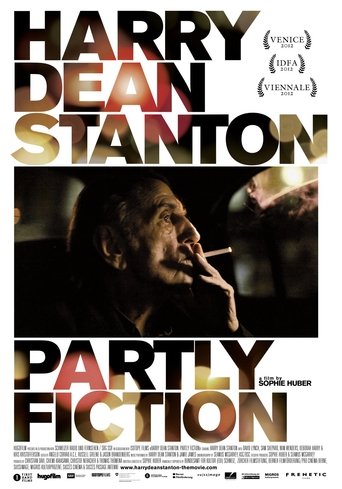
An impressionistic portrait of the iconic actor Harry Dean Stanton comprised of intimate moments, film clips from some of his 250 films and his renditions of American folk songs.
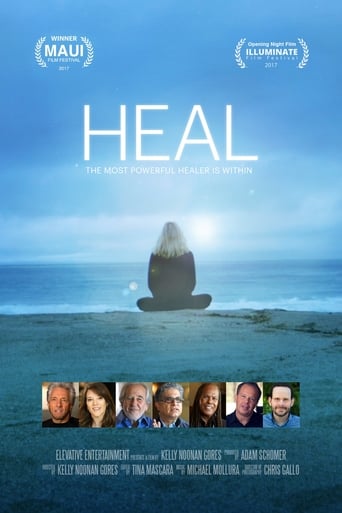
A documentary film that takes us on a scientific and spiritual journey where we discover that by changing one's perceptions, the human body can heal itself from any disease.
For over 40 years Val Kilmer, one of Hollywood’s most mercurial and/or misunderstood actors has been documenting his own life and craft through film and video. He has amassed thousands of hours of footage, from 16mm home movies made with his brothers, to time spent in iconic roles for blockbuster movies like Top Gun, The Doors, Tombstone, and Batman Forever. This raw, wildly original and unflinching documentary reveals a life lived to extremes and a heart-filled, sometimes hilarious look at what it means to be an artist and a complex man.
Life Is But a Dream is a HBO documentary about the life of US singer Beyoncé Knowles during the years 2011 and 2012 and on the recording of her fifth album. The film was directed by Beyoncé herself. The film shows Beyoncé from intimate moments of her pregnancy to behind the scenes and rehearsals of the main concerts of that time.
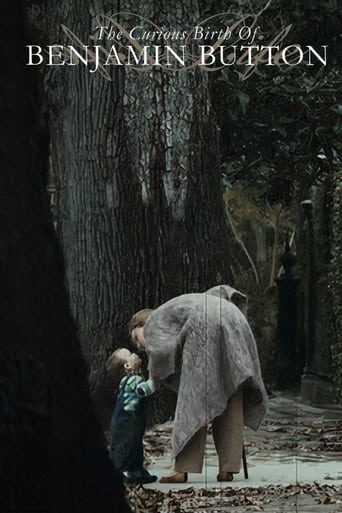
A documentary about the making of David Fincher's 2008 film THE CURIOUS CASE OF BENJAMIN BUTTON. Virtually every element in the evolution of the Fincher's film is documented here, from the project's attachment to numerous other directors during the 1990s, to its shoot in 2006 and 2007 in New Orleans, to its complex, CGI-intensive postproduction process.
Wheel of Time is Werner Herzog's photographed look at the largest Buddhist ritual in Bodh Gaya, India.
In 1999, Internet entrepreneur Josh Harris recruits dozens of young men and women who agree to live in underground apartments for weeks at a time while their every movement is broadcast online. Soon, Harris and his girlfriend embark on their own subterranean adventure, with cameras streaming live footage of their meals, arguments, bedroom activities, and bathroom habits. This documentary explores the role of technology in our lives, as it charts the fragile nature of dot-com economy.
A documentary directed by Winding Refn's wife, Liv Corfixen, and it follows the Danish-born filmmaker during the making of his 2013 film Only God Forgives.
Going beyond the occasional news clip from Burma, the acclaimed filmmaker, Anders Østergaard, brings us close to the video journalists who deliver the footage. Though risking torture and life in jail, courageous young citizens of Burma live the essence of journalism as they insist on keeping up the flow of news from their closed country.
A documentary about how a dominant cultural and demographic institution both sustains their traditional activities and adapts to the digital revolution.
A love letter from a young mother to her daughter, the film tells the story of Waad al-Kateab’s life through five years of the uprising in Aleppo, Syria as she falls in love, gets married and gives birth to Sama, all while cataclysmic conflict rises around her. Her camera captures incredible stories of loss, laughter and survival as Waad wrestles with an impossible choice– whether or not to flee the city to protect her daughter’s life, when leaving means abandoning the struggle for freedom for which she has already sacrificed so much.
Nine filmmakers each profile a young girl from a different part of the world to weave a global tapestry of youth in the 21st century.
A documentary that explores the downloading revolution; the kids that created it, the bands and the businesses that were affected by it, and its impact on the world at large.
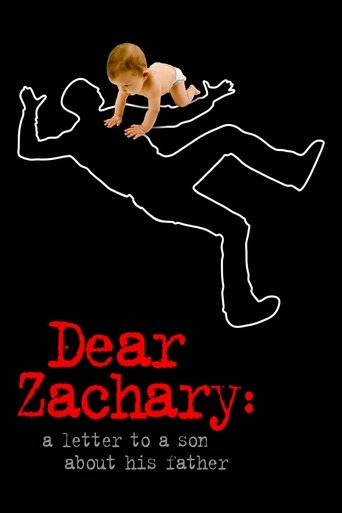
In 2001, Andrew Bagby, a medical resident, is murdered not long after breaking up with his girlfriend. Soon after, when she announces she's pregnant, one of Andrew's many close friends, Kurt Kuenne, begins this film, a gift to the child.