A documentary on the railroads of America produced by the Association of American Railroads
Social & External
Narrator
A group of people are standing along the platform of a railway station in La Ciotat, waiting for a train. One is seen coming, at some distance, and eventually stops at the platform. Doors of the railway-cars open and attendants help passengers off and on. Popular legend has it that, when this film was shown, the first-night audience fled the café in terror, fearing being run over by the "approaching" train. This legend has since been identified as promotional embellishment, though there is evidence to suggest that people were astounded at the capabilities of the Lumières' cinématographe.
Karen Zaitchik jumps on and off moving boxcars, throws switches, pulls brakes and uncouples freights with ease and confidence. She's a railroader for CN and that's what this 21-year-old highly individualistic woman wants out of life for the moment. This colourful short film shows how Karen manages in the traditionally male world of the railroad.
This short documentary shows the reactions of European immigrants as they land in Halifax at the beginning of the 1960s. From the port, we follow them on a snowy journey by train to Montreal.
A film about winter railroading in the Canadian Rockies and the men who keep the lines clear. The stretch between Revelstoke and Field, British Columbia, is a snow-choked threat to communications. The film shows the work of section hands, maintenance men, train crews and telegraph operators.
The Ashtabula train disaster and bridge collapse was the worst train disaster of the 19th century, claiming the lives of 97 people. The engineering and structural failures that caused the collapse of a bridge that stood for over a decade, also took down the most luxurious train of the day, “The Pacific Express #5.” The accident happened in Ashtabula, Ohio on December 29, 1876 during a raging blizzard, sending the luxury train crashing 70-feet into a river gorge and costing the lives of 97 people. The disaster shocked the nation, yet it’s a story that’s been lost in the pages of history. In a strange twist of fate and intrigue, the bridge disaster also became the backdrop to the still unsolved murder of Charles Collins, the railroad’s chief engineer. It also contributed to the eventual suicide of millionaire Amasa Stone, the president of the railroad and the designer and builder of the bridge.
First Thursday of each month, the members of Stockholm's model railroad club meet and run their beloved trains on a schedule. The trains pass towns such as Bångfors and Farsarvet. Sometimes, a delay occurs, which then spreads throughout the network.
"The End of the Line - Rochester's Subway" tells the little-known story of the rail line that operated in a former section of the Erie Canal from 1927 until its abandonment in 1956. Produced in 1994 by filmmakers Fredrick Armstrong and James P. Harte, the forty-five minute documentary recounts the tale of an American city's bumpy ride through the Twentieth Century, from the perspective of a little engine that could, but didn't. The film has since been rereleased (2005) and now contains the main feature with special portions that were added as part of the rereleased version. These include a look at the only surviving subway car from the lines and a Phantom tun through the tunnels in their abandoned state, among others, for a total of 90 minutes of unique and well preserved historical information.
A film that excavates layers of myth and memory, on an ancient Eritrean steam railway, to learn the elusive truth about Eritrea, its war-ridden history, and at the core of it all, a deep friendship that keeps it all going.
On a train crossing Tanzania, a rolling microcosm of East African society, we follow three main characters, reflecting on the strength to survive.
A day in the city of Berlin, which experienced an industrial boom in the 1920s, and still provides an insight into the living and working conditions at that time. Germany had just recovered a little from the worst consequences of the First World War, the great economic crisis was still a few years away and Hitler was not yet an issue at the time.
Take a breathtaking train a ride through Nothern Quebec and Labrador on Canada’s first First Nations-owned railway. Come for the celebration of the power of independence, the crucial importance of aboriginal owned businesses and stay for the beauty of the northern landscape.
Production for the Seaboard Railroad company outlining their railroad activities in the 1940s and heading into the 1950s
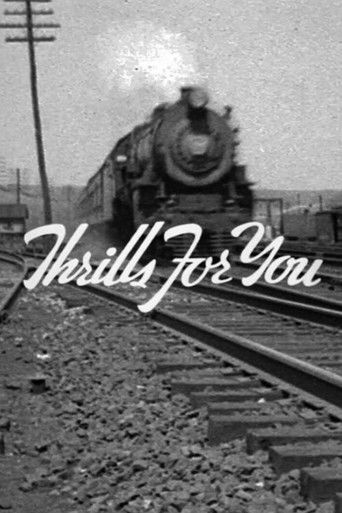
A production of the association of American Railroads outlining the wonders of America's rail system.
The film chronicles the remarkable saga of Mike Kirk, a devoted model train enthusiast, whose unwavering determination, along with the support of a dedicated circle of family and friends, spearheaded the decades-long restoration of the long-abandoned train depot nestled in the heart of rural Waupaca. Through Kirk's indomitable spirit and vision, the Waupaca Depot emerges as a phoenix rising from literal ashes, symbolizing resilience and community revival. "Back on Track" transcends the boundaries of a mere restoration project, delving deep into the rich tapestry of American history and the birth of rural communities. This film explores the intertwined narratives of Kirk's personal quest and the broader narrative of American heritage.
The Channel Tunnel linking Britain with France is one of the seven wonders of the modern world but what did it take to build the longest undersea tunnel ever constructed? We hear from the men and women, who built this engineering marvel. Massive tunnel boring machines gnawed their way through rock and chalk, digging not one tunnel but three; two rail tunnels and a service tunnel. This was a project that would be privately financed; not a penny of public money would be spent on the tunnel. Business would have to put up all the money and take all the risks. This was also a project that was blighted by flood, fire, tragic loss of life and financial bust ups. Today, it stands as an engineering triumph and a testament to what can be achieved when two nations, Britain and France put aside their historic differences and work together.
Trace the history of Hitler's armored private train, a 15-car mobile headquarters boasting state-of-the-art communications and anti-aircraft cannons.
In this travelogue, actor David Suchet journeys across Europe aboard the world famous Orient Express train, as he prepares to play Poirot in an adaptation of Agatha Christie's "Murder on the Orient Express".
In the 1870s Victorian politicians debated the virtues of constructing a 20km-long railway through Melbourne's east, simply to circumvent a privately-owned railway from South Yarra to Flinders Street Station. By 1878 the private railway had been purchased by the Victorian Government and there was no longer a need to build the orbital railway. But greedy politicians pushed legislation through parliament, authorising the construction of the railway through their own private land holdings. This is the story of Melbourne's Outer Circle Railway.
Discover the world's most luxurious trains and relive a bygone era, when the journey was an experience in itself, aboard the opulent carriages of the world's railways. A voyage where the passenger becomes a real traveller, steeped not only in the natural, stunning beauty of the surroundings but also in the romance and opulence associated with the golden age of rail. A classic rail adventure experiencing the thrills of crossing the Canadian Rockies. Torrential waterfalls, soaring eagles and the contrast of sapphire blue lakes and snow-capped peaks are spectacular and can all be viewed from either the magnificent bi-level dome car or the observation carriage. The unmatchable comfort and elegance of the Goldleaf service brings to life the era when the railways were the "only" way to travel.