Social & External
Commissioned by MK Gallery, this film combines contemporary footage of public artworks in Milton Keynes with archive footage from the Open University, cartoons from the Milton Keynes Development Corporation's internal newspaper and accounts from early residents, juxtaposing several perspectives on England's most ambitious 'new town'.
The Finnish architect Alvar Aalto (1898–1976) is one of the great figures of modern architecture, ranked alongside Gropius, Le Corbusier and Mies van der Rohe. This film analyses Aalto’s uniquely successful resolution of the demands and possibilities created by new technology and construction materials with the need to make his buildings sympathetic both to their users and to their natural surroundings. His inventive use of timber in particular represents both a reference to the forest landscape of Finland and a building material that is ‘warm’ and extremely adaptable. Filmed in Finland, Italy, Germany and the USA, this documentary shows how the Finnish natural environment and art traditions were essential elements in Aalto’s pioneering harmonization of technology and nature.
In the midst of the chaos of México City, a group of eight bachelor millennials who call themselves ´The Hermits´, open the doors to their tiny apartments in the historic Ermita Building, in the yet-to-be gentrified neighborhood of Tacubaya, and share their life experiences in a time when precarity changes the way in which we love, feel and relate to each other. As we explore the homes of these eight neighbors, we also witness their personalities intersect in a Whatsapp chat, a virtual space that functions as a supporting system that helps them face the adversities that living alone in this city brings.
A biography documentary of the Argentine modernist architect Amancio Williams.
Poème Électronique is an 8-minute piece of electronic music by composer Edgard Varèse, written for the Philips Pavilion at the 1958 Brussels World’s Fair. The Philips corporation commissioned Le Corbusier to design the pavilion, which was intended as a showcase of their engineering progress. The pavilion was shaped like a stomach, with a narrow entrance and exit on either side of a large central space. As the audience entered and exited the pavilion, the electronic composition Concret PH by Iannis Xenakis (who also acted as Le Corbusier's architectural assistant for the pavilion's design) was heard. Poème électronique was synchronized to a film of black and white photographs selected by Le Corbusier which touched on vague themes of human existence.
In 1919 an art school opened in Germany that would change the world forever. It was called the Bauhaus. A century later, its radical thinking still shapes our lives today. Bauhaus 100 is the story of Walter Gropius, architect and founder of the Bauhaus, and the teachers and students he gathered to form this influential school. Traumatised by his experiences during the Great War, and determined that technology should never again be used for destruction, Gropius decided to reinvent the way art and design were taught. At the Bauhaus, all the disciplines would come together to create the buildings of the future, and define a new way of living in the modern world.
The camera goes back through the alleys and alleys of the community, leading the viewer to compare, with simultaneous shots of 76 and 96, the little or almost nothing that was accomplished, the neglect of the State, the abandonment over the 20 years. Finishing with a virtual image of the colored facades, as part of the proposed urbanization.
A group of young architects, confined to a forest in Barcelona during the COVID crisis, explore the problems generated by the ambition of wanting to be completely self-sufficient.
The film Together we cycle investigates the critical events that has led to the revival of the Dutch cycling culture. For most people, cycling in the Netherlands, seems a natural phenomenon. However, until the 1970s the development of mobility in the Netherlands followed trents across the globe. The bicycle had had its day, and the future belonged to the car. The only thing that had to be done was to adapt cities to the influx of cars. Then Dutch society took a different turn. Against all odds people kept on cycling. The question why this happened in the Netherlands, has not an easy answer. There are many factors, events and circumstances that worked together, both socially and policy-wise. In Together we cycle, key players tell the story of the bumpy road which led to the current state. Where cycling is an obvious choice for most citizens.
A docu-art film about Kyiv and the contemporary problems of the capital. The film raises the issue of the dilapidated state of Kyiv's old buildings and the search for effective mechanisms to preserve the city's architectural heritage.
The life of a couple is observed through the home they have left behind.
In 1959 Hiroshi Teshigahara shot the following 16 mm footage of he and his father’s first trip to Barcelona and the outlying Catalonian countryside, including a visit to the home of Salvador Dali in Port Lligat. The footage was recorded without sound.
5000 years ago the ancient Elamites established a glorious civilization that lasted about three millennia. They created marvelous works in architecture and craftsmanship. These works of art depict the lifestyle, thoughts, and beliefs of the Elamites.
Invisible Water Layers discusses and questions the origins of Teresina and its urbanization over the years. The film deals with the move from the capital of Piauí to Oeiras in 1852, the ideas of modernity at the time and the problems that resulted from this process in people and in the city. Along with the idea of progress of the railway, factories and steamboats, many families and workers were relocated from the central areas of the city to more distant parts. The traditional ways of life of these people coexisted, not free from conflict, with the will of civility of the local elites. With 4 interviewees, including architects, historians and researchers, the film also brings a rich set of images from different places in the city, such as the Center, the Parnaíba riverbank and the Poty Velho neighborhood.
His buildings are garish, colorful and completely overloaded. Columns and glittering chandeliers everywhere, and way too much of everything. The Bolivian civil engineer and architect Freddy Mamani Silvestre (*1971) builds houses in El Alto for a nouveau riche upper class of the Aymara, the largest indigenous ethnic group in Bolivia.
Explorations in 21st Century American Architecture Series: Ray Kappe has long been a cult figure in the architectural scene in and around Los Angeles. In 1972, he founded the influential, avant garde Southern California Institute of Architecture (SCI-ARC), where many of the younger-generation architects have studied or taught.
No understanding of the modern movement in architecture is possible without knowledge of its master builder, Mies van der Rohe. Together with documentation of his life, this film shows all his major buildings, as well as rare film footage of Mies explaining his philosophy. Phyllis Lambert relates her choice of Mies as the architect for the Seagram building. Mies's achievements and continuing influence are debated by architects Robert A.M. Stern, Robert Venturi, and Philip Johnson, by former students and by architectural historians. Mies is seen in rare documentary footage.
In the heart of Paris, Île de la Cité once featured one of the most majestic palaces of medieval times: The Palais des Rois. Built in the early Middle Ages, only two parts of this grandiose palace remain: The Sainte-Chapelle, the largest and most daring palatial chapel of the time; and the Conciergerie, a medieval room of impressive dimensions, known for having served as a prison and housing the jails of Marie-Antoinette.
Alan Yentob profiles the most successful female architect there has ever been, the late Zaha Hadid, who designed buildings around the globe from Austria to Azerbaijan.
Catalan architect Antonio Gaudí (1852-1926) designed some of the world's most astonishing buildings, interiors, and parks; Japanese director Hiroshi Teshigahara constructed some of the most aesthetically audacious films ever made. With camera work as bold and sensual as the curves of his subject's organic structures, Teshigahara immortalizes Gaudí on film.
A documentary focused on plastic pollution in the world's oceans.
A documentary about the design of cities, which looks at the issues and strategies behind urban design and features some of the world's foremost architects, planners, policymakers, builders, and thinkers.
Behind-the-scenes documentary about how Lionel Messi succeeded in lifting the World Cup – the only trophy to have eluded him in an incredible career.
A collection of stories about and images of our world, offering an immersion to the core of what it means to be human. Through these stories full of love and happiness, as well as hatred and violence, it brings us face to face with the Other, making us reflect on our lives. From stories of everyday experiences to accounts of the most unbelievable lives, these poignant encounters share a rare sincerity and underline who we are – our darker side, but also what is most noble in us, and what is universal. Our Earth is shown at its most sublime through never-before-seen aerial images accompanied by soaring music, resulting in an ode to the beauty of the world, providing a moment to draw breath and for introspection. This film is a politically engaged work which allows us to embrace the human condition and to reflect on the meaning of our existence.
The life and career of an actor, artist, and icon. His own journey through his own camera.
Ross McElwee sets out to make a documentary about the lingering effects of General Sherman's march of destruction through the South during the Civil War, but is continually sidetracked by women who come and go in his life, his recurring dreams of nuclear holocaust, and Burt Reynolds.
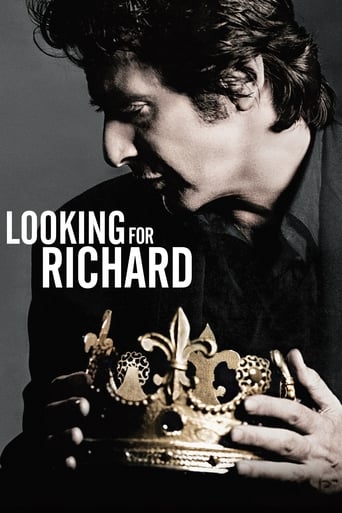
Al Pacino's deeply-felt rumination on Shakespeare's significance and relevance to the modern world through interviews and an in-depth analysis of "Richard III."
Angelic and demonic serpentine dance from dawn of cinema. Hand-colored frame by frame. Lumière no. 765 or 765.1 (colorized, different dancer?).
A comedic, brutally honest documentary following self-destructive TV writer Dan Harmon as he takes his live podcast on a national tour.
What does being a woman really mean? How do women live the status society reserves for them? A group of women, beautiful or not, young or not, gifted with motherly instinct or not, answer before Agnès Varda's camera.
A documentary about the life and films of director John Ford.
In the Realms of the Unreal is a documentary about the reclusive Chicago-based artist Henry Darger. Henry Darger was so reclusive that when he died his neighbors were surprised to find a 15,145-page manuscript along with hundreds of paintings depicting The Story of the Vivian Girls, in What is Known as the Realms of the Unreal, of the Glodeco-Angelinnian War Storm, Cased by the Child Slave Rebellion.
The film follows adventurer Jeff Johnson as he retraces the epic 1968 journey of his heroes Yvon Chouinard and Doug Tompkins to Patagonia.
Those who knew iconic funnyman John Candy best share his story, in their own words, through never-before-seen archival footage, imagery, and interviews.
A visual montage portrait of our contemporary world dominated by globalized technology and violence.
A detailing of the rise to prominence and global sporting superstardom of six supremely talented young Manchester United football players (David Beckham, Nicky Butt, Ryan Giggs, Paul Scholes, Phil and Gary Neville). The film covers the period 1992-1999, culminating in Manchester United's European Cup triumph.
An intimate portrait of the small shops and shopkeepers of the Rue Daguerre in Paris, a picturesque street that has been the filmmaker’s home for more than 50 years.
A look at the origins, history and conspiracies behind the "Majestic 12", a clandestine group of military and corporate figureheads charged with reverse-engineering extraterrestrial technology.
The life of Mr. Spock, as well as that of Leonard Nimoy, the actor who played him for almost fifty years, written and directed by his son: Adam.
SEDUCED AND ABANDONED combines acting legend Alec Baldwin with director James Toback as they lead us on a troublesome and often hilarious journey of raising financing for their next feature film. Moving from director to financier to star actor, the two players provide us with a unique look behind the curtain at the world's biggest and most glamourous film festival, shining a light on the bitter-sweet relationship filmmakers have with Cannes and the film business. Featuring insights from directors Martin Scorsese, 'Bernando Bertolucci' and Roman Polanski; actors Ryan Gosling and Jessica Chastain and a host of film distribution luminaries.