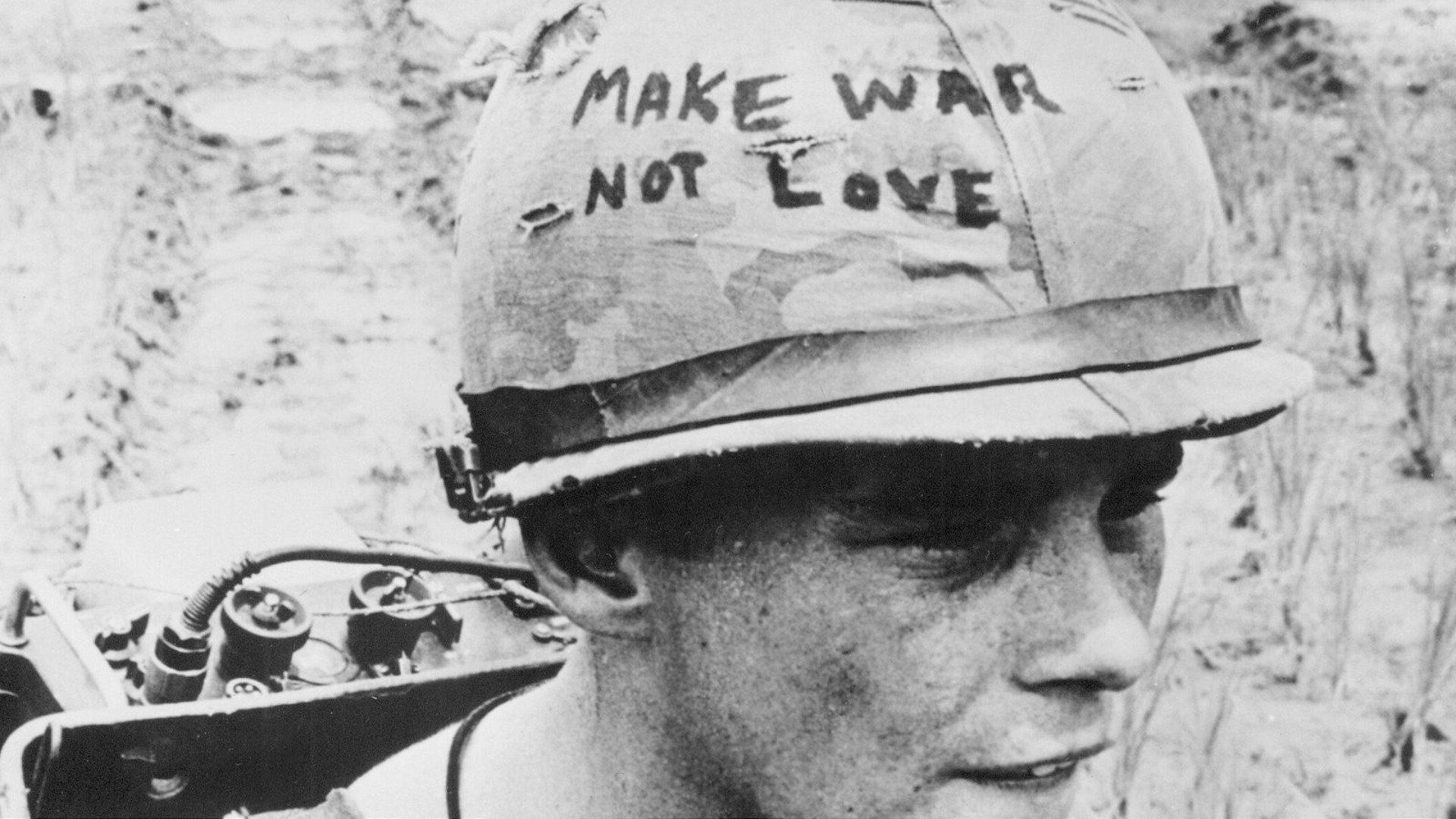
Both sober and sobering, producer-director Emile de Antonio’s In the Year of the Pig is a powerful and, no doubt for many, controversial documentary about the Vietnam War.
Social & External
Himself
Self
lui-même
A German Documentary about the “village of friendship” that was created by American Veteran George Mizo to help the Vietnamese kids suffering from the Vietnam War.
At the height of the Vietnam war, Captain Benjamin Willard is sent on a dangerous mission that, officially, "does not exist, nor will it ever exist." His goal is to locate - and eliminate - a mysterious Green Beret Colonel named Walter Kurtz, who has been leading his personal army on illegal guerrilla missions into enemy territory.
During the Vietnam War, Brian Anderson, a young Army medic, is stationed in Saigon. Initially apathetic and self-serving, he eventually has his heart won over by the children at a nearby orphanage where he does volunteer work. At first, a doctor named Katherine Cross has to persuade him to help the children. But soon, Brian willingly puts his career and safety on the line to provide the orphans with the food and medical supplies they need.
An old Vietnam war veteran struggles with his past when his granddaughter leaves for the military.
A Vietnam vet who specializes in freeing POWs goes behind enemy lines on a rescue mission with a group of mercenaries.
Jack "Fingers" Ensch served in the Navy for 30 years. Recounting his experience of getting shot down and held as a POW in the infamous Hanoi Hilton, Jack explains how he was able to move forward from the experience and enjoy a full life.
Raymond Carlson remembers his older brother, a medic killed in action in the Vietnam War when Raymond was only seven years old. The impact of that loss lingers today more than fifty years later.
A veteran creates support systems that help other veterans and their families.
The story of Noble Sissle Jr., a production company owner, community development expert, and veteran of the Vietnam War. Combining archival footage with interviews and family portraits, the film explores Sissle Jr.’s life, and the way he carries on the legacy of his father, Noble Sissle – the famous WWI Harlem Hell Fighter and leader of the Harlem Renaissance. Includes original music and footage of Noble Sissle.
John Baumhackl recalls the early days of the Vietnam War when more and more troops were being sent into combat every month. In 1968, John's number came up and he was drafted into the conflict. Buying a camera at his company store before shipping off, he captured many battles while in a helicopter. John was near the front lines when President Nixon made the controversial decision to push into Cambodia. In John's view, this saved American lives.
When former Green Beret John Rambo is harassed by local law enforcement and arrested for vagrancy, he is forced to flee into the mountains and wage an escalating one-man war against his pursuers.
John Rambo is released from prison by the government for a top-secret covert mission to the last place on Earth he'd want to return - the jungles of Vietnam.
New York Times reporter Sydney Schanberg is on assignment covering the Cambodian Civil War, with the help of local interpreter Dith Pran and American photojournalist Al Rockoff. When the U.S. Army pulls out amid escalating violence, Schanberg makes exit arrangements for Pran and his family. Pran, however, tells Schanberg he intends to stay in Cambodia to help cover the unfolding story — a decision he may regret as the Khmer Rouge rebels move in.
A pragmatic U.S. Marine observes the dehumanizing effects the U.S.-Vietnam War has on his fellow recruits from their brutal boot camp training to the bloody street fighting in Hue.
A disk jockey goes to Vietnam to work for the Armed Forces Radio Service. While he becomes popular among the troops, his superiors disapprove of his humor.
As a young and naive recruit in Vietnam, Chris Taylor faces a moral crisis when confronted with the horrors of war and the duality of man.
Paralyzed in the Vietnam war, Ron Kovic becomes an anti-war and pro-human rights political activist after feeling betrayed by the country he fought for.
How does a nation slip into war? Dateline-Saigon profiles the controversial reporting of five Pulitzer Prize-winning journalists -The New York Times' David Halberstam, the Associated Press' Malcolm Browne, Peter Arnett, and legendary photojournalist Horst Faas, and UPI's Neil Sheehan -- during the early years of the Vietnam War as President John F. Kennedy is secretly committing US troops to what is initially dismissed by some as 'a nice little war in a land of tigers and elephants.' 'When the government is telling the truth, reporters become a relatively unimportant conduit to what is happening,' Halberstam tells us. 'But when the government doesn't tell the truth, begins to twist the truth, hide the truth, then the journalist becomes involuntarily infinitely more important.'
A group of self-absorbed actors set out to make the most expensive war film ever. After ballooning costs force the studio to cancel the movie, the frustrated director refuses to stop shooting, leading his cast into the jungles of Southeast Asia, where they encounter real bad guys.
From the director of “Made In America” and “The Money Pit” comes a hilarious look at one of the most expensive blunders in military history. Over 17 years and almost as many billion dollars have gone into devising the BFV (Bradley Fighting Vehicle). There's only one problem. . . it doesn't work. (Spoiler alert: 25 years later ... it does work.)
Prelude to War was the first film of Frank Capra's Why We Fight propaganda film series, commissioned by the Pentagon and George C. Marshall. It was made to convince American troops of the necessity of combating the Axis Powers during World War II. This film examines the differences between democratic and fascist states.
When Sgt. First Class Brian Eisch is critically wounded in Afghanistan, it sets him and his sons on a journey of love, loss, redemption and legacy.
Set both in Latin America and the United States, the film explores the historic and current relationship of Washington with countries such as Venezuela, Bolivia and Chile. Pilger says that the film "...tells a universal story... analysing and revealing, through vivid testimony, the story of great power behind its venerable myths. It allows us to understand the true nature of the so-called "war on terror". According to Pilger, the film’s message is that the greed and power of empire is not invincible and that people power is always the "seed beneath the snow".
With unprecedented access, this documentary follows the extraordinary journey of “Raqqa is Being Slaughtered Silently”—a group of anonymous citizen journalists who banded together after their homeland was overtaken by ISIS—as they risk their lives to stand up against one of the greatest evils in the world today.
Korengal picks up where Restrepo left off; the same men, the same valley, the same commanders, but a very different look at the experience of war.
Armed only with their cameras, Peabody and Emmy Award-winning conflict Journalist Mike Boettcher, and his son, Carlos, provide unprecedented access into the longest war in U.S. history: they are embed with U.S. troops during nine days of intense combat in Afghanistan.
Amid the failing counteroffensive, a journalist follows a Ukrainian platoon on their mission to traverse one mile of heavily fortified forest and liberate a strategic village from Russian occupation. But the farther they advance through their destroyed homeland, the more they realize that this war may never end.
A unit of American military advisors in Vietnam prior to the major U.S. involvement finds similarities between their helpless struggle against the Viet Cong and the doomed actions of a French unit at the same site a decade before.
During the chaotic final weeks of the Vietnam War, the North Vietnamese Army closes in on Saigon as the panicked South Vietnamese people desperately attempt to escape. On the ground, American soldiers and diplomats confront a moral quandary: whether to obey White House orders to evacuate only U.S. citizens.
Produced and presented as evidence at the Nuremberg war crimes trial of Hermann Göring and twenty other Nazi leaders, this film consists primarily of dead and surviving prisoners and of facilities used to kill and torture during the World War II.
The most comprehensive retrospective of the '80s action film genre ever made.
Many times during his presidency, Lyndon B. Johnson said that ultimate victory in the Vietnam War depended upon the U.S. military winning the "hearts and minds" of the Vietnamese people. Filmmaker Peter Davis uses Johnson's phrase in an ironic context in this anti-war documentary, filmed and released while the Vietnam War was still under way, juxtaposing interviews with military figures like U.S. Army Chief of Staff William C. Westmoreland with shocking scenes of violence and brutality.
Henry Fleming is a young Union soldier in the American Civil War. During his unit's first engagement, Henry flees the battlefield in fear. When he learns that the Union actually won the battle, shame over his cowardice leads him to lie to his friend Tom and the other soldiers, saying that he had been injured in battle. However, when he learns that his unit will be leading a charge against the enemy, Henry takes the opportunity to face his fears and redeem himself.
This documentary movie is about the battle of San Pietro, a small village in Italy. Over 1,100 US soldiers were killed while trying to take this location, that blocked the way for the Allied forces from the Germans. Preserved by the Academy Film Archive in 2005.
When Allied forces liberated the Nazi concentration camps in 1944-45, their terrible discoveries were recorded by army and newsreel cameramen, revealing for the first time the full horror of what had happened. Making use of British, Soviet and American footage, the Ministry of Information’s Sidney Bernstein (later founder of Granada Television) aimed to create a documentary that would provide lasting, undeniable evidence of the Nazis’ unspeakable crimes. He commissioned a wealth of British talent, including editor Stewart McAllister, writer and future cabinet minister Richard Crossman – and, as treatment advisor, his friend Alfred Hitchcock. Yet, despite initial support from the British and US Governments, the film was shelved, and only now, 70 years on, has it been restored and completed by Imperial War Museums under its original title "German Concentration Camps Factual Survey".
A love letter from a young mother to her daughter, the film tells the story of Waad al-Kateab’s life through five years of the uprising in Aleppo, Syria as she falls in love, gets married and gives birth to Sama, all while cataclysmic conflict rises around her. Her camera captures incredible stories of loss, laughter and survival as Waad wrestles with an impossible choice– whether or not to flee the city to protect her daughter’s life, when leaving means abandoning the struggle for freedom for which she has already sacrificed so much.
Using archival footage, cabinet conversation recordings, and an interview of the 85-year-old Robert McNamara, The Fog of War depicts his life, from working as a WWII whiz-kid military officer, to being the Ford Motor Company's president, to managing the Vietnam War as defense secretary for presidents Kennedy and Johnson.
War stories about family, ethics and honor include the true story of two U.S. Marines who in a span of six seconds, must stand their ground to stop a suicide truck bomb, a Navy Corpsman who attempts to hold on to his humanity, and a WW2 soldier who gets separated from his squad and is forced to re-evaluate his code.
Pete Postlethwaite stars as a man living alone in the devastated future world of 2055, looking at old footage from 2008 and asking: why didn’t we stop climate change when we had the chance?
A visual montage portrait of our contemporary world dominated by globalized technology and violence.