"Turn Grief into Greatness"
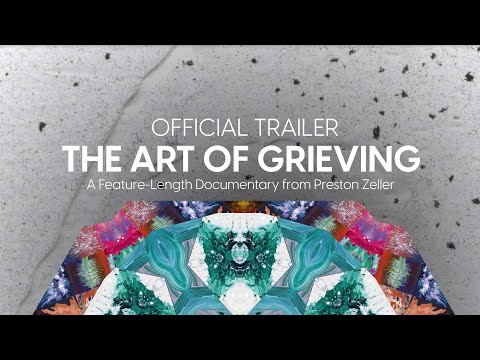
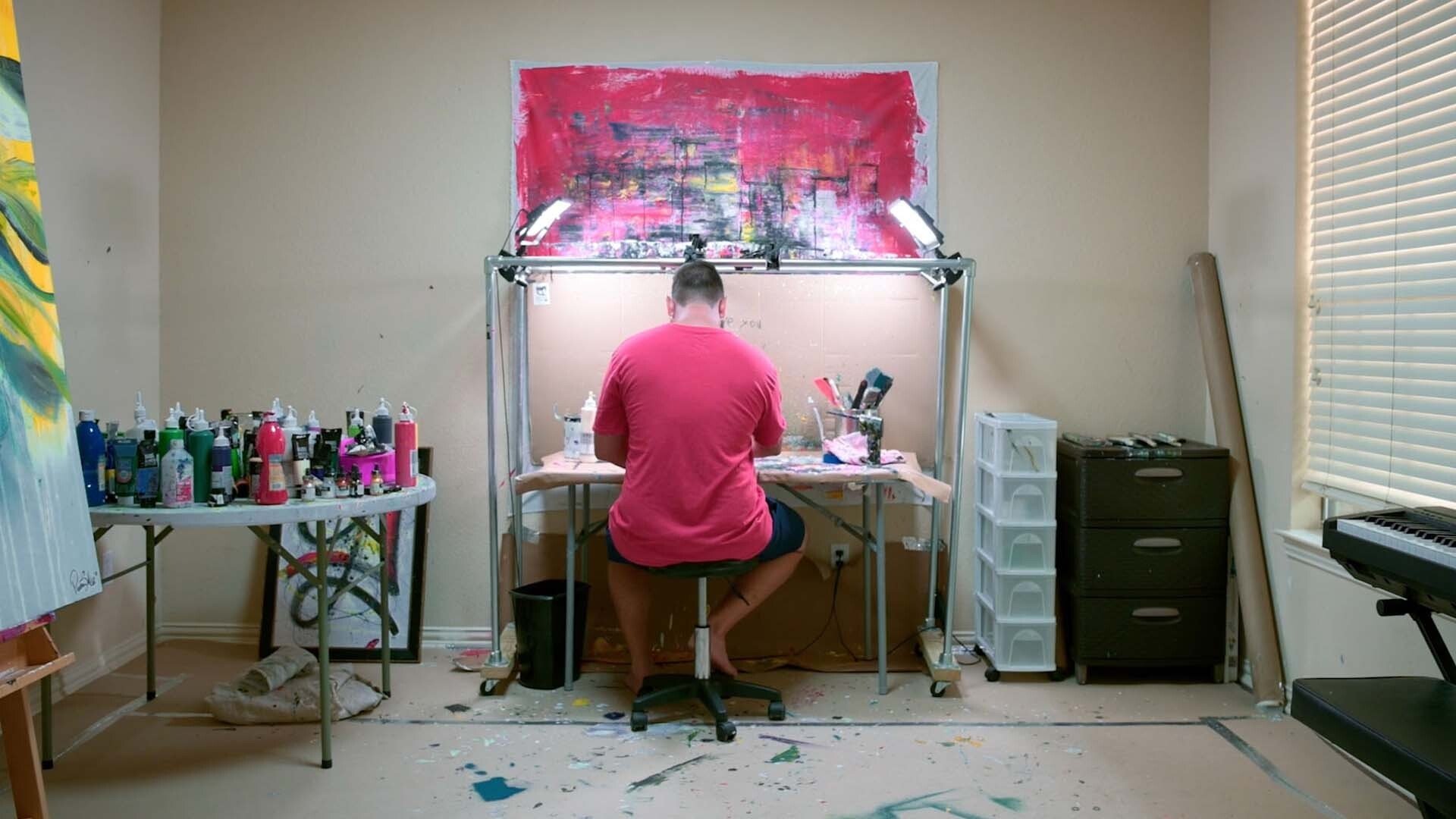
After the untimely death of his 35-year old brother, an artist explores the questions that surfaced from grief by painting 365 paintings and to spur conversation in culture.
Social & External
Himself
Overcoming the seemingly insurmountable odds that life threw his way, Liston became heavyweight champion of the world when he knocked out Floyd Patterson in 1962. Eight years later, he died but friends questioned the cause of his death.
This MGM Passing Parade series short takes a look at changing definitions of art in the United States.
In 1940, the German artist Charlotte Salomon (1917-43) undertook an extraordinary artistic adventure, during which she combined painting, text and music: in only eighteen months, she painted more than a thousand paintings. In 1943, she was arrested by the Nazis and sent to the Auschwitz extermination camp.
In 2020, just as the pandemic was beginning, Gazala purchased land in western Ohio, on which sits a disused school building. This site allowed her to explore her complex relationship with “the land.” As the daughter of displaced indigenous Palestinians, she attempts to form a proxy bond with the earth, on ground that was stolen from the displaced indigenous Shawnee people. Closeness to the Land is video footage of hand-painted text signs that translate the word الأرض (ard) into six English words, displayed performatively in multiple locations to capture the now-invisible nature of indigenous culture in Ohio. These signs were installed on the old schoolhouse in early 2021.
A documentary about the life and works of the artist M. C. Escher. Maurits Cornelis Escher (1898-1972) usually referred to as M. C. Escher, was a Dutch graphic artist. He is known for his often mathematically inspired woodcuts, lithographs, and mezzotints. These feature impossible constructions, explorations of infinity, architecture, and tessellations.
Jim Carrey exhibits his talent as a painter and reflects on the value and power of art.
EXHIBITION ON SCREEN open its fifth season with Canaletto & the Art of Venice, an immersive journey into the life and art of Venice’s famous view-painter. No artist better captures the essence and allure of Venice than Giovanni Antonio Canal, better known as Canaletto. The remarkable group of over 200 paintings, drawings and prints on display offer unparalleled insight into the artistry of Canaletto and his contemporaries, and the city he became a master at capturing. The film also offers the chance to step inside two official royal residences - Buckingham Palace and Windsor Castle – to learn more about the artist, and Joseph Smith, the man who introduced Canaletto to Britain.
Widely considered Britain’s most popular artist, David Hockney is a global sensation with exhibitions in London, New York, Paris and beyond, attracting millions of visitors worldwide. Now entering his 9th decade, Hockney shows absolutely no evidence of slowing down or losing his trademark boldness. Featuring intimate and in-depth interviews with Hockney, this revealing film focuses on two blockbuster exhibitions held in 2012 and 2016 at the Royal Academy of Art in London. Director Phil Grabsky secured privileged access to craft this cinematic celebration of a 21st century master of creativity.
Dedicated to the portrait work of Paul Cézanne, the exhibition opens in Paris before traveling to London and Washington. One cannot appreciate 20th century art without understanding the significance and genius of Paul Cézanne. Filmed at the National Portrait Gallery in London, with additional interviews from experts and curators from MoMA in New York, National Gallery of Art in Washington DC, and Musée d’Orsay in Paris, and correspondence from the artist himself, the film takes audiences to the places Cézanne lived and worked and sheds light on an artist who is perhaps one of the least known and yet most important of all the Impressionists.
Filmed on location in Montana and Washington State, this 1976 biography of poet and teacher Richard Hugo features readings of some of his most famous poems as well as interviews with his family and friends.
Ningwasum follows two time travellers Miksam and Mingsoma, played by Subin Limbu and Shanta Nepali respectively, in the Himalayas weaving indigenous folk stories, culture, climate change and science fiction.
By drawing a parallel between the Indian Durga Puja festival and other forms of celebrating the divine feminine, Santa Shakti reveals the Sacred Power beyond languages and religions.
A documentary made for Konrad Mägi exhibition "The Light of the North" in Torino, Musei Reali (2019-2020), about Mägi's life and his legacy.
From the legendary times of Romulus and Remus to the present day, the compelling story of the eternal city's twenty-five centuries of civilization traces the rise of Christianity over paganism through studies of Vatican art treasures.
A collection of death scenes, ranging from TV-material to home-made super-8 movies. The common factor is death by some means.
"The prevailing stigmatization of the 'villero' universe is fed back by the images. In order to dismantle this stigmatization, other images must be presented or we need to reveal what the existing ones seek to cover up. The slum is usually represented from a limited and deceitful visual panorama. This representation has an intention. Cinema and television are two image-producing devices that strengthen the stereotypes that we have about the people who inhabit these spaces. And what happens in the field of painting? Do clichés reign there too? This visual essay seeks to confront various works by national painters and sculptors, belonging to the Palais collection, with the kinetic images of current cinema and television, to reflect on both the differences and the similarities in the meanings and discourses that both regimes of images can produce." César González
X-ray images were invented in 1895, the same year in which the Lumière brothers presented their respective invention in what today is considered to be the first cinema screening. Thus, both cinema and radiography fall within the scopic regime inaugurated by modernity. The use of X-rays on two sculptures from the Bilbao Fine Arts Museum generates images that reveal certain elements of them that would otherwise be invisible to our eyes. These images, despite being generally created for technical or scientific purposes, seem to produce a certain form of 'photogénie': they lend the radiographed objects a new appearance that lies somewhere between the material and the ethereal, endowing them with a vaporous and spectral quality. It is not by chance that physics and phantasmagoria share the term 'spectrum' in their vocabulary.