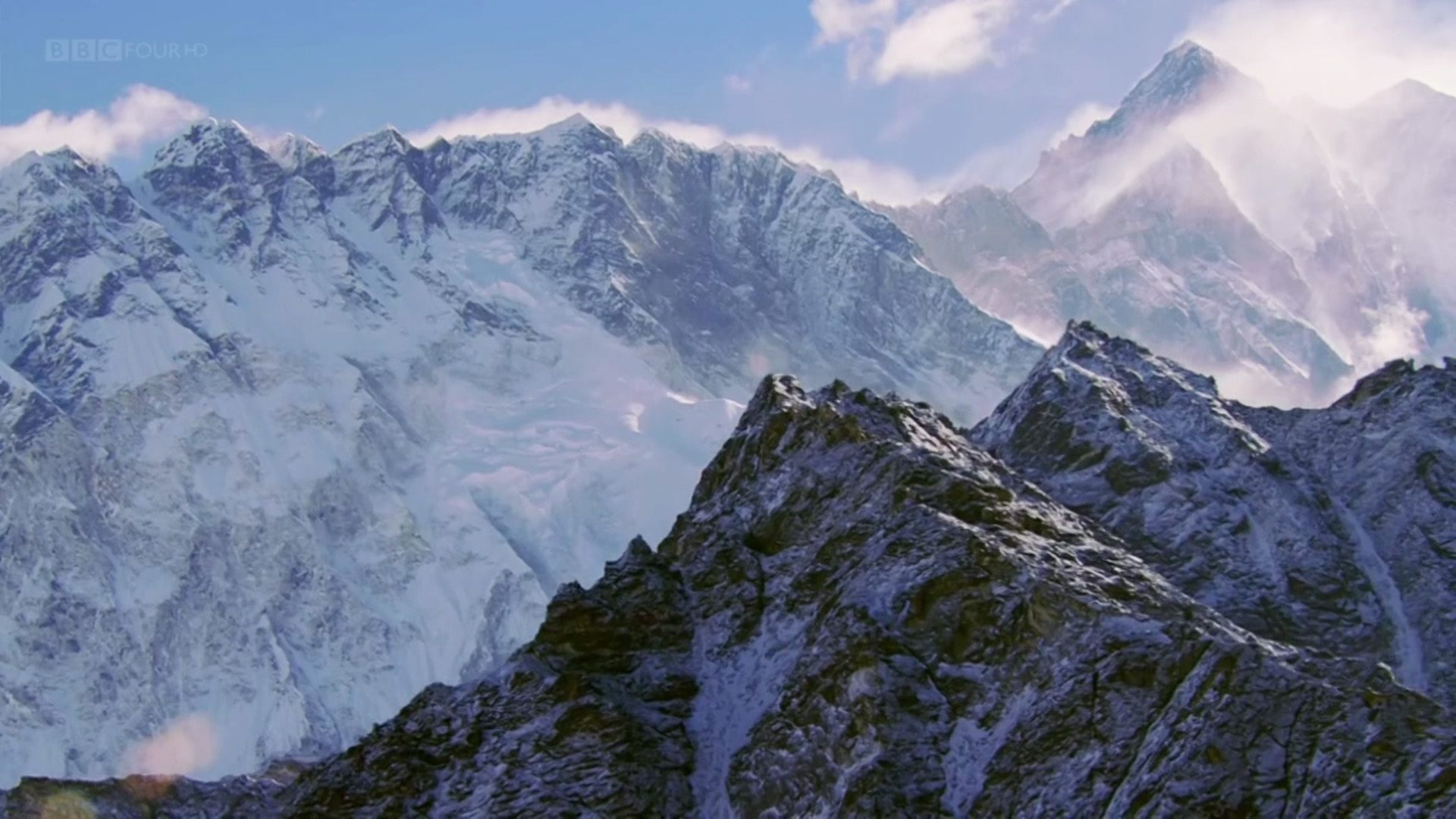
Series showing how new camera technology is revealing the inner workings of the Earth's most spectacular natural wonders.
Social & External
Self - Presenter
James May gives a straightforward guide to some of science's big ideas, explaining everything from evolution and Einstein to engineering and chemistry.
Physicist and professor Brian Cox travels across the globe to uncover the secrets of the most extraordinary phenomenon in the universe: life.
Enlightening, uplifting and refreshingly innovative, this series takes a pioneering journey through the unexplored galaxy inside our own heads. Combining cutting edge science with extraordinary experiments, dazzling graphics and inspiring human stories, it shows how personality is formed throughout our lives and how our minds work to win friends and influence people. By exploring the science behind the workings of the human mind, the programmes reveal what each of us can do to make the most of its remarkable capability - including how to literally 'think faster' and even master our most powerful emotions.
Dr Helen Czerski goes on a spectacular journey to the extremes of the temperature scale, where everyday laws of physics break down and a new world of scientific possibility begins.
From Pete, David and Leila - the creators of History Time, Voices of the Past and Something Incredible. From dust to dinosaurs; come with us as we explore the entire history of our planet. History of the Earth tells the entire story of the Earth, from its formation 4.5 billion years ago to today – covering eye-watering geology and bizarre biology along the way.
Where and how will we be in 60 years? The next decades will undergo the biggest and fastest transformation ever. In technology, in science, in the environment, in interpersonal relationships. We live in a kind of great accelerator of science, in which the pace of discoveries does not cease to amaze. In the last decades more scientific knowledge accumulated than in all the history of the Humanity. In 2077 this scientific knowledge will have doubled several times.
Surgeon Gabriel Weston introduces us to people from across the globe with the world's most unique bodies.
Professor Jim Al-Khalili shows how, by uncovering its secrets, scientists have used light to reveal the universe.
We live in a world ablaze with colour. Rainbows and rainforests, oceans and humanity, Earth is the most colourful place we know of. But the colours we see are far more complex and fascinating than they appear. In this series, Dr Helen Czerski uncovers what colour is, how it works, and how it has written the story of our planet - from the colours that transformed a dull ball of rock into a vivid jewel to the colours that life has used to survive and thrive. But the story doesn't end there - there are also the colours that we can't see, the ones that lie beyond the rainbow. Each one has a fascinating story to tell.
Advances in forensic sciences have led to the resolution of complex cases thanks to microscopic clues. The documentary series Police Scientifique analyses crimes committed in Quebec, which were solved thanks to science and new police techniques. Experts and detectives recount how they reconstituted the circumstances of various murders, by using ballistics, toxicology, chemistry, physics, biology and even entomology. These testimonies come with those of the victim’s loved ones, along with realistic constitutions that put the scale of these tragic events in images.
Discoveries that have revolutionised our understanding of what it means to be human, allowing us to live longer, better, smarter and stronger.
Philippe Cousteau Jr., grandson of the legendary Jacques Cousteau, explores the most spectacular places - on the earth, inside the earth, and above the earth - in this riveting earth science series.
Precision: The Measure of All Things is a three-part British television series outlining aspects of the history of measurement. It was originally aired in June 2013 on BBC Four. The series comprised three programmes: Time and Distance; Mass and Moles and Heat, Light and Electricity.
The story of life, from the first primitive cells to the plants and animals that now live around us.
Geologist Iain Stewart explain in three stages of natural history the crucial interaction of our very planet's physiology and its unique wildlife. Biological evolution is largely driven bu adaptation to conditions such as climate, soil and irrigation, but biotopes were also shaped by wildlife changing earth's surface and climate significantly, even disregarding human activity.
In this two-part series, we take a look at the monumental discoveries underway, specifically surrounding black holes and meteorites. Black holes have been revealed as one of the foundations for the basic conditions of life. Through black holes, life is possible in an infinite number of places in space. We also follow how meteorites brought the basic substances of life to our planet, allowing for its creation. The films describe the latest findings concerning cosmic events in relation to the origin of life, providing a grandiose perspective of what makes life possible.
Join Derek Muller (Veritasium) as he looks into the weird, bizarre, and seemingly inexplicable images found on Google Earth to discover what on Earth they actually are. It’s a travel vlog, documentary, and science show wrapped into one. It’s Pindrop.
Anatomy for Beginners is a television show created by Gunther von Hagens. In this 4-part series, Dr Gunther von Hagens and Professor John Lee demonstrated the anatomical structure and workings of the body. The 4 episodes were screened in the United Kingdom on Channel 4 in 2005. The show features public anatomy demonstrations with the use of real human cadavers and live nude models, carried out at Gunther von Hagens' "Institute for Plastination" in Heidelberg, Germany. Dr von Hagens’ public demonstrations are not formal anatomy dissections performed by medical students in some countries as part of their medical training. Formal dissection are performed slowly and take dozens of hours of dissection. Anatomy for Beginners performs quicker autopsy and also combines with demonstration of plastinated body parts and specimens to gives just a glimpse of the human anatomy. The individuals on whom the demonstration was performed had, before their death, enrolled on von Hagens’ body donor programme and consented to the use of their bodies for public education in anatomy, including public demonstration.