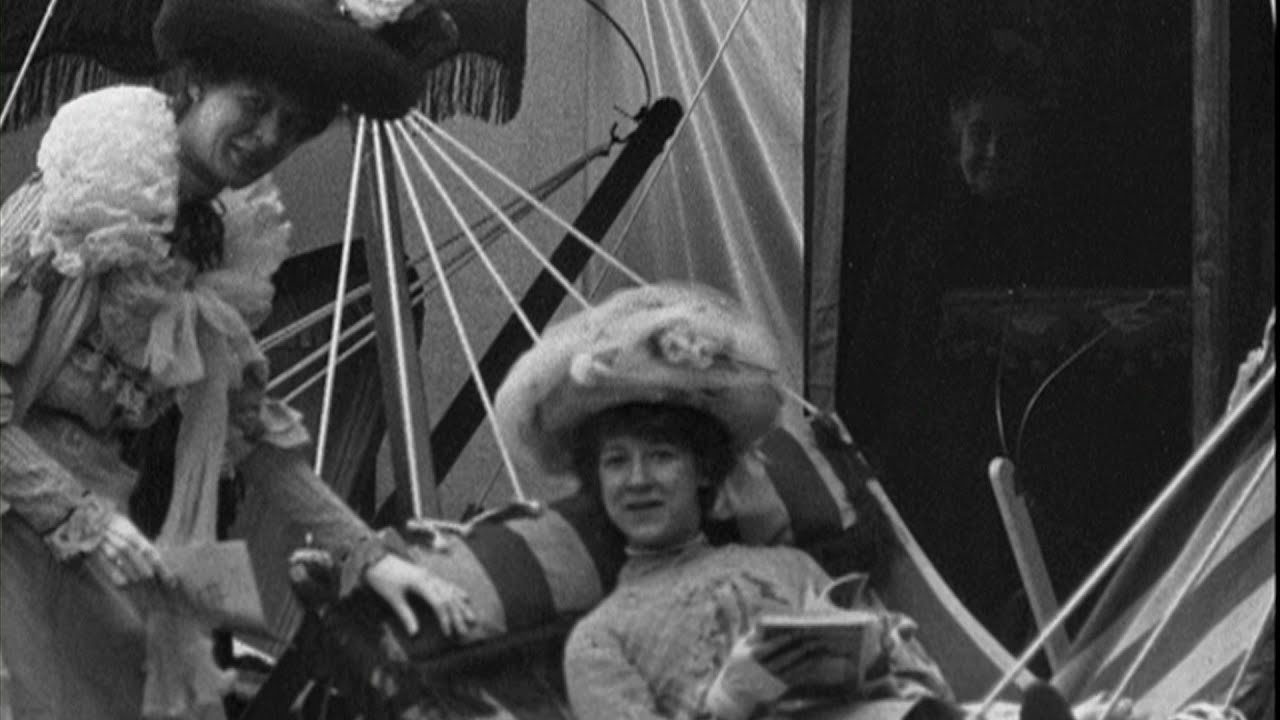
The well-dressed Edwardian ladies and gents of the county tour the annual agricultural show.
Social & External
In California’s Central Valley, tucked between the county jail and the shooting range, 100 Mexican-American farmworking families live, love and strive at the Artesi II Migrant Family Housing Center. Until every December, that is, when they’re asked to leave.
Made in 1896 during the flat racing season (March-October) at Stockton Racecourse, a former horse racing venue in Thornaby-on-Tees, North Yorkshire, UK. Several horses are ridden by jockeys past the camera. Many men in flat caps from the crowd run onto the course and run past the camera at the end of the race. Two policemen follow the men.
King Corn is a fun and crusading journey into the digestive tract of our fast food nation where one ultra-industrial, pesticide-laden, heavily-subsidized commodity dominates the food pyramid from top to bottom – corn. Fueled by curiosity and a dash of naiveté, two college buddies return to their ancestral home of Greene, Iowa to figure out how a modest kernel conquered America. With the help of some real farmers, oodles of fertilizer and government aide, and some genetically modified seeds, the friends manage to grow one acre of corn. Along the way, they unlock the hilarious absurdities and scary but hidden truths about America’s modern food system in this engrossing and eye-opening documentary.
Railroad of Hope consists of interviews and footage collected over three days by Ning Ying of migrant agricultural workers traveling from Sichuan in China's interior, to the Xinjiang Autonomous Region, China's northwest frontier.[1] Through informal interviews aboard the cramped rail cars, Ning Ying explores the hopes and dreams of the workers, many of whom have never left their homes before.
Occurring from the mid-1970s to 1981, the Ripper committed 13 murders. Viewed as ritualistic in nature, they were done with extreme brutality as he mocked the police during their desperate hunt for him. The victims were primiarly prostitutes or poor girls, with a few working girls tossed in. Generally he would hit a victim on the head with a hammer, sexually assault the lady, mutilate her, and then redress/re-arrangement the clothing and cover the corpse with her own coat.
Story of Annette Kellerman, the international swimming vaudeville and silent screen star whose life story inspired the MGM classic Million Dollar Mermaid starring Esther Williams, which featured lavish Busby Berkeley scenes.
X-ray images were invented in 1895, the same year in which the Lumière brothers presented their respective invention in what today is considered to be the first cinema screening. Thus, both cinema and radiography fall within the scopic regime inaugurated by modernity. The use of X-rays on two sculptures from the Bilbao Fine Arts Museum generates images that reveal certain elements of them that would otherwise be invisible to our eyes. These images, despite being generally created for technical or scientific purposes, seem to produce a certain form of 'photogénie': they lend the radiographed objects a new appearance that lies somewhere between the material and the ethereal, endowing them with a vaporous and spectral quality. It is not by chance that physics and phantasmagoria share the term 'spectrum' in their vocabulary.
Rare documentary footage from around 1900 depicts the mood of life in Berlin at the turn of the century.