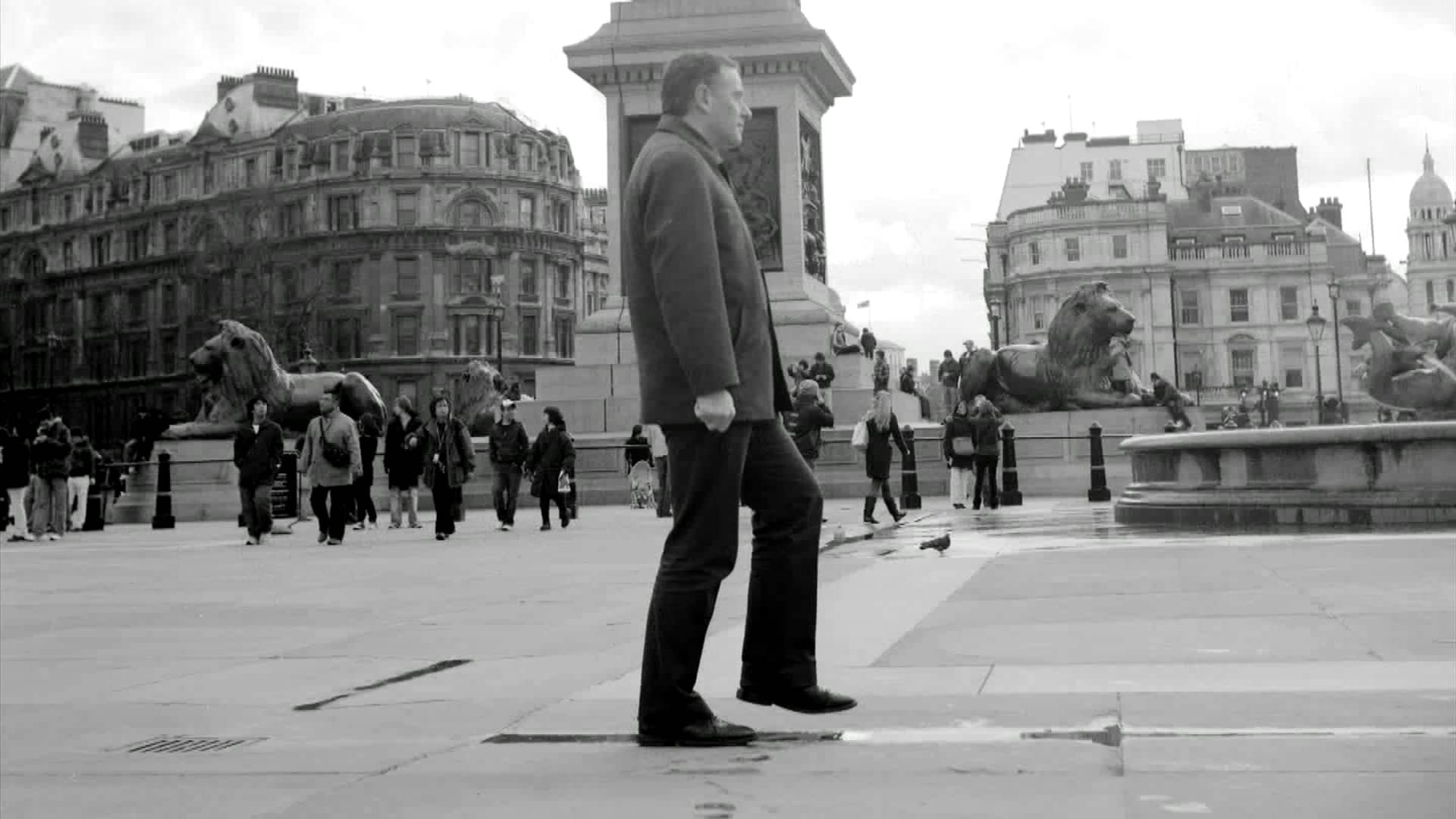
Stochastics investigates the possibility of making a primitive film, using a flea market Rolleiflex from the fifties, shooting on 120 (6 X 6) black and white film on which each roll takes twelve pictures.
Social & External
This experimental nature documentary by Minna Rainio and Mark Roberts depicts climate change and the wave of extinction from the point of view of our near future. Actually, it depicts the age we live in now, or rather its fateful consequences.
Made on a wind-up Bolex camera, The Sound of Seeing announced the arrival of 21-year-old filmmaker Tony Williams. Based around a painter and a composer wandering the city (and beyond), the film meshes music and imagery to show the duo taking inspiration from their surroundings.
An experimental ethnographic documentary that criticizes the colonizer view of anthropology.
In 1967, experimental filmmaker Jorgen Leth created a striking short film, The Perfect Human, starring a man and women sitting in a box while a narrator poses questions about their relationship and humanity. Years later, Danish director Lars von Trier made a deal with Leth to remake his film five times, each under a different set of circumstances and with von Trier's strictly prescribed rules. As Leth completes each challenge, von Trier creates increasingly further elaborate stipulations.
Walking 5,800 miles around the United States, Veteran Jonathan Hancock uses the solitude of the road and the company of his fellow Marine brothers and the families of their fallen to successfully manage his wounds from war.
The earliest surviving motion-picture film, and believed to be one of the very first moving images ever created, was shot by Louis Aimé Augustin Le Prince using the LPCCP Type-1 MkII single-lens camera. It was taken on paper-based photographic film in the garden of Oakwood Grange, the Whitley family house in Roundhay, Leeds, West Riding of Yorkshire (UK), on 14 October 1888. The film shows Adolphe Le Prince (Le Prince’s son), Mrs. Sarah Whitley (Le Prince’s mother-in-law), Joseph Whitley, and Miss Harriet Hartley walking around in circles, laughing to themselves, and staying within the area framed by the camera. Roundhay Garden Scene is often associated with a recording speed of around 12 frames per second and runs for about 2 to 3 seconds.
A small portrait of the volatility of intimacy and of breaking free from abusive cycles: made in response to a year of collapsing relationships and violent accidents that left me broken, dislocated and stuck in my apartment.
I turned my gaze to the various events in daily life and made this filmic diary in a manner as if confessing my feelings. Of course, since I was making the film, I wanted to depict these feelings and events with tricky techniques. I used various methods to shoot photographs of a relative's wedding, the landscape I see from window of my house, commemorative travel photographs and the like frame-by-frame.
Creeping from the halls of the maze brain, corruption and terror is woven by devils born from the denied errors of mankind.
In continuous motion with no end or barrier in its way.
A manufactured memory.
The discovery of a human torso thrown into a waterway, leads the viewer to observe the work of modern criminology and the task of special agents to track and record the psychopath's mentality through the elucidation of techniques present in the reality of the police investigation.
This film describes a psychological state "kin to moonstruck, its images emblems (not quite symbols) of suspension-of-self within consciousness and then that feeling of falling away from conscious thought. The film can only be said to describe or be emblematic of this state because I cannot imagine symbolizing or otherwise representing an equivalent of thoughtlessness itself. Thus the actors in the film, Jane Brakhage, Tom and Gloria Bartek, Williams Burroughs, Allen Ginsberg, Peter Olovsky and Phillip Whalen are figments of this 'Thought-Fallen Process', as are their images in the film to find themselves being photographed."
Thanks to his myriad film roles, Lon Chaney is known as “the man of a thousand faces,” and you could say that the early horror era never beheld a figure more intriguing. Yet because of his numerous transformations, his face never became as iconic as that of, say, Boris Karloff. Accompanied by a soundtrack from Bernhard Lang, this “re-imagination of shots” taken from Chaney´s forty-six surviving films offers a beguiling excursion into the history of film. The director reveals surprising associations, while highlighting the enduring magic of works which are now more or less forgotten.
This portrait of a guinea fowl is the first clear vision I've had of the hot-blooded dinosaurs still living among us. (SB)
WORM AND WEB LOVE begins with bracketed light, a throbbing worm in the sand and sea foam mixed with grass and oceanic detritus, soon superimposed upon the dark blue-toned face of a man, then a woman (Michael McClure and Amy Evans McClure), each seen, then on, through superimpositions of drifting smoke and the back-lit stark grid of a spider's web. The obvious affections of the man and woman, their clear display of love, is metaphored in these tenuous superimpositions, culminating in the frantic movements of the spider itself and the dance of joy of the features of the couple in loving resolution.
This stream-of-consciousness could be nothing less than pathway of the soul, as images of Marilyn's window are remembered from inside-out, its "view" interwoven with all of other windowing and the Elements of the known world.
After a six -or seven- year study of Hammurabi's Code, original Babylonian Text and translation, I've tried to feel my way into the moving visual thought process of this ancient culture (whose numerical system is composed primarily of building materials, nails, joints and the like): this, then, is a visual music which balances the two thought processes of Structure and Nature.
Out of the vagueries of sometime beseeming repetitive light patterns, and the delicately variable rhythms of thought process, the imagination of The Monumental and of the Ephemeral are born to mind hard as nails.